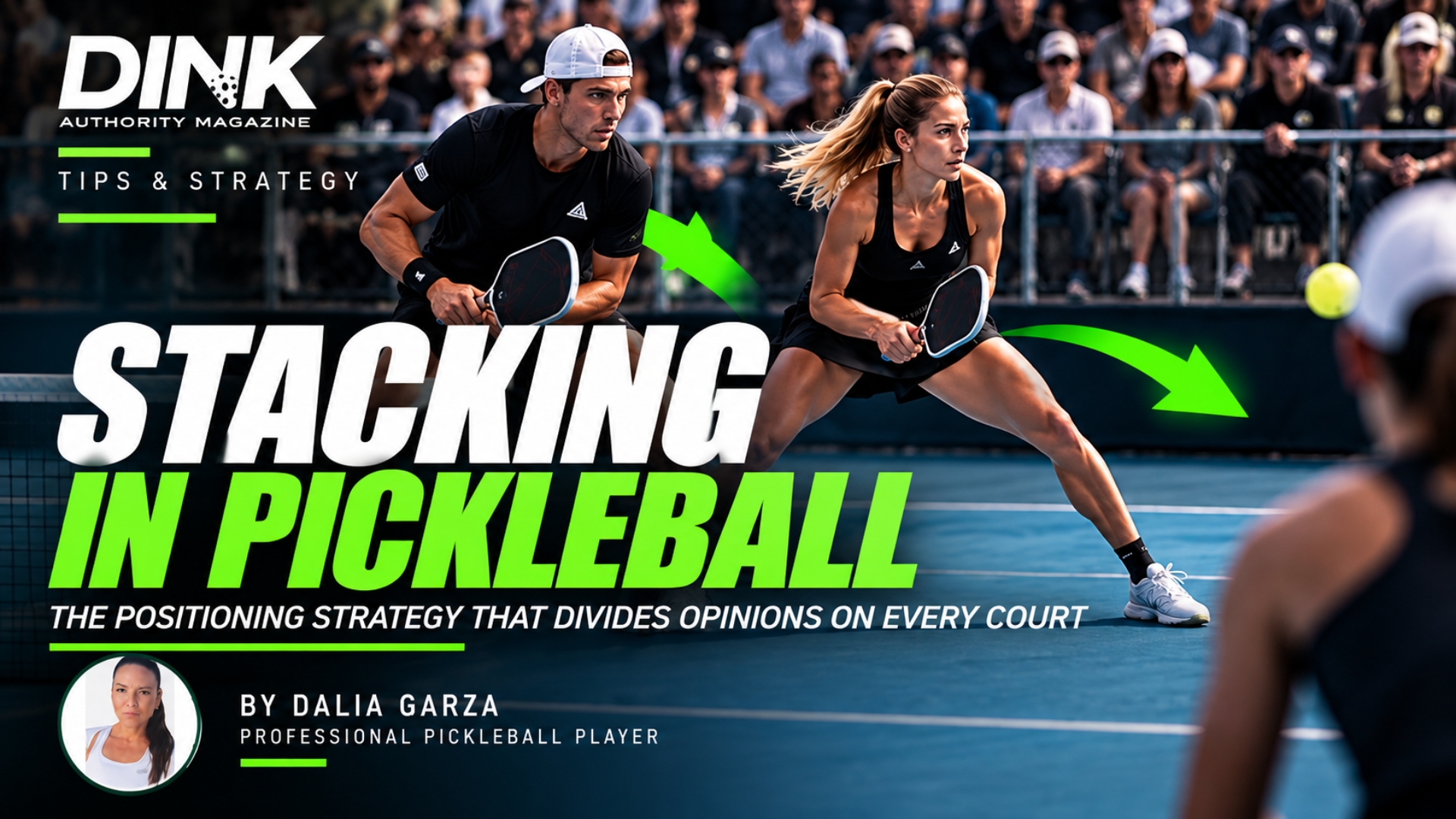
Stacking in Pickleball: The Positioning Strategy That Divides Opinions on Every Court
Stacking in Pickleball: The Positioning Strategy That Divides Opinions on Every Court
By Dalia Garza
Professional Pickleball Player
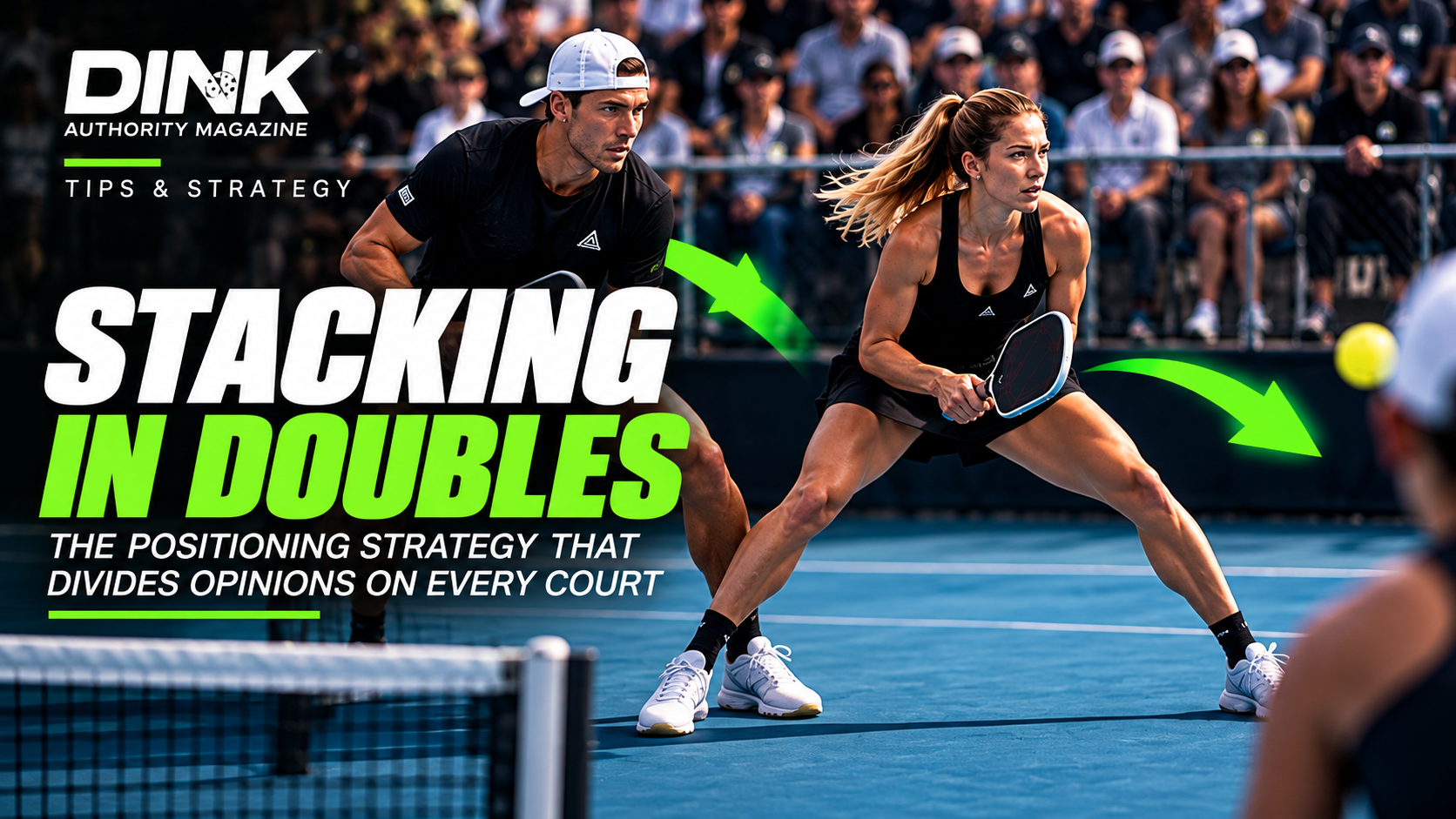
If you've ever seen a doubles team line up on "the wrong side" of the court before a serve — and wondered whether they were confused or knew exactly what they were doing — you were probably watching stacking.
It's one of the most talked-about (and most misunderstood) positional tactics in recreational pickleball, and while it sounds complicated, the logic behind it is actually pretty simple once it's explained properly.
What Is Stacking?
In standard pickleball, each player on a team covers their side of the court based on whose turn it is to serve or receive — which sometimes means your right-handed player ends up covering the left side, or your left-handed partner ends up on the right, depending on how the score has been rotating.
Stacking is a way of repositioning before the point starts so that each player ends up playing from their preferred side of the court — usually so each person plays with their strong shot (forehand) toward the center, instead of leaving a weaker backhand exposed in that critical zone.
In simple terms: instead of letting the normal rotation of the game put you in an awkward position, you move strategically before the point begins to be exactly where you want to be.
The "Forehand in the Middle" Convention
LOVE PICKLEBALL?
Get Dink Authority Magazine updates, new editions, pro stories and event alerts.
We respect your privacy. Unsubscribe anytime.
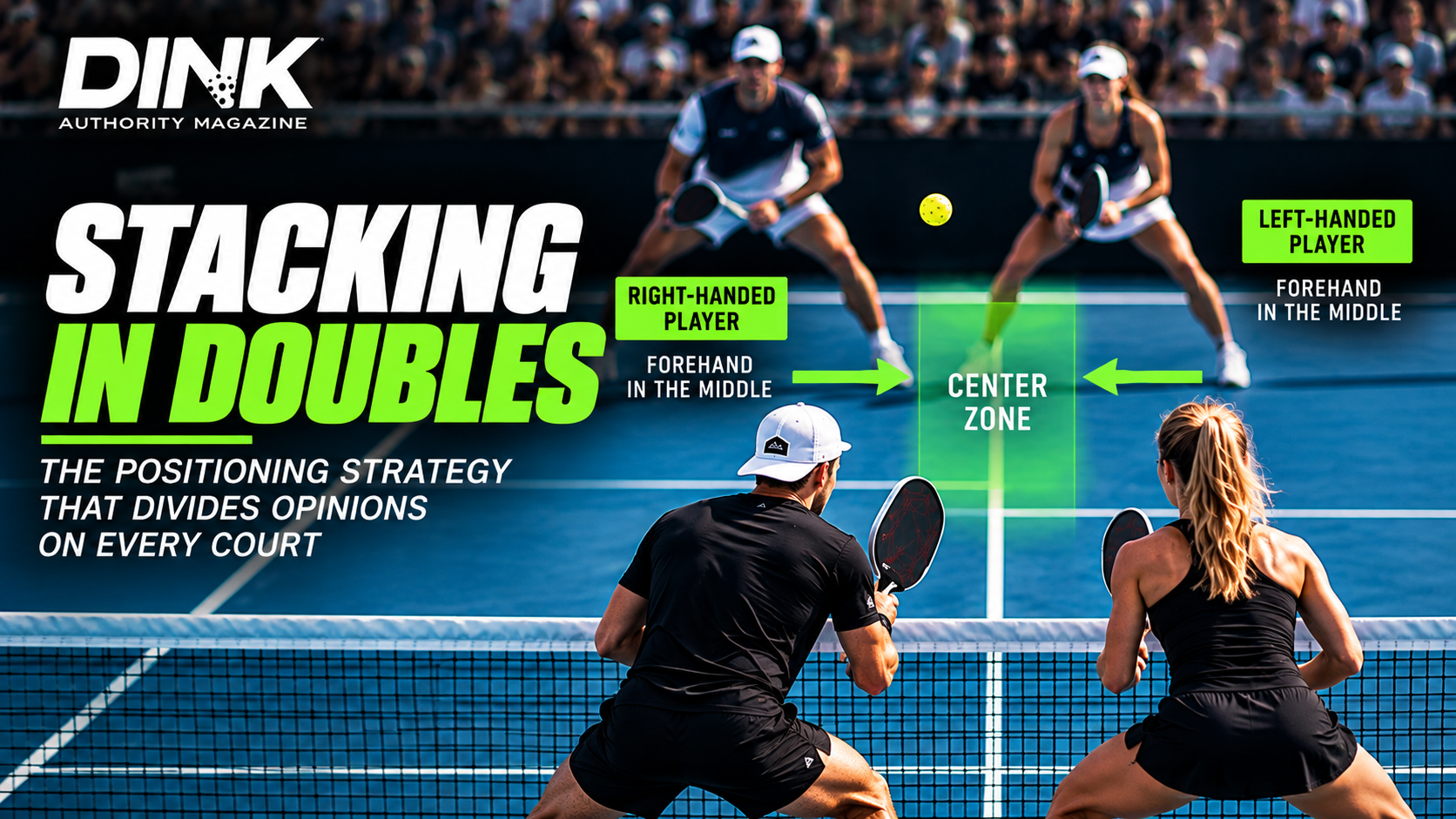
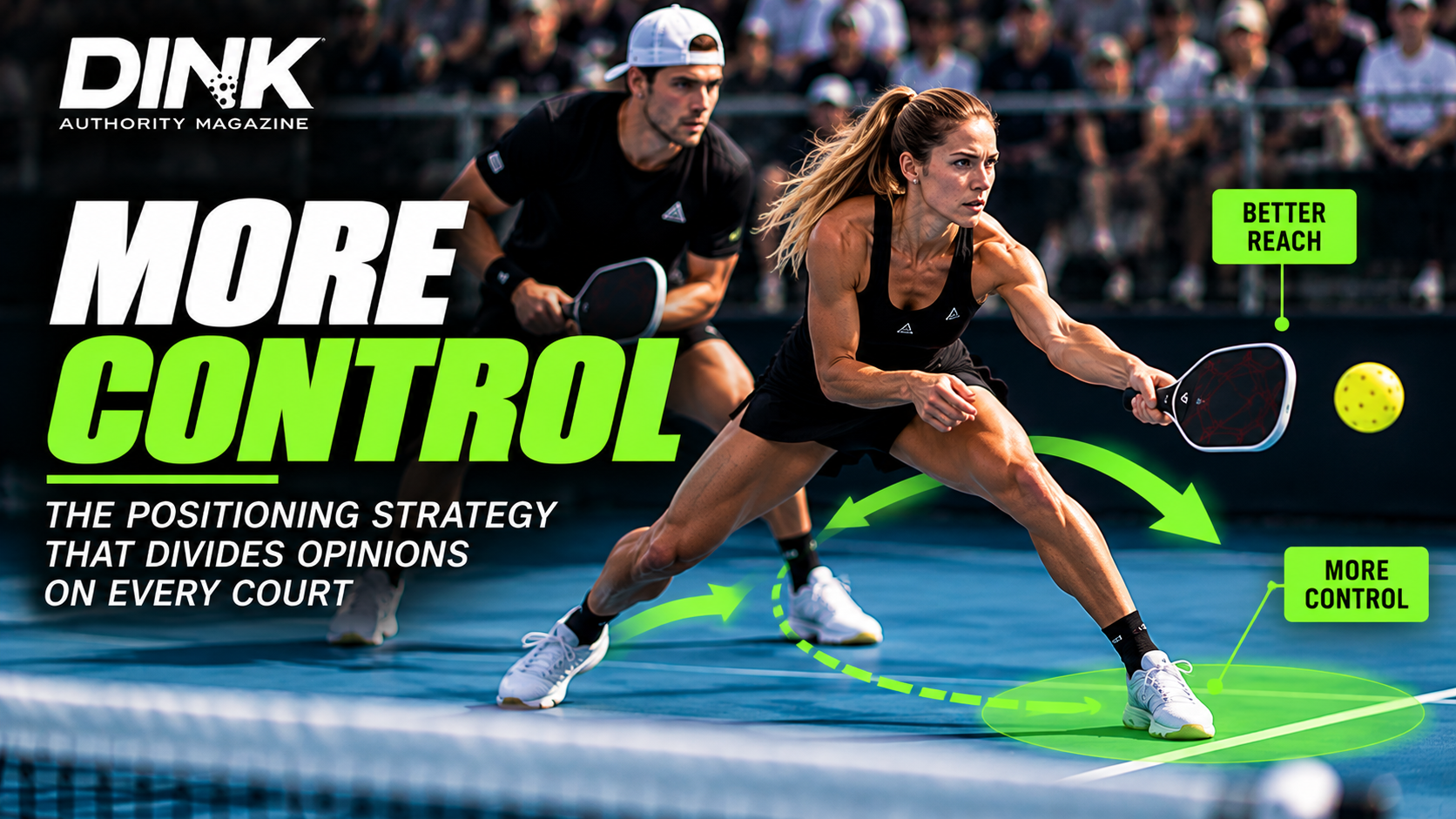
This is the principle coaches cite most when explaining stacking: in doubles, most of the tough balls come toward the center of the court, right where both players' responsibilities overlap. That zone is played much better with a forehand than a backhand — forehands generally offer more control, more reach, and more power in that specific position.
If you have a right-handed player and a left-handed player on the same team, well-executed stacking allows both forehands to point toward the center, regardless of who's serving or receiving from which side at that point in the score.
How It Works in Practice
Before the serve or return, both players stand together, on the same side of the court (one behind the other, or one beside the other), instead of each occupying their "official" side.
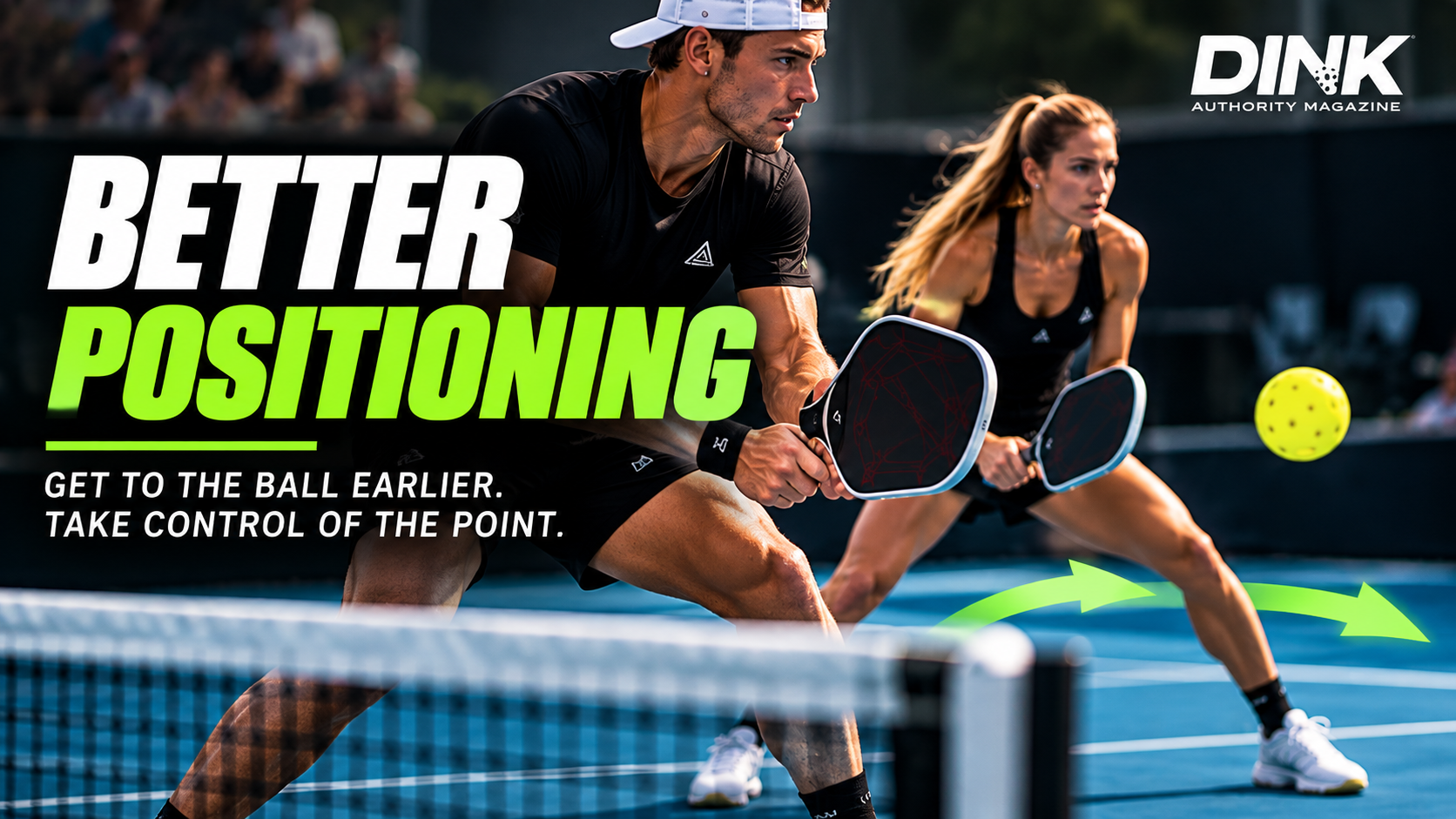
The moment the ball is put into play, each player quickly moves into the position they actually want to cover — crossing over if needed.
It requires clear, well-practiced communication — if one player doesn't move in time, or both end up on the same side, the point can be lost before it really begins.
It's a technique seen a lot on the pro circuit, because there the advantage of always having the forehand well-positioned justifies the execution risk. At the recreational level is where the debate starts.
The Debate It Sparks on Recreational Courts
Here's the part you've probably already experienced if you play open play regularly: stacking, while completely legal under the official rules, can create friction in casual recreational settings.
Some players see it as a legitimate advanced tactic anyone can learn. Others view it as "too serious" a maneuver for a casual match, especially when executed against opponents who don't expect it or don't recognize it, leaving them confused about who was supposed to cover what.
The practical recommendation: if you're going to use stacking in a recreational setting, it's good etiquette to give your opponents a heads-up before starting ("we're going to stack, don't be confused if you see us switch sides") — not because it's required, but because it avoids misunderstandings and keeps things cordial. At tournaments and competitive levels, that heads-up isn't necessary — everyone is assumed to know the tactic there.
When Is It Worth Using?
When you have a right-handed/left-handed mixed pair and want both players playing forehand toward the center
When one partner has a clearly weaker backhand you want to protect from that critical zone
At skill levels where having the right shot at the right moment genuinely decides points
When NOT to Force It:
If your partner hasn't practiced the transition, the risk of confusion outweighs the benefit
In very casual matches where the priority is fun, not tactical optimization
The Bottom Line
Stacking isn't a trick or a loophole — it's a real tactical tool, used constantly on the professional circuit. The key is communication and practice: poorly executed, it creates confusion and gifted points; well executed, it gives your team a real positional advantage on every point.
If you've never tried it, the next time you play with a partner you trust, give it a shot in a practice match before bringing it to a tournament — like any new tactic, execution is built through repetition, not overnight.
And to close things out, a piece of advice that sounds funny but is 100% real: the most important thing with stacking is having a good memory. Just like we often forget the score or who's serving — especially after a long, close rally — the exact same thing happens with stacking. So along with practicing the tactic, you also need to train your memory.
See you in the next edition.
— Dalia Garza
Stacking in Pickleball: The Positioning Strategy That Divides Opinions on Every Court
By Dalia Garza
Professional Pickleball Player
If you've ever seen a doubles team line up on "the wrong side" of the court before a serve — and wondered whether they were confused or knew exactly what they were doing — you were probably watching stacking.
It's one of the most talked-about (and most misunderstood) positional tactics in recreational pickleball, and while it sounds complicated, the logic behind it is actually pretty simple once it's explained properly.
What Is Stacking?
In standard pickleball, each player on a team covers their side of the court based on whose turn it is to serve or receive — which sometimes means your right-handed player ends up covering the left side, or your left-handed partner ends up on the right, depending on how the score has been rotating.
Current Issue

Domenika Turkovic: Fighting Her Own Demons
Read Now →
Stacking is a way of repositioning before the point starts so that each player ends up playing from their preferred side of the court — usually so each person plays with their strong shot (forehand) toward the center, instead of leaving a weaker backhand exposed in that critical zone.
In simple terms: instead of letting the normal rotation of the game put you in an awkward position, you move strategically before the point begins to be exactly where you want to be.
The "Forehand in the Middle" Convention
LOVE PICKLEBALL?
Get Dink Authority Magazine updates, new editions, pro stories and event alerts.
We respect your privacy. Unsubscribe anytime.
This is the principle coaches cite most when explaining stacking: in doubles, most of the tough balls come toward the center of the court, right where both players' responsibilities overlap. That zone is played much better with a forehand than a backhand — forehands generally offer more control, more reach, and more power in that specific position.
If you have a right-handed player and a left-handed player on the same team, well-executed stacking allows both forehands to point toward the center, regardless of who's serving or receiving from which side at that point in the score.
How It Works in Practice
Before the serve or return, both players stand together, on the same side of the court (one behind the other, or one beside the other), instead of each occupying their "official" side.
The moment the ball is put into play, each player quickly moves into the position they actually want to cover — crossing over if needed.
It requires clear, well-practiced communication — if one player doesn't move in time, or both end up on the same side, the point can be lost before it really begins.

It's a technique seen a lot on the pro circuit, because there the advantage of always having the forehand well-positioned justifies the execution risk. At the recreational level is where the debate starts.
The Debate It Sparks on Recreational Courts
Here's the part you've probably already experienced if you play open play regularly: stacking, while completely legal under the official rules, can create friction in casual recreational settings.
Some players see it as a legitimate advanced tactic anyone can learn. Others view it as "too serious" a maneuver for a casual match, especially when executed against opponents who don't expect it or don't recognize it, leaving them confused about who was supposed to cover what.
The practical recommendation: if you're going to use stacking in a recreational setting, it's good etiquette to give your opponents a heads-up before starting ("we're going to stack, don't be confused if you see us switch sides") — not because it's required, but because it avoids misunderstandings and keeps things cordial. At tournaments and competitive levels, that heads-up isn't necessary — everyone is assumed to know the tactic there.
When Is It Worth Using?
When you have a right-handed/left-handed mixed pair and want both players playing forehand toward the center
When one partner has a clearly weaker backhand you want to protect from that critical zone
At skill levels where having the right shot at the right moment genuinely decides points

When NOT to Force It:
If your partner hasn't practiced the transition, the risk of confusion outweighs the benefit
In very casual matches where the priority is fun, not tactical optimization
The Bottom Line
Stacking isn't a trick or a loophole — it's a real tactical tool, used constantly on the professional circuit. The key is communication and practice: poorly executed, it creates confusion and gifted points; well executed, it gives your team a real positional advantage on every point.
If you've never tried it, the next time you play with a partner you trust, give it a shot in a practice match before bringing it to a tournament — like any new tactic, execution is built through repetition, not overnight.
And to close things out, a piece of advice that sounds funny but is 100% real: the most important thing with stacking is having a good memory. Just like we often forget the score or who's serving — especially after a long, close rally — the exact same thing happens with stacking. So along with practicing the tactic, you also need to train your memory.
See you in the next edition.
— Dalia Garza
Gallery