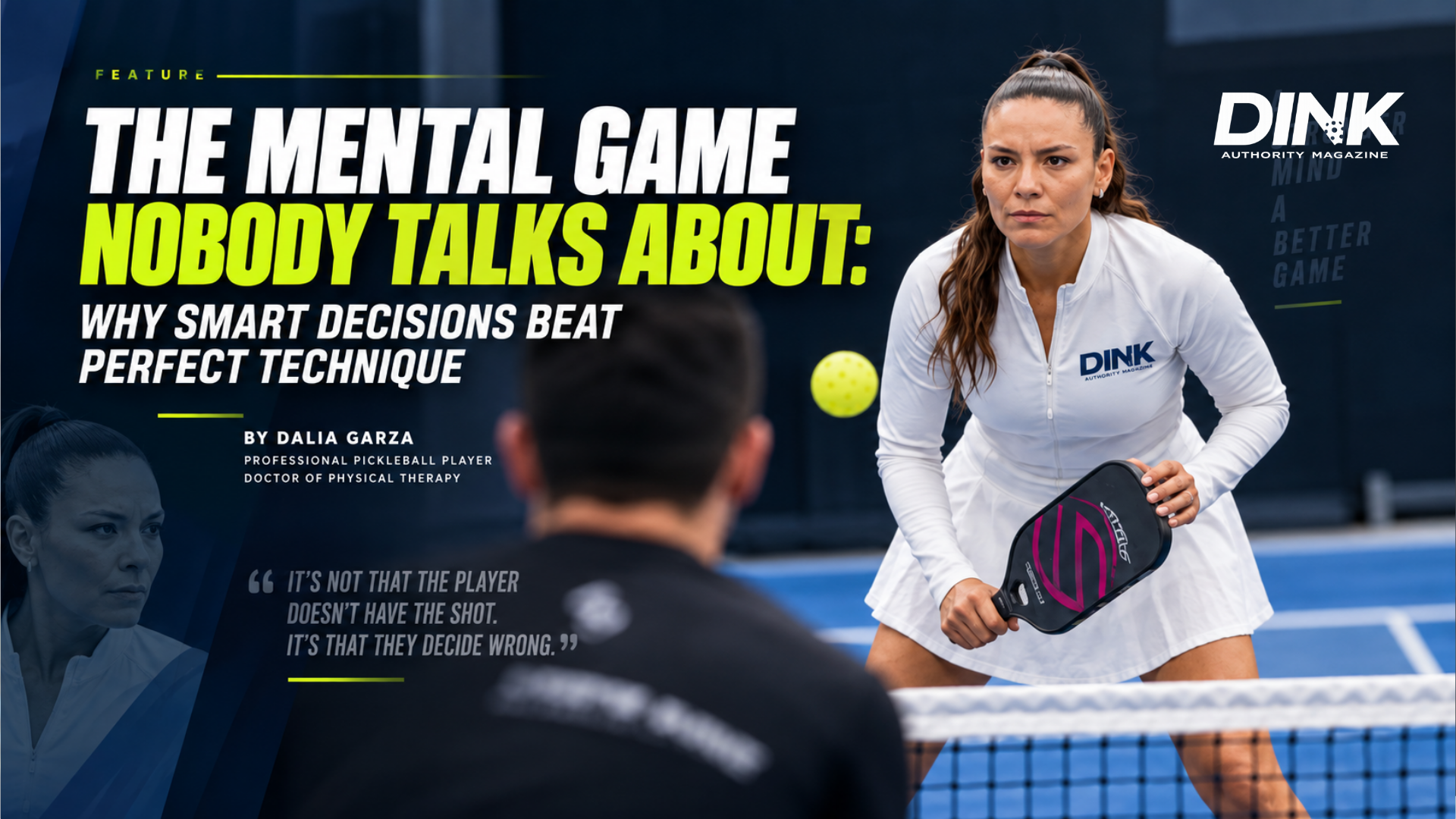
The Mental Game Nobody Talks About: Why Smart Decisions Beat Perfect Technique
The Mental Game Nobody Talks About: Why Smart Decisions Beat Perfect Technique
By Dalia Garza
Professional Pickleball Player
Most players don't lose points because of bad technique. They lose points by making the wrong decision at the wrong time.
"When I watch intermediate-level matches, I see players with really solid mechanics who still lose the point," Dalia says. "It's not that they don't know how to hit the ball. It's that they don't know when to hit it, when to wait, and when to just let it go."
This is something Dalia understands from a fairly uncommon angle among professional players. Before becoming a pickleball athlete, she was a high-performance college tennis player, and today she's a licensed Doctor of Physical Therapy. That combination — years of elite competition plus a clinical background focused on biomechanics and movement — gives her a distinct perspective on why the body and mind fail under pressure, and how to train both at once.
"In physical therapy, you learn that the body almost never fails from pure weakness. It fails from poorly executed movement decisions under stress," she explains. "The exact same thing happens in pickleball. It's not that the player doesn't have the shot. It's that they decide wrong, and that bad decision triggers a tense, rushed, incorrect execution."
Here's what she teaches about the real differentiator between skill levels: the mind, not the hands.
"It's not that the player doesn't have the shot. It's that they decide wrong."
Reset vs. Speed Up: The Decision That Defines the Point
One of the most common mistakes Dalia sees in players trying to move up a level is speeding up at the wrong moment. The speed-up — a fast, aggressive shot aimed at the opponent's body — is a powerful tool, but only when the ball actually sets you up for it.
"The question you need to ask yourself before speeding up isn't 'can I hit this hard?' It's 'does this ball actually give me the advantage to speed up, or am I putting myself at a disadvantage if I try?'" Dalia explains. "If the ball comes in high and comfortable, maybe. If it comes in low, tight, or awkward, the right call is almost always to reset — slow the pace down, return a soft, controlled shot, and wait for your real opportunity."
The reset isn't a defensive play or a sign of weakness. According to Dalia, it's actually one of the more advanced decisions a player can make.
"Higher-level players reset all the time. The difference is they're doing it on purpose, not out of panic."
From her clinical perspective, Dalia adds something few coaches ever mention: the reset also protects your body. "When a player tries to speed up a ball that isn't ready to be sped up, they usually do it with forced mechanics — the wrist compensates, the shoulder compensates, the elbow absorbs a load it shouldn't be absorbing. Over time, those rushed decisions don't just lose points. They cause injuries. A well-executed reset isn't just a smarter play — it's a safer play for your body long-term."
LOVE PICKLEBALL?
Get Dink Authority Magazine updates, new editions, pro stories and event alerts.
We respect your privacy. Unsubscribe anytime.
Patience in the Dinking Game: The Point Isn't Won in One Shot
The dink — the soft, controlled shot near the net — is, according to Dalia, where the difference between an impatient player and one with real command of the game becomes most obvious.
"The most common mistake I see is players treating dinking like it's boring, like they have to 'do something' to move the point forward," she says. "But a well-executed dink is already winning the point. Every dink that forces your opponent to move, to stretch, to hit from an uncomfortable position, is bringing you closer to your real opportunity."
Her advice is simple but demands discipline: "Don't break the pattern just because you got impatient. Break the pattern when the ball actually gives you a real reason to."
Dalia compares this phase of the point to something she sees constantly in her physical therapy practice: progressive rehab.
"In physical therapy, one of the biggest mistakes a patient makes is wanting to progress faster than their body is actually ready for. They see improvement, they feel good, and they want to skip steps. That almost always ends in a setback. Dinking works the same way — you want to end the point before it's actually ready to end, and that rush is exactly what makes you lose it."
"Don't break the pattern just because you got impatient. Break it when the ball actually gives you a real reason to."
Reading Your Opponent's Body Before They Even Hit the Ball
There's a mental skill Dalia considers underrated, one that's rarely taught directly: reading your opponent's physical cues before the ball even leaves their paddle.
"Every player, without realizing it, tells you what they're about to do with their body before they hit," she explains. "Foot position, paddle angle, whether they're balanced or stretching to reach the ball. All of that information is available half a second before contact — the question is whether you're actually paying attention to it, or just watching the ball."
For Dalia, training this kind of reading is just as important as training the shot itself.
"If you learn to read that your opponent is off-balance or stretching to reach the ball, you already know a weak ball is coming before they even hit it. That gives you a huge window of time to decide calmly — speed up, change direction, or just get ready to capitalize on that weakness. Players who only watch the ball are always a step behind the ones who read the whole body."
Controlling Reaction Time: Play the Point, Not the Pressure
The last piece of the mental puzzle, according to Dalia, is something that's almost never taught explicitly: controlling your own reaction time under pressure.
"When the point gets tense — a long rally, a close score, an opponent who starts talking — the natural instinct is to rush. To react faster than necessary, to force a play before you're actually ready," she explains. "But pressure doesn't change the actual time you have to decide. It only changes how that time feels."
Her recommendation: consciously work on slowing down mentally in the highest-tension moments. "Breathe, let the ball arrive, and make the decision with the same clarity you'd have at the first point of the match, not the panic of match point."
As a mother and a professional athlete competing at the highest level, Dalia also applies this lesson off the court. "Balancing being a mom and competing professionally taught me something similar: pressure is rarely as urgent as it feels in the moment. If you learn to shift down mentally, you make better decisions — on the court and off it."
A Simple Exercise to Train the Mind, Not Just the Body
Before wrapping up, Dalia shares something she often recommends to the players she coaches: a simple exercise, no paddle required, to train this exact decision-making skill under pressure.
"During your next practice matches, before every point, tell yourself, out loud or mentally: 'am I about to play reactive, or am I about to play with intention?'"
It sounds simple, almost silly. But that one second of conscious pause, right before the point starts, completely changes how you make decisions during the rally. It's a mental muscle, and like any muscle, it's trained through repetition.
"The players who make the jump are the ones who learn to think better under pressure — not just hit better."
Dalia's Bottom Line
Technique will only take you so far. The players who really make the jump — from 3.5 to 4.0, from 4.0 to competitive — are the ones who learn to think better under pressure, not just hit better.
That's the part of the game nobody sees in a highlight reel, but it's the part that actually wins matches.
With love, to all my readers — Dalia.
The Mental Game Nobody Talks About: Why Smart Decisions Beat Perfect Technique
By Dalia Garza
Professional Pickleball Player
Most players don't lose points because of bad technique. They lose points by making the wrong decision at the wrong time.
"When I watch intermediate-level matches, I see players with really solid mechanics who still lose the point," Dalia says. "It's not that they don't know how to hit the ball. It's that they don't know when to hit it, when to wait, and when to just let it go."
This is something Dalia understands from a fairly uncommon angle among professional players. Before becoming a pickleball athlete, she was a high-performance college tennis player, and today she's a licensed Doctor of Physical Therapy. That combination — years of elite competition plus a clinical background focused on biomechanics and movement — gives her a distinct perspective on why the body and mind fail under pressure, and how to train both at once.
"In physical therapy, you learn that the body almost never fails from pure weakness. It fails from poorly executed movement decisions under stress," she explains. "The exact same thing happens in pickleball. It's not that the player doesn't have the shot. It's that they decide wrong, and that bad decision triggers a tense, rushed, incorrect execution."
Here's what she teaches about the real differentiator between skill levels: the mind, not the hands.
"It's not that the player doesn't have the shot. It's that they decide wrong."
Reset vs. Speed Up: The Decision That Defines the Point
One of the most common mistakes Dalia sees in players trying to move up a level is speeding up at the wrong moment. The speed-up — a fast, aggressive shot aimed at the opponent's body — is a powerful tool, but only when the ball actually sets you up for it.

"The question you need to ask yourself before speeding up isn't 'can I hit this hard?' It's 'does this ball actually give me the advantage to speed up, or am I putting myself at a disadvantage if I try?'" Dalia explains. "If the ball comes in high and comfortable, maybe. If it comes in low, tight, or awkward, the right call is almost always to reset — slow the pace down, return a soft, controlled shot, and wait for your real opportunity."
The reset isn't a defensive play or a sign of weakness. According to Dalia, it's actually one of the more advanced decisions a player can make.
"Higher-level players reset all the time. The difference is they're doing it on purpose, not out of panic."
From her clinical perspective, Dalia adds something few coaches ever mention: the reset also protects your body. "When a player tries to speed up a ball that isn't ready to be sped up, they usually do it with forced mechanics — the wrist compensates, the shoulder compensates, the elbow absorbs a load it shouldn't be absorbing. Over time, those rushed decisions don't just lose points. They cause injuries. A well-executed reset isn't just a smarter play — it's a safer play for your body long-term."
LOVE PICKLEBALL?
Get Dink Authority Magazine updates, new editions, pro stories and event alerts.
We respect your privacy. Unsubscribe anytime.
Patience in the Dinking Game: The Point Isn't Won in One Shot
The dink — the soft, controlled shot near the net — is, according to Dalia, where the difference between an impatient player and one with real command of the game becomes most obvious.
"The most common mistake I see is players treating dinking like it's boring, like they have to 'do something' to move the point forward," she says. "But a well-executed dink is already winning the point. Every dink that forces your opponent to move, to stretch, to hit from an uncomfortable position, is bringing you closer to your real opportunity."
Her advice is simple but demands discipline: "Don't break the pattern just because you got impatient. Break the pattern when the ball actually gives you a real reason to."
Dalia compares this phase of the point to something she sees constantly in her physical therapy practice: progressive rehab.
"In physical therapy, one of the biggest mistakes a patient makes is wanting to progress faster than their body is actually ready for. They see improvement, they feel good, and they want to skip steps. That almost always ends in a setback. Dinking works the same way — you want to end the point before it's actually ready to end, and that rush is exactly what makes you lose it."

"Don't break the pattern just because you got impatient. Break it when the ball actually gives you a real reason to."
Reading Your Opponent's Body Before They Even Hit the Ball
There's a mental skill Dalia considers underrated, one that's rarely taught directly: reading your opponent's physical cues before the ball even leaves their paddle.
"Every player, without realizing it, tells you what they're about to do with their body before they hit," she explains. "Foot position, paddle angle, whether they're balanced or stretching to reach the ball. All of that information is available half a second before contact — the question is whether you're actually paying attention to it, or just watching the ball."
For Dalia, training this kind of reading is just as important as training the shot itself.
"If you learn to read that your opponent is off-balance or stretching to reach the ball, you already know a weak ball is coming before they even hit it. That gives you a huge window of time to decide calmly — speed up, change direction, or just get ready to capitalize on that weakness. Players who only watch the ball are always a step behind the ones who read the whole body."
Controlling Reaction Time: Play the Point, Not the Pressure
The last piece of the mental puzzle, according to Dalia, is something that's almost never taught explicitly: controlling your own reaction time under pressure.
"When the point gets tense — a long rally, a close score, an opponent who starts talking — the natural instinct is to rush. To react faster than necessary, to force a play before you're actually ready," she explains. "But pressure doesn't change the actual time you have to decide. It only changes how that time feels."

Her recommendation: consciously work on slowing down mentally in the highest-tension moments. "Breathe, let the ball arrive, and make the decision with the same clarity you'd have at the first point of the match, not the panic of match point."
As a mother and a professional athlete competing at the highest level, Dalia also applies this lesson off the court. "Balancing being a mom and competing professionally taught me something similar: pressure is rarely as urgent as it feels in the moment. If you learn to shift down mentally, you make better decisions — on the court and off it."
A Simple Exercise to Train the Mind, Not Just the Body
Before wrapping up, Dalia shares something she often recommends to the players she coaches: a simple exercise, no paddle required, to train this exact decision-making skill under pressure.
"During your next practice matches, before every point, tell yourself, out loud or mentally: 'am I about to play reactive, or am I about to play with intention?'"
It sounds simple, almost silly. But that one second of conscious pause, right before the point starts, completely changes how you make decisions during the rally. It's a mental muscle, and like any muscle, it's trained through repetition.
"The players who make the jump are the ones who learn to think better under pressure — not just hit better."
Dalia's Bottom Line
Technique will only take you so far. The players who really make the jump — from 3.5 to 4.0, from 4.0 to competitive — are the ones who learn to think better under pressure, not just hit better.
That's the part of the game nobody sees in a highlight reel, but it's the part that actually wins matches.
With love, to all my readers — Dalia.