
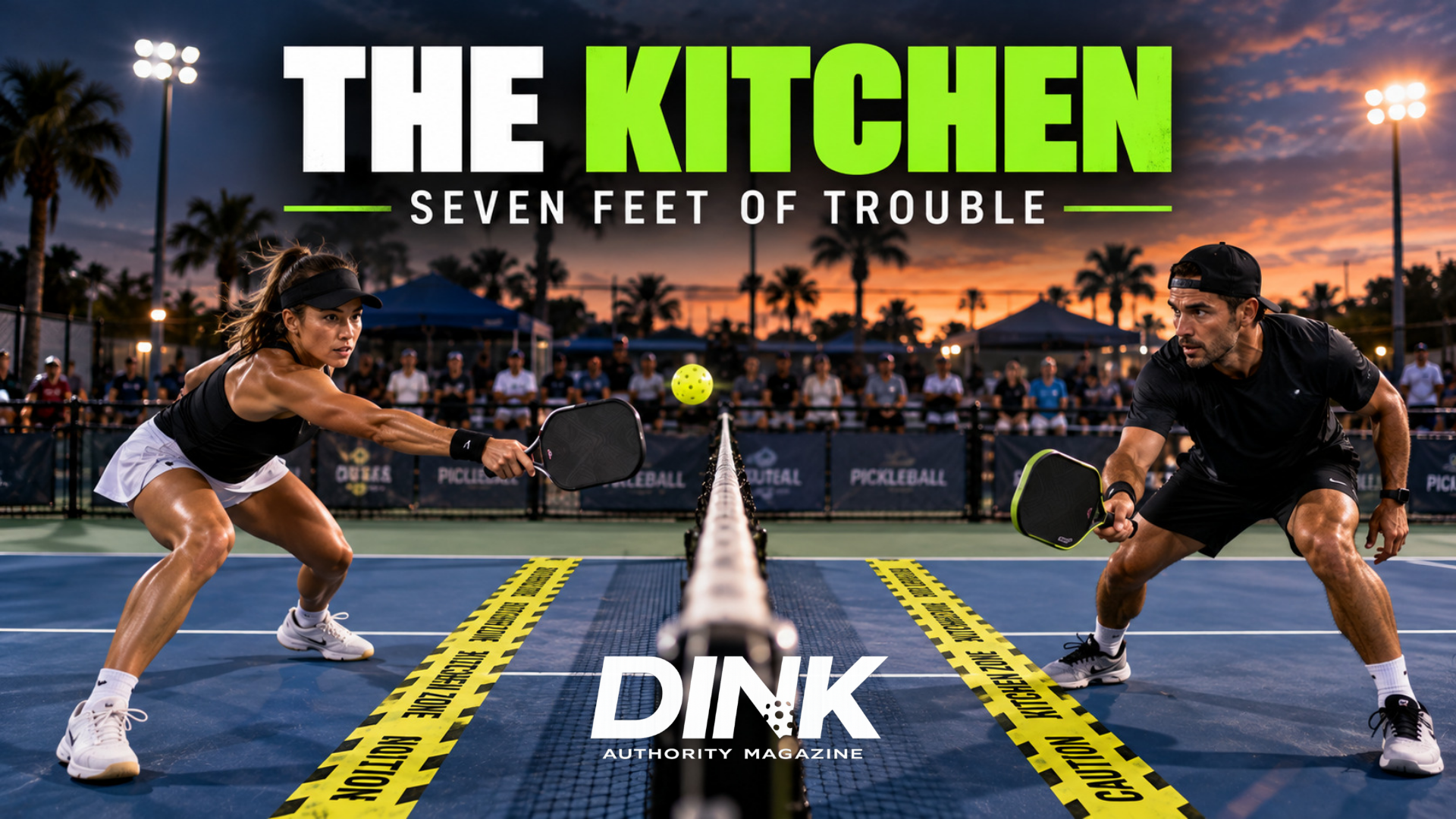
The Kitchen: Seven Feet of Trouble
The Kitchen: Seven Feet of Trouble
The place where you play low, think fast… and one ball popped up too high can turn into a very bad idea.
Seven feet. That's all that strip of court measures from the net, and it's enough to strip away almost everything you know — or thought you knew — about pickleball. Welcome to the Kitchen.
Officially it's called the Non-Volley Zone: seven feet deep, twenty feet wide on each side of the net. In practice, it's something else entirely. It's a negotiating table, a chessboard, a patience test, and every so often, a remarkably efficient place to take a ball to the chest.
Because the Kitchen doesn't care how much your paddle cost, how good your warm-up drive looked, or how many hours of pro pickleball you watched over the weekend. Sooner or later, standing on that line, it asks a much more uncomfortable question: do you actually know how to play?
That's where patience becomes a weapon. Pop the ball up a little too much and somebody on the other side will happily explain your mistake — no words required. Lose focus for half a second, attack the wrong ball, speed up when you shouldn't have, overextend, hand over a high dink, drift back when you should've held your ground — the Kitchen keeps score on all of it. And it almost always collects.
The Player Who Won't Come In
Doubles has this wonderful character we all know. Their partner is already parked on the line, paddle up, ready to work the point, while they linger several feet back, apparently waiting for a formal invitation to join.
Sometimes there's a perfectly good reason. Knees complain. Backs complain. Somewhere along the way the body starts renegotiating contracts you swore were lifetime deals. But other times it's just a misread of the game. We watch the pros on TV attacking, speeding things up, ripping drives, closing out flashy points, and think: that's what I need to do.
The problem is we're only watching the ending. We didn't see the drop. We didn't see the reset. We didn't see the dinks, or how they moved their opponent, or all those supposedly boring balls that set up the one that made it onto Instagram. Getting to the Kitchen doesn't mean the strategy is over. It means it just started.
There's Not Much Time to Think Here
And here's another charming feature of the Kitchen: you're close. Really close — close enough that when somebody decides diplomacy is over and fires a ball straight at your body, there isn't much room left for philosophical reflection. Paddle up, hands ready, reflexes on.
If you're going to live in this neighborhood, sooner or later rent comes due. And sometimes you pay it in plastic.
It shouldn't be a surprise. If you're going to hold one of the most valuable pieces of real estate on the court, you'd better be ready to defend it: reflexes, paddle position, hand speed, reading your opponent — and above all, knowing exactly when that seemingly innocent ball is about to turn into a missile with holes in it.
LOVE PICKLEBALL?
Get Dink Authority Magazine updates, new editions, pro stories and event alerts.
We respect your privacy. Unsubscribe anytime.
The Ultimate Lie Detector
This might be my favorite thing about the Kitchen: it's pickleball's ultimate lie detector.
From the back of the court, everybody can look dangerous for a while. A good drive. A hard serve. A couple of winners. That ball that lands right on the line and makes you feel like a pro for about seven seconds.
But come up. Step to the line. Stay there. Now show me your hands. Show me your patience, your control, your placement, your reflexes, your ability to reset a fast-incoming ball, your discipline not to attack the one your brain is screaming at you to smash. And maybe hardest of all: your ability to wait.
Because one of the Kitchen's great secrets is that the point doesn't always go to whoever hits first. Often it goes to whoever gets the other person to hit the wrong ball first. And that changes everything.
Why Do These Seven Feet Even Exist?
They're not there for decoration. The non-volley zone stops a player from camping on top of the net and smashing anything that comes close. Without it, we'd probably be playing a different sport altogether.
The Kitchen forces you to create — to bring the ball down, build the point, find angles, move your opponent, decide when to speed things up. And to live with one of the most universally painful experiences in pickleball: knowing you popped the ball up too high before your opponent even touches it.
That instant is wonderful, in the worst possible way. The ball leaves your paddle. It rises. You see it rise. Your partner sees it rise. Both opponents see it rise. Everybody knows exactly what's coming. And for a split second there's a very particular inner silence where you're probably thinking: oh, no…
Too late.
If You Want to Play Doubles, You'll Have to Come In Eventually
You can dodge it for a while. Stay back, hit drives, wait for opponents to miss — you can even win some matches that way. But as the level rises, that space at the net becomes too valuable to simply hand over to the other side. Especially in doubles.
That doesn't mean sprinting forward like a maniac after every ball. Getting to the Kitchen also means knowing how to get there: a good third shot, a drop, a reset, a smart transition. Sometimes moving in. Sometimes holding. Sometimes stepping back half a step to survive and try again. The goal isn't to arrive first. It's to arrive ready to play the next shot.
Training the Kitchen: Don't Just Show Up to Play
And here's the part we all love to ignore: don't just show up to play matches every day. Yes, playing is fun. Yes, competing is addictive. Yes, somebody always says "one more and we're out," even though everybody knows that sentence can easily turn into two more hours on court.
But if you genuinely want to get better, give the Kitchen at least thirty focused minutes of training. Thirty minutes teaching your mind and body to wait, to be patient, to watch each ball leave your paddle slow and controlled, to pick the exact moment to shift the point's rhythm. Because the Kitchen isn't mastered by rushing — it's mastered by learning when not to do anything spectacular.
Dink. Wait. Watch. Dink again. Feel the ball, listen for that particular sound off your paddle, learn to move in rhythm with your partner without drifting apart, without crowding their space, without turning every single ball into a national emergency.
The goal isn't winning every exchange with a brilliant shot. The goal is waiting for that moment when your opponent decides they've had enough — they get impatient, overreach, attack the wrong ball, pop up the dink, make the mistake. And there you are. Ready. Closing in.
And then… boom 💥 — point's yours.
But here's the catch: that moment doesn't show up by magic. It doesn't arrive because you watched a slow-motion pro highlight, or because you bought a new paddle, or because one day everything just clicked and you ran hot. That moment shows up when you train. When you repeat. When you learn to wait. When your mind stops screaming "attack!" every time the ball crosses the net — when your body finally understands that patience is its own form of aggression.
Just Seven Feet
That's the funny part. It's only seven feet — a tiny sliver inside an already small court. And yet, around that line lives so much of what makes pickleball the sport it is. Soft hands and quick hands. Patience and aggression. Control and reflexes. Strategy and instinct. Attack, defend, wait — and learn that hitting harder doesn't always mean playing better.
Anybody can land a good shot once in a while. But stand at that line during a real match: dink after dink, reset after reset, speed-up after speed-up. Protect your body, hold your ground, move with your partner, listen to the ball, keep your patience, don't give anything away. And when that ball finally shows up — the one you're actually supposed to attack — don't hesitate. That's when we talk.
Because there's something pretty ironic about the name, when you think about it. We call it the Kitchen. But nobody comes to these seven feet to cook.
This is where, if you're not careful, you're the one who gets cooked.
See you next Sunday.
The Kitchen: Seven Feet of Trouble
The place where you play low, think fast… and one ball popped up too high can turn into a very bad idea.
Seven feet. That's all that strip of court measures from the net, and it's enough to strip away almost everything you know — or thought you knew — about pickleball. Welcome to the Kitchen.
Officially it's called the Non-Volley Zone: seven feet deep, twenty feet wide on each side of the net. In practice, it's something else entirely. It's a negotiating table, a chessboard, a patience test, and every so often, a remarkably efficient place to take a ball to the chest.
Because the Kitchen doesn't care how much your paddle cost, how good your warm-up drive looked, or how many hours of pro pickleball you watched over the weekend. Sooner or later, standing on that line, it asks a much more uncomfortable question: do you actually know how to play?
That's where patience becomes a weapon. Pop the ball up a little too much and somebody on the other side will happily explain your mistake — no words required. Lose focus for half a second, attack the wrong ball, speed up when you shouldn't have, overextend, hand over a high dink, drift back when you should've held your ground — the Kitchen keeps score on all of it. And it almost always collects.
The Player Who Won't Come In
Doubles has this wonderful character we all know. Their partner is already parked on the line, paddle up, ready to work the point, while they linger several feet back, apparently waiting for a formal invitation to join.
Sometimes there's a perfectly good reason. Knees complain. Backs complain. Somewhere along the way the body starts renegotiating contracts you swore were lifetime deals. But other times it's just a misread of the game. We watch the pros on TV attacking, speeding things up, ripping drives, closing out flashy points, and think: that's what I need to do.
The problem is we're only watching the ending. We didn't see the drop. We didn't see the reset. We didn't see the dinks, or how they moved their opponent, or all those supposedly boring balls that set up the one that made it onto Instagram. Getting to the Kitchen doesn't mean the strategy is over. It means it just started.

There's Not Much Time to Think Here
And here's another charming feature of the Kitchen: you're close. Really close — close enough that when somebody decides diplomacy is over and fires a ball straight at your body, there isn't much room left for philosophical reflection. Paddle up, hands ready, reflexes on.
If you're going to live in this neighborhood, sooner or later rent comes due. And sometimes you pay it in plastic.
It shouldn't be a surprise. If you're going to hold one of the most valuable pieces of real estate on the court, you'd better be ready to defend it: reflexes, paddle position, hand speed, reading your opponent — and above all, knowing exactly when that seemingly innocent ball is about to turn into a missile with holes in it.
LOVE PICKLEBALL?
Get Dink Authority Magazine updates, new editions, pro stories and event alerts.
We respect your privacy. Unsubscribe anytime.
The Ultimate Lie Detector
This might be my favorite thing about the Kitchen: it's pickleball's ultimate lie detector.
From the back of the court, everybody can look dangerous for a while. A good drive. A hard serve. A couple of winners. That ball that lands right on the line and makes you feel like a pro for about seven seconds.
But come up. Step to the line. Stay there. Now show me your hands. Show me your patience, your control, your placement, your reflexes, your ability to reset a fast-incoming ball, your discipline not to attack the one your brain is screaming at you to smash. And maybe hardest of all: your ability to wait.
Because one of the Kitchen's great secrets is that the point doesn't always go to whoever hits first. Often it goes to whoever gets the other person to hit the wrong ball first. And that changes everything.
Why Do These Seven Feet Even Exist?

They're not there for decoration. The non-volley zone stops a player from camping on top of the net and smashing anything that comes close. Without it, we'd probably be playing a different sport altogether.
The Kitchen forces you to create — to bring the ball down, build the point, find angles, move your opponent, decide when to speed things up. And to live with one of the most universally painful experiences in pickleball: knowing you popped the ball up too high before your opponent even touches it.
That instant is wonderful, in the worst possible way. The ball leaves your paddle. It rises. You see it rise. Your partner sees it rise. Both opponents see it rise. Everybody knows exactly what's coming. And for a split second there's a very particular inner silence where you're probably thinking: oh, no…
Too late.
If You Want to Play Doubles, You'll Have to Come In Eventually
You can dodge it for a while. Stay back, hit drives, wait for opponents to miss — you can even win some matches that way. But as the level rises, that space at the net becomes too valuable to simply hand over to the other side. Especially in doubles.
That doesn't mean sprinting forward like a maniac after every ball. Getting to the Kitchen also means knowing how to get there: a good third shot, a drop, a reset, a smart transition. Sometimes moving in. Sometimes holding. Sometimes stepping back half a step to survive and try again. The goal isn't to arrive first. It's to arrive ready to play the next shot.
Training the Kitchen: Don't Just Show Up to Play
And here's the part we all love to ignore: don't just show up to play matches every day. Yes, playing is fun. Yes, competing is addictive. Yes, somebody always says "one more and we're out," even though everybody knows that sentence can easily turn into two more hours on court.
But if you genuinely want to get better, give the Kitchen at least thirty focused minutes of training. Thirty minutes teaching your mind and body to wait, to be patient, to watch each ball leave your paddle slow and controlled, to pick the exact moment to shift the point's rhythm. Because the Kitchen isn't mastered by rushing — it's mastered by learning when not to do anything spectacular.

Dink. Wait. Watch. Dink again. Feel the ball, listen for that particular sound off your paddle, learn to move in rhythm with your partner without drifting apart, without crowding their space, without turning every single ball into a national emergency.
The goal isn't winning every exchange with a brilliant shot. The goal is waiting for that moment when your opponent decides they've had enough — they get impatient, overreach, attack the wrong ball, pop up the dink, make the mistake. And there you are. Ready. Closing in.
And then… boom 💥 — point's yours.
But here's the catch: that moment doesn't show up by magic. It doesn't arrive because you watched a slow-motion pro highlight, or because you bought a new paddle, or because one day everything just clicked and you ran hot. That moment shows up when you train. When you repeat. When you learn to wait. When your mind stops screaming "attack!" every time the ball crosses the net — when your body finally understands that patience is its own form of aggression.
Just Seven Feet
That's the funny part. It's only seven feet — a tiny sliver inside an already small court. And yet, around that line lives so much of what makes pickleball the sport it is. Soft hands and quick hands. Patience and aggression. Control and reflexes. Strategy and instinct. Attack, defend, wait — and learn that hitting harder doesn't always mean playing better.
Anybody can land a good shot once in a while. But stand at that line during a real match: dink after dink, reset after reset, speed-up after speed-up. Protect your body, hold your ground, move with your partner, listen to the ball, keep your patience, don't give anything away. And when that ball finally shows up — the one you're actually supposed to attack — don't hesitate. That's when we talk.
Because there's something pretty ironic about the name, when you think about it. We call it the Kitchen. But nobody comes to these seven feet to cook.
This is where, if you're not careful, you're the one who gets cooked.
See you next Sunday.