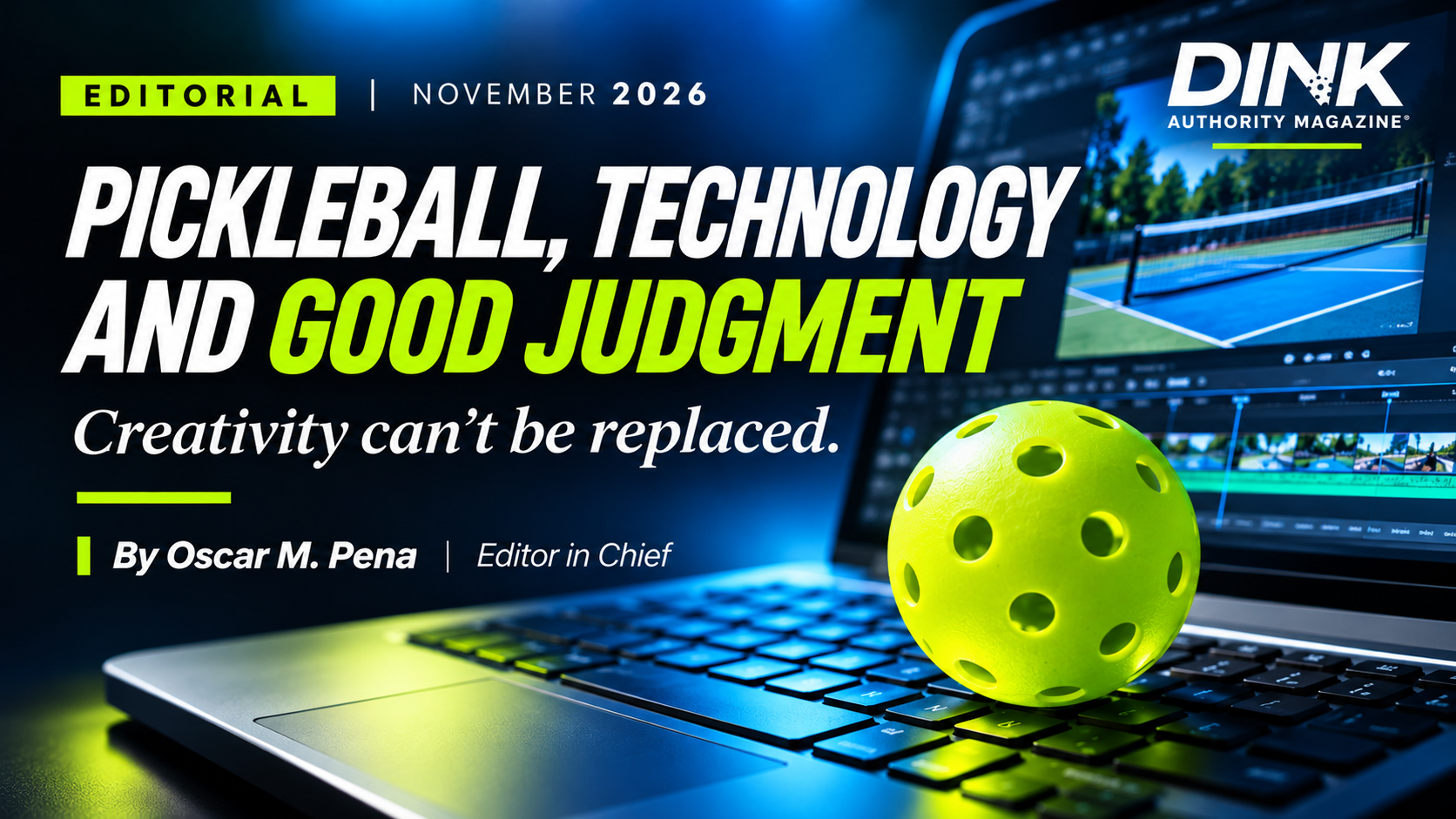
PICKLEBALL, TECHNOLOGY AND GOOD JUDGMENT: CREATIVITY CAN’T BE REPLACED
EDITORIAL | NOVEMBER 2026
By Oscar M. Pena | Editor in Chief
Something has always caught my attention: every time a new technology comes along that can transform the way we work, so do those who resist it. Some out of unfamiliarity, others out of fear of change, and a few simply because it’s easier to criticize what others are building than to dare to create something different.
At DINK Authority, our philosophy is very clear: we believe in evolution, we bet on innovation and we use the tools that allow us to take our ideas, and pickleball, further. But above all, we believe in the human talent behind every project.
And when I talk about technology, I’m not only talking about artificial intelligence. I’m talking about decades of transformation that many of us have lived through firsthand.
I clearly remember when computers began replacing typewriters. There was no shortage of people insisting it would never be the same, that the essence of writing would be lost. And they were right about one thing: it definitely wasn’t the same. It was much better. Funny enough, none of those critics ever went back to the typewriter.
Those of us who lived through that transition know how much it helped to have learned how to type. In my case, I still remember with special affection my teacher Aura, at Colegio La Salle in my beloved Colombia. She was probably one of the strictest teachers I ever had, but also one of those people whose lessons stay with you for life. With her, I learned where to place my fingers on the keyboard, to memorize every letter and to type without looking at my hands. I never imagined how much those classes would serve me.
Typewriters gave way to computers, then came smartphones and now artificial intelligence. But those lessons remain. Technology changed. What I learned stayed. And good teachers are never forgotten.
LOVE PICKLEBALL?
Get Dink Authority Magazine updates, new editions, pro stories and event alerts.
We respect your privacy. Unsubscribe anytime.
Then came another revolution: Photoshop. The criticism wasn’t long in coming. Photos would no longer be authentic, retouching would destroy art, anyone could become a photographer just by pressing a few buttons. Twenty years later, we’re still waiting for those buttons to make a cover on their own.
Because there is something none of these revolutions has managed to replace: the eye of the creator, the sensitivity of the interpreter, good judgment and the human ability to turn an idea into something extraordinary. A tool can modify an image, but it can’t understand the story we want to tell. It can help us write, but it can’t live our experiences. It can translate our words into dozens of languages, but it can’t replace the emotion of an interview or the human connection that knows no borders.
At DINK Authority, we use artificial intelligence as part of a much broader ecosystem: digital platforms and tools for editing, design, video production, translation and distribution. And behind all of it is a human team that researches, interviews, photographs, writes, edits, designs and makes decisions. There is talent, creative debate, long hours and an enormous passion for telling the story of pickleball in a different way.
We don’t expect technology to do our job for us. We want it to help us do it better.
That’s why certain criticisms that show up every time someone dares to explore something new feel so outdated to us. We don’t have to think alike or use the same tools; diversity of opinion is healthy, even necessary. What should never be lost is respect.
Questioning a project with arguments is one thing. Trying to discredit someone else’s work, or the people who do it, to get a few likes, views or minutes of attention is something else entirely. Some people have discovered that controversy pays better than hard work. It’s a valid strategy… if the goal is lots of noise and very little to show for it.
It’s also curious how certain voices get louder right when they hear big footsteps approaching. We get it: competing with ideas is harder than competing by shouting.
Creativity shouldn’t be a race to see who can trample other people’s ideas first. It should be a space to inspire one another, learn, experiment and build. That is the conviction that drives us at DINK Authority.
Our November issue is a good example. Alongside the talented and fearless Shelby Bates, we took on a different kind of editorial concept, one that goes beyond conventional sports photography to reveal another dimension of an extraordinary athlete. Behind that concept is also our friend and Miami team member, Javier Herrera, with whom we’ve fought countless creative battles in front of his lens: always quick to capture the right moment, with a patience that seems to have no limits.
Images that tell stories aren’t born in an app. They’re born from a shared vision, from trust between everyone involved and from a team’s ability to imagine something that doesn’t exist yet. Tools help bring that vision to life, but they are not the ones who conceive it.
In a world where producing images, text and content will keep getting easier, I’m convinced that the real value will lie in what can’t be automated: originality, good judgment, sensitivity, ethics and the ability to truly connect with other people.
We’re not afraid of the future. We’re excited about it. We’ll keep learning, experimenting and using whatever tools we need to take pickleball’s stories to new horizons, without forgetting that behind every great idea there must always be a mind willing to imagine it and a human being able to give it meaning.
And to those who prefer noise: thank you. Every comment reminds us that we’re doing something worth watching.
Until next time.
EDITORIAL | NOVEMBER 2026
By Oscar M. Pena | Editor in Chief
Something has always caught my attention: every time a new technology comes along that can transform the way we work, so do those who resist it. Some out of unfamiliarity, others out of fear of change, and a few simply because it’s easier to criticize what others are building than to dare to create something different.
At DINK Authority, our philosophy is very clear: we believe in evolution, we bet on innovation and we use the tools that allow us to take our ideas, and pickleball, further. But above all, we believe in the human talent behind every project.
And when I talk about technology, I’m not only talking about artificial intelligence. I’m talking about decades of transformation that many of us have lived through firsthand.
I clearly remember when computers began replacing typewriters. There was no shortage of people insisting it would never be the same, that the essence of writing would be lost. And they were right about one thing: it definitely wasn’t the same. It was much better. Funny enough, none of those critics ever went back to the typewriter.
Current Issue
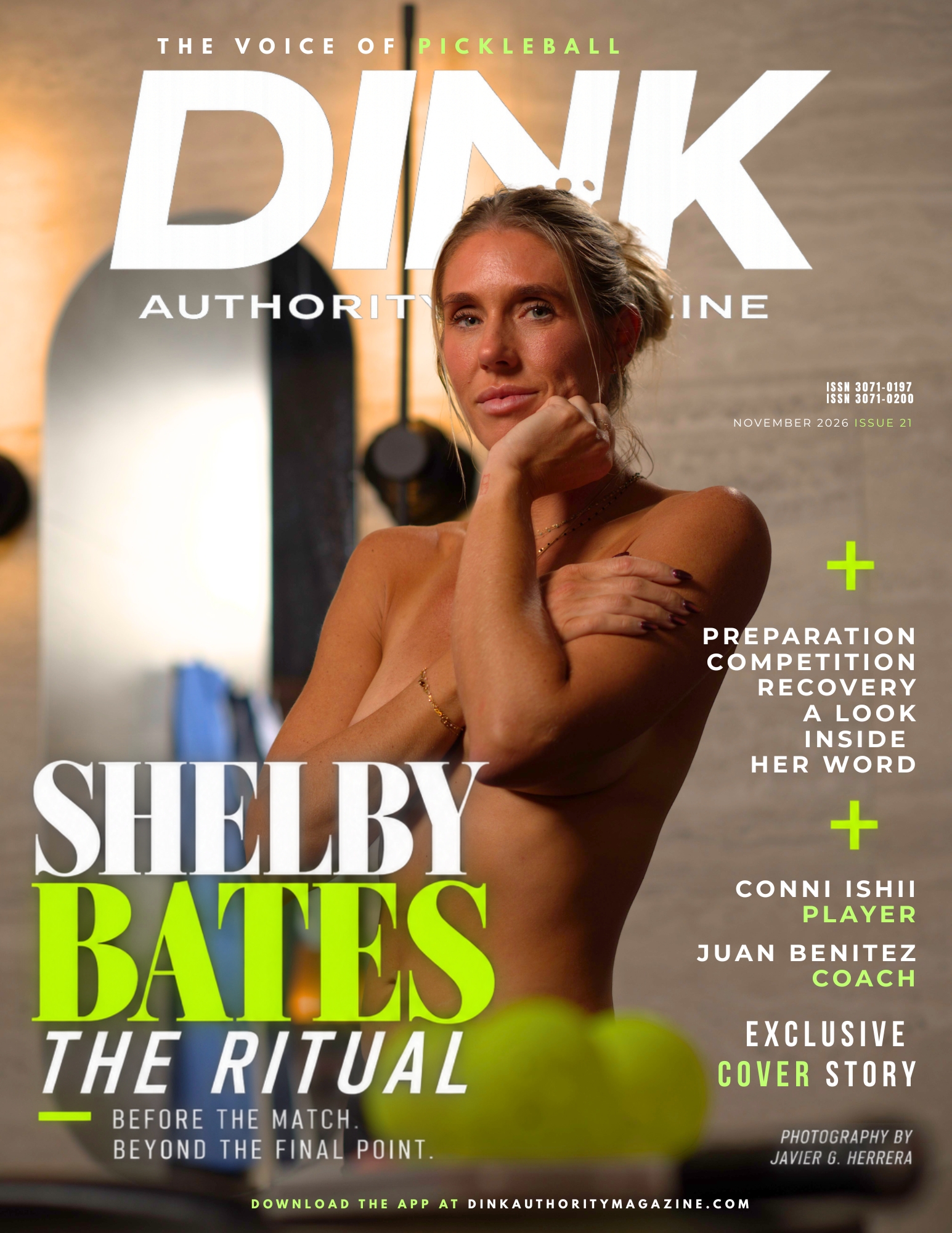
Shelby Bates: The Ritual
Read Now →
Those of us who lived through that transition know how much it helped to have learned how to type. In my case, I still remember with special affection my teacher Aura, at Colegio La Salle in my beloved Colombia. She was probably one of the strictest teachers I ever had, but also one of those people whose lessons stay with you for life. With her, I learned where to place my fingers on the keyboard, to memorize every letter and to type without looking at my hands. I never imagined how much those classes would serve me.
Typewriters gave way to computers, then came smartphones and now artificial intelligence. But those lessons remain. Technology changed. What I learned stayed. And good teachers are never forgotten.
LOVE PICKLEBALL?
Get Dink Authority Magazine updates, new editions, pro stories and event alerts.
We respect your privacy. Unsubscribe anytime.
Then came another revolution: Photoshop. The criticism wasn’t long in coming. Photos would no longer be authentic, retouching would destroy art, anyone could become a photographer just by pressing a few buttons. Twenty years later, we’re still waiting for those buttons to make a cover on their own.
Because there is something none of these revolutions has managed to replace: the eye of the creator, the sensitivity of the interpreter, good judgment and the human ability to turn an idea into something extraordinary. A tool can modify an image, but it can’t understand the story we want to tell. It can help us write, but it can’t live our experiences. It can translate our words into dozens of languages, but it can’t replace the emotion of an interview or the human connection that knows no borders.
At DINK Authority, we use artificial intelligence as part of a much broader ecosystem: digital platforms and tools for editing, design, video production, translation and distribution. And behind all of it is a human team that researches, interviews, photographs, writes, edits, designs and makes decisions. There is talent, creative debate, long hours and an enormous passion for telling the story of pickleball in a different way.

We don’t expect technology to do our job for us. We want it to help us do it better.
That’s why certain criticisms that show up every time someone dares to explore something new feel so outdated to us. We don’t have to think alike or use the same tools; diversity of opinion is healthy, even necessary. What should never be lost is respect.
Questioning a project with arguments is one thing. Trying to discredit someone else’s work, or the people who do it, to get a few likes, views or minutes of attention is something else entirely. Some people have discovered that controversy pays better than hard work. It’s a valid strategy… if the goal is lots of noise and very little to show for it.
It’s also curious how certain voices get louder right when they hear big footsteps approaching. We get it: competing with ideas is harder than competing by shouting.
Creativity shouldn’t be a race to see who can trample other people’s ideas first. It should be a space to inspire one another, learn, experiment and build. That is the conviction that drives us at DINK Authority.

Our November issue is a good example. Alongside the talented and fearless Shelby Bates, we took on a different kind of editorial concept, one that goes beyond conventional sports photography to reveal another dimension of an extraordinary athlete. Behind that concept is also our friend and Miami team member, Javier Herrera, with whom we’ve fought countless creative battles in front of his lens: always quick to capture the right moment, with a patience that seems to have no limits.
Images that tell stories aren’t born in an app. They’re born from a shared vision, from trust between everyone involved and from a team’s ability to imagine something that doesn’t exist yet. Tools help bring that vision to life, but they are not the ones who conceive it.
In a world where producing images, text and content will keep getting easier, I’m convinced that the real value will lie in what can’t be automated: originality, good judgment, sensitivity, ethics and the ability to truly connect with other people.
We’re not afraid of the future. We’re excited about it. We’ll keep learning, experimenting and using whatever tools we need to take pickleball’s stories to new horizons, without forgetting that behind every great idea there must always be a mind willing to imagine it and a human being able to give it meaning.
And to those who prefer noise: thank you. Every comment reminds us that we’re doing something worth watching.
Until next time.