Mixed Doubles Pickleball Strategy 4.0: The Patterns, Communication and Transitions That Win Points
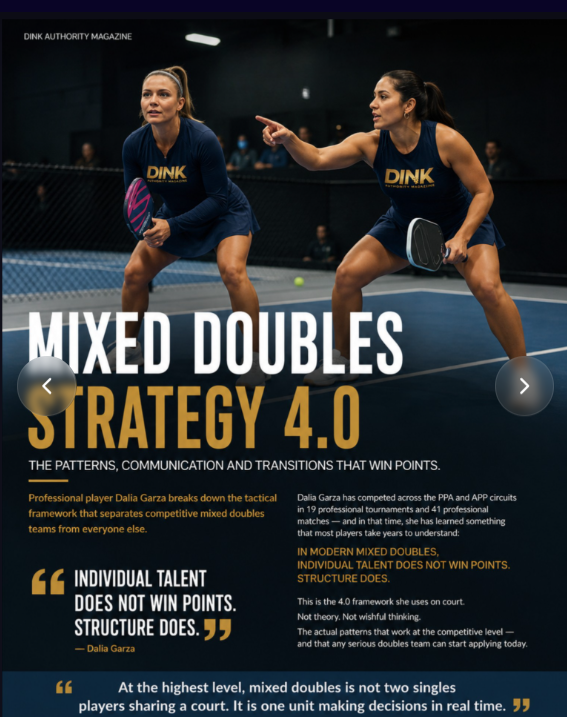
Professional player Dalia Garza breaks down the tactical framework that separates competitive mixed doubles teams from everyone else.
The 4.0 Reality: It's Not About Power
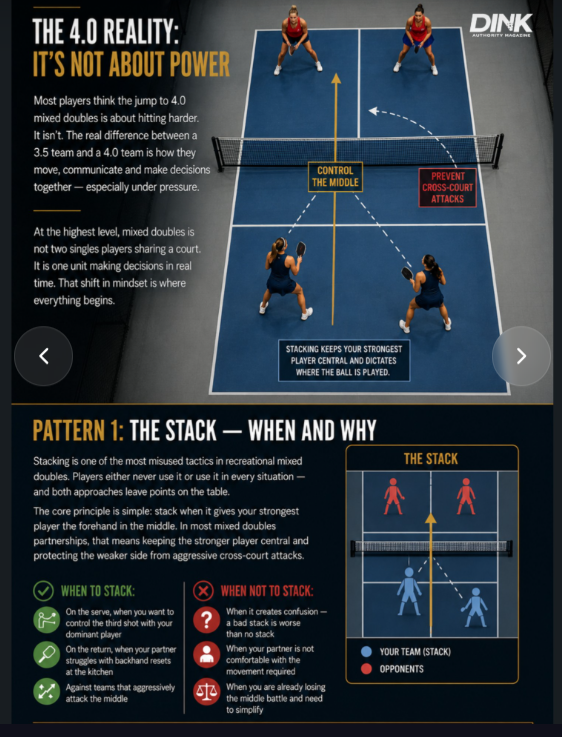
Most players think the jump to 4.0 mixed doubles is about hitting harder. It isn't. The real difference between a 3.5 team and a 4.0 team is how they move, communicate and make decisions together — especially under pressure.
At the highest level, mixed doubles is not two singles players sharing a court. It is one unit making decisions in real time. That shift in mindset is where everything begins.
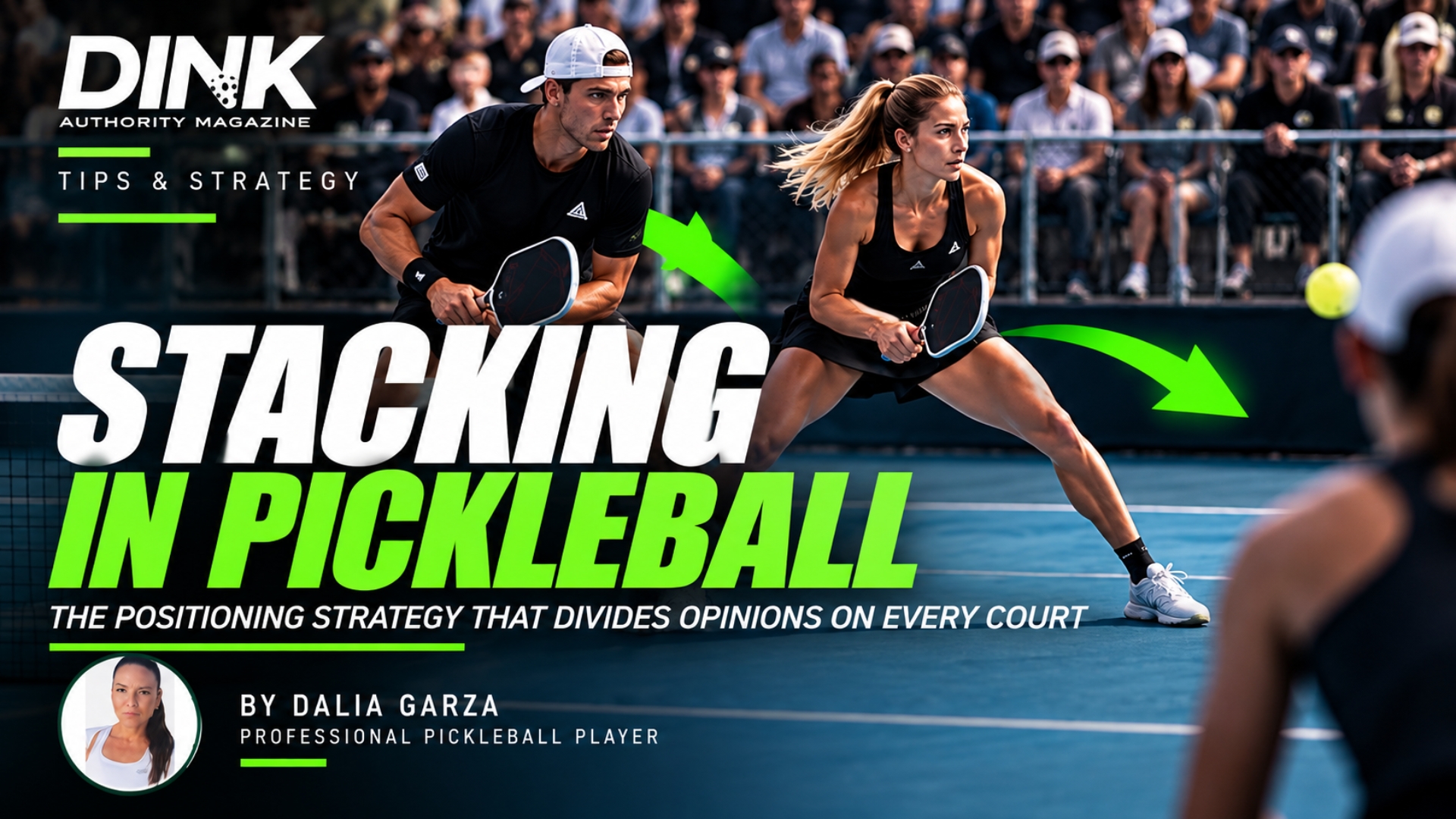
Pattern 1: The Stack — When and Why
Stacking is one of the most misused tactics in recreational mixed doubles. Players either never use it or use it in every situation — and both approaches leave points on the table.
The core principle is simple: stack when it gives your strongest player the forehand in the middle. In most mixed doubles partnerships, that means keeping the stronger player central and protecting the weaker side from aggressive cross-court attacks.
When to stack:
On the serve, when you want to control the third shot with your dominant player
On the return, when your partner struggles with backhand resets at the kitchen
Against teams that aggressively attack the middle
When NOT to stack:
When it creates confusion — a bad stack is worse than no stack
When your partner is not comfortable with the movement required
When you are already losing the middle battle and need to simplify
Key: if you and your partner cannot execute the stack smoothly in practice, do not attempt it in a match. Confusion at the kitchen kills rallies before they start.
Pattern 2: Middle Ball Ownership — No Gray Zones
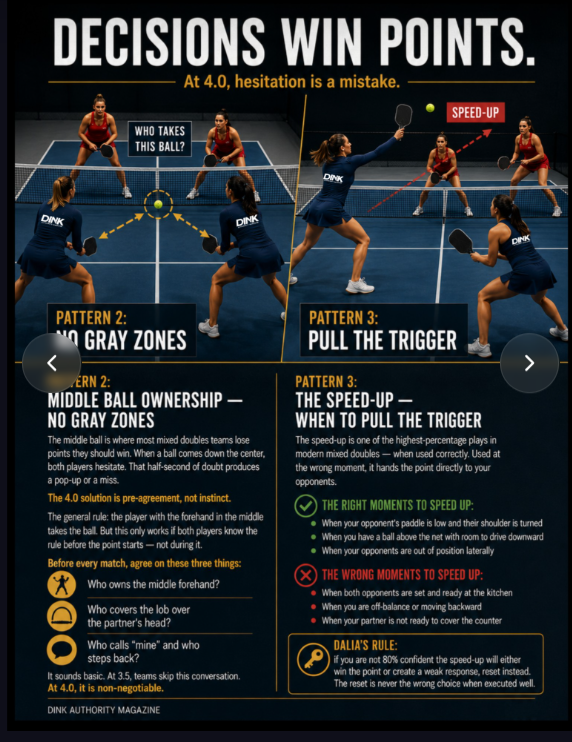
The middle ball is where most mixed doubles teams lose points they should win. When a ball comes down the center, both players hesitate. That half-second of doubt produces a pop-up or a miss.
The 4.0 solution is pre-agreement, not instinct.
The general rule: the player with the forehand in the middle takes the ball. But this only works if both players know the rule before the point starts — not during it.
Before every match, agree on these three things:
LOVE PICKLEBALL?
Get Dink Authority Magazine updates, new editions, pro stories and event alerts.
We respect your privacy. Unsubscribe anytime.
Who owns the middle forehand?
Who covers the lob over the partner's head?
Who calls "mine" and who steps back?
It sounds basic. At 3.5, teams skip this conversation. At 4.0, it is non-negotiable.
Pattern 3: The Speed-Up — When to Pull the Trigger
The speed-up is one of the highest-percentage plays in modern mixed doubles — when used correctly. Used at the wrong moment, it hands the point directly to your opponents.
The right moments to speed up:
When your opponent's paddle is low and their shoulder is turned
When you have a ball above the net with room to drive downward
When your opponents are out of position laterally
The wrong moments to speed up:
When both opponents are set and ready at the kitchen
When you are off-balance or moving backward
When your partner is not ready to cover the counter
Dalia's rule: if you are not 80% confident the speed-up will either win the point or create a weak response, reset instead. The reset is never the wrong choice when executed well.
Pattern 4: Communication Between Points — The Difference Maker
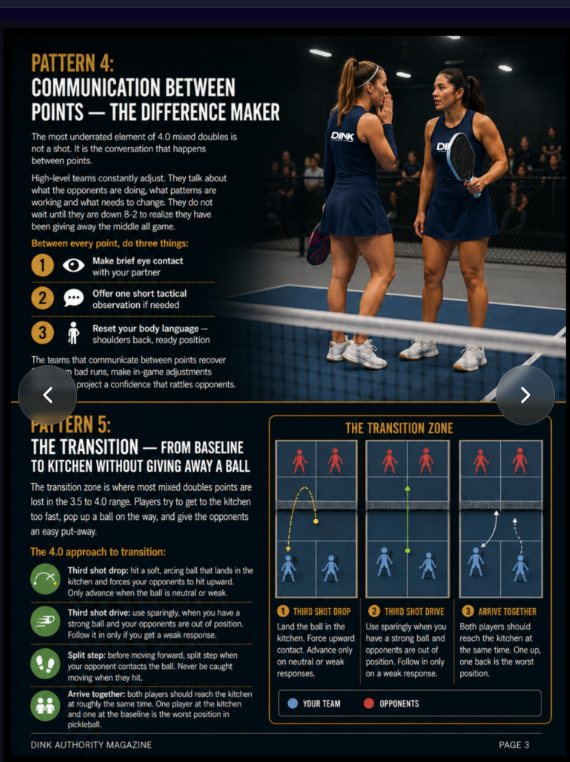
The most underrated element of 4.0 mixed doubles is not a shot. It is the conversation that happens between points.
High-level teams constantly adjust. They talk about what the opponents are doing, what patterns are working and what needs to change. They do not wait until they are down 8-2 to realize they have been giving away the middle all game.
Between every point, do three things:
Make brief eye contact with your partner
Offer one short tactical observation if needed
Reset your body language — shoulders back, ready position
The teams that communicate between points recover faster from bad runs, make in-game adjustments quicker and project a confidence that rattles opponents.
Pattern 5: The Transition — From Baseline to Kitchen Without Giving Away a Ball
The transition zone is where most mixed doubles points are lost in the 3.5 to 4.0 range. Players try to get to the kitchen too fast, pop up a ball on the way, and give the opponents an easy put-away.
The 4.0 approach to transition:
Third shot drop: hit a soft, arcing ball that lands in the kitchen and forces your opponents to hit upward. Only advance when the ball is neutral or weak.
Third shot drive: use sparingly, when you have a strong ball and your opponents are out of position. Follow it in only if you get a weak response.
Split step: before moving forward, split step when your opponent contacts the ball. Never be caught moving when they hit.
Arrive together: both players should reach the kitchen at roughly the same time. One player at the kitchen and one at the baseline is the worst position in pickleball.
The 4.0 Mindset in Mixed Doubles
Dalia's final word on mixed doubles strategy is not technical. It is mental.
"At 4.0, the biggest mistake I see in mixed doubles is players trying to do too much. They go for the winner when the reset was the right call. They speed up when the dink was working. They abandon a pattern that was winning because they got impatient.
The best mixed doubles teams are not always the most talented ones. They are the most disciplined ones. They trust the process, they trust their partner, and they trust that staying in the rally is already winning."
See you on the courts.
Professional player Dalia Garza breaks down the tactical framework that separates competitive mixed doubles teams from everyone else.
The 4.0 Reality: It's Not About Power
Most players think the jump to 4.0 mixed doubles is about hitting harder. It isn't. The real difference between a 3.5 team and a 4.0 team is how they move, communicate and make decisions together — especially under pressure.
At the highest level, mixed doubles is not two singles players sharing a court. It is one unit making decisions in real time. That shift in mindset is where everything begins.
Pattern 1: The Stack — When and Why
Stacking is one of the most misused tactics in recreational mixed doubles. Players either never use it or use it in every situation — and both approaches leave points on the table.
The core principle is simple: stack when it gives your strongest player the forehand in the middle. In most mixed doubles partnerships, that means keeping the stronger player central and protecting the weaker side from aggressive cross-court attacks.
When to stack:
On the serve, when you want to control the third shot with your dominant player
On the return, when your partner struggles with backhand resets at the kitchen
Against teams that aggressively attack the middle
When NOT to stack:
When it creates confusion — a bad stack is worse than no stack
When your partner is not comfortable with the movement required
When you are already losing the middle battle and need to simplify
Current Issue
Domenika Turkovic: Fighting Her Own Demons
Read Now →
Key: if you and your partner cannot execute the stack smoothly in practice, do not attempt it in a match. Confusion at the kitchen kills rallies before they start.
Pattern 2: Middle Ball Ownership — No Gray Zones
The middle ball is where most mixed doubles teams lose points they should win. When a ball comes down the center, both players hesitate. That half-second of doubt produces a pop-up or a miss.
The 4.0 solution is pre-agreement, not instinct.
The general rule: the player with the forehand in the middle takes the ball. But this only works if both players know the rule before the point starts — not during it.
Before every match, agree on these three things:
LOVE PICKLEBALL?
Get Dink Authority Magazine updates, new editions, pro stories and event alerts.
We respect your privacy. Unsubscribe anytime.
Who owns the middle forehand?
Who covers the lob over the partner's head?
Who calls "mine" and who steps back?
It sounds basic. At 3.5, teams skip this conversation. At 4.0, it is non-negotiable.
Pattern 3: The Speed-Up — When to Pull the Trigger
The speed-up is one of the highest-percentage plays in modern mixed doubles — when used correctly. Used at the wrong moment, it hands the point directly to your opponents.
The right moments to speed up:

When your opponent's paddle is low and their shoulder is turned
When you have a ball above the net with room to drive downward
When your opponents are out of position laterally
The wrong moments to speed up:
When both opponents are set and ready at the kitchen
When you are off-balance or moving backward
When your partner is not ready to cover the counter
Dalia's rule: if you are not 80% confident the speed-up will either win the point or create a weak response, reset instead. The reset is never the wrong choice when executed well.
Pattern 4: Communication Between Points — The Difference Maker
The most underrated element of 4.0 mixed doubles is not a shot. It is the conversation that happens between points.
High-level teams constantly adjust. They talk about what the opponents are doing, what patterns are working and what needs to change. They do not wait until they are down 8-2 to realize they have been giving away the middle all game.
Between every point, do three things:

Make brief eye contact with your partner
Offer one short tactical observation if needed
Reset your body language — shoulders back, ready position
The teams that communicate between points recover faster from bad runs, make in-game adjustments quicker and project a confidence that rattles opponents.
Pattern 5: The Transition — From Baseline to Kitchen Without Giving Away a Ball
The transition zone is where most mixed doubles points are lost in the 3.5 to 4.0 range. Players try to get to the kitchen too fast, pop up a ball on the way, and give the opponents an easy put-away.
The 4.0 approach to transition:
Third shot drop: hit a soft, arcing ball that lands in the kitchen and forces your opponents to hit upward. Only advance when the ball is neutral or weak.
Third shot drive: use sparingly, when you have a strong ball and your opponents are out of position. Follow it in only if you get a weak response.
Split step: before moving forward, split step when your opponent contacts the ball. Never be caught moving when they hit.
Arrive together: both players should reach the kitchen at roughly the same time. One player at the kitchen and one at the baseline is the worst position in pickleball.
The 4.0 Mindset in Mixed Doubles
Dalia's final word on mixed doubles strategy is not technical. It is mental.
"At 4.0, the biggest mistake I see in mixed doubles is players trying to do too much. They go for the winner when the reset was the right call. They speed up when the dink was working. They abandon a pattern that was winning because they got impatient.
The best mixed doubles teams are not always the most talented ones. They are the most disciplined ones. They trust the process, they trust their partner, and they trust that staying in the rally is already winning."
See you on the courts.
Gallery