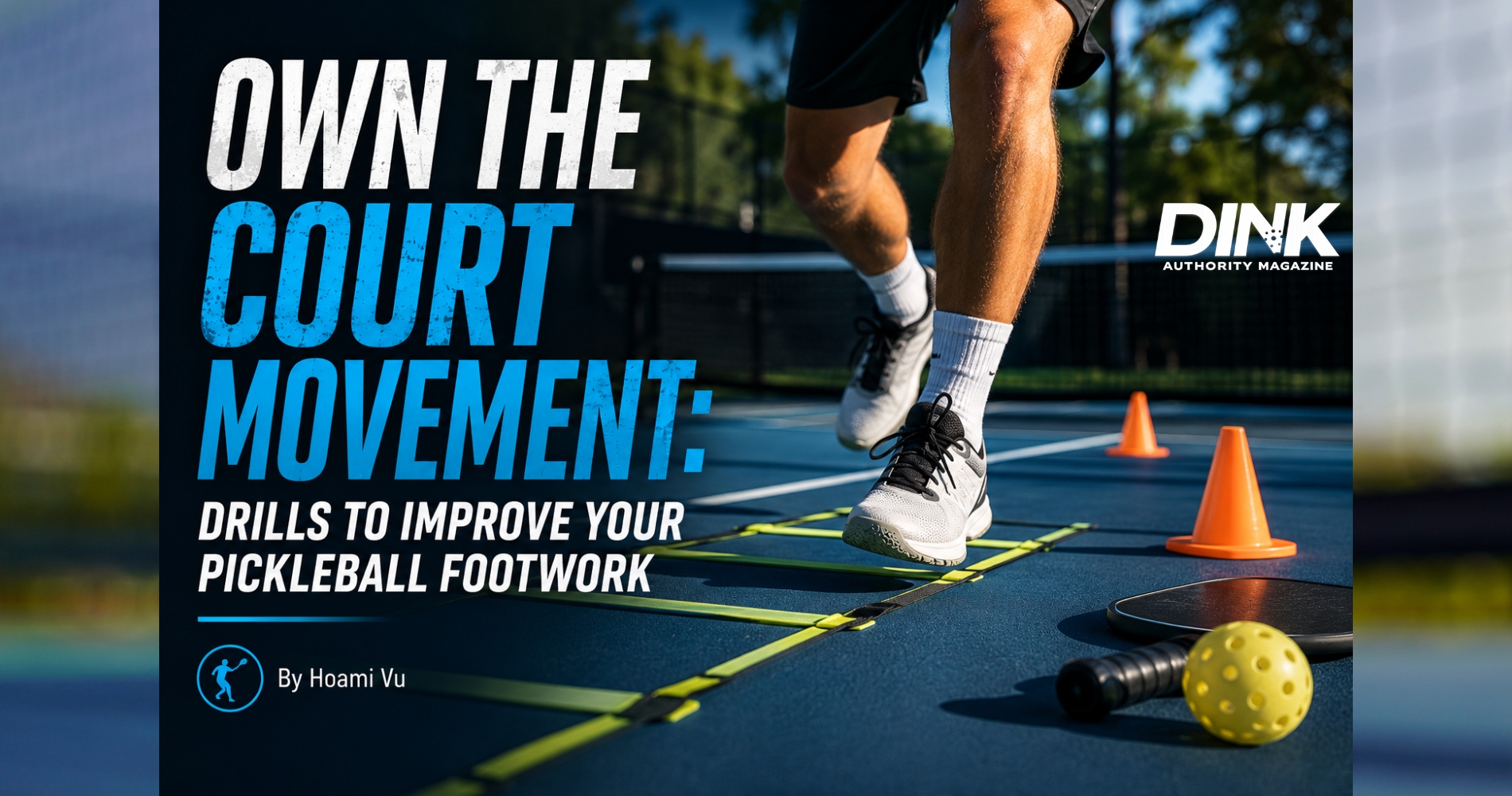
Own the Court Movement: Drills to Improve Your Pickleball Footwork
Pickleball is more than just hitting great shots. In fact, some of the best players you'll ever face won't overpower you with speed or spin — they'll simply always be in the right place at the right time. That's the secret nobody talks about enough: footwork.
Your feet are the foundation of every single shot you hit. Before your paddle even makes contact with the ball, your body positioning has already determined the quality of that shot. A player with elite footwork reaches the ball early, sets up in balance, and recovers quickly — while everyone else is scrambling, lunging, and hitting off their back foot. The difference between a 3.5 and a 4.5 player is often not the paddle or the technique. It's the feet.
The good news? Footwork is a skill, and skills can be trained. You don't need a court partner or a ball machine to improve it. All you need is a little space, some cones or tape, and the commitment to practice these five drills consistently. Add them to your warm-up routine two or three times a week and you'll feel the difference within a month.
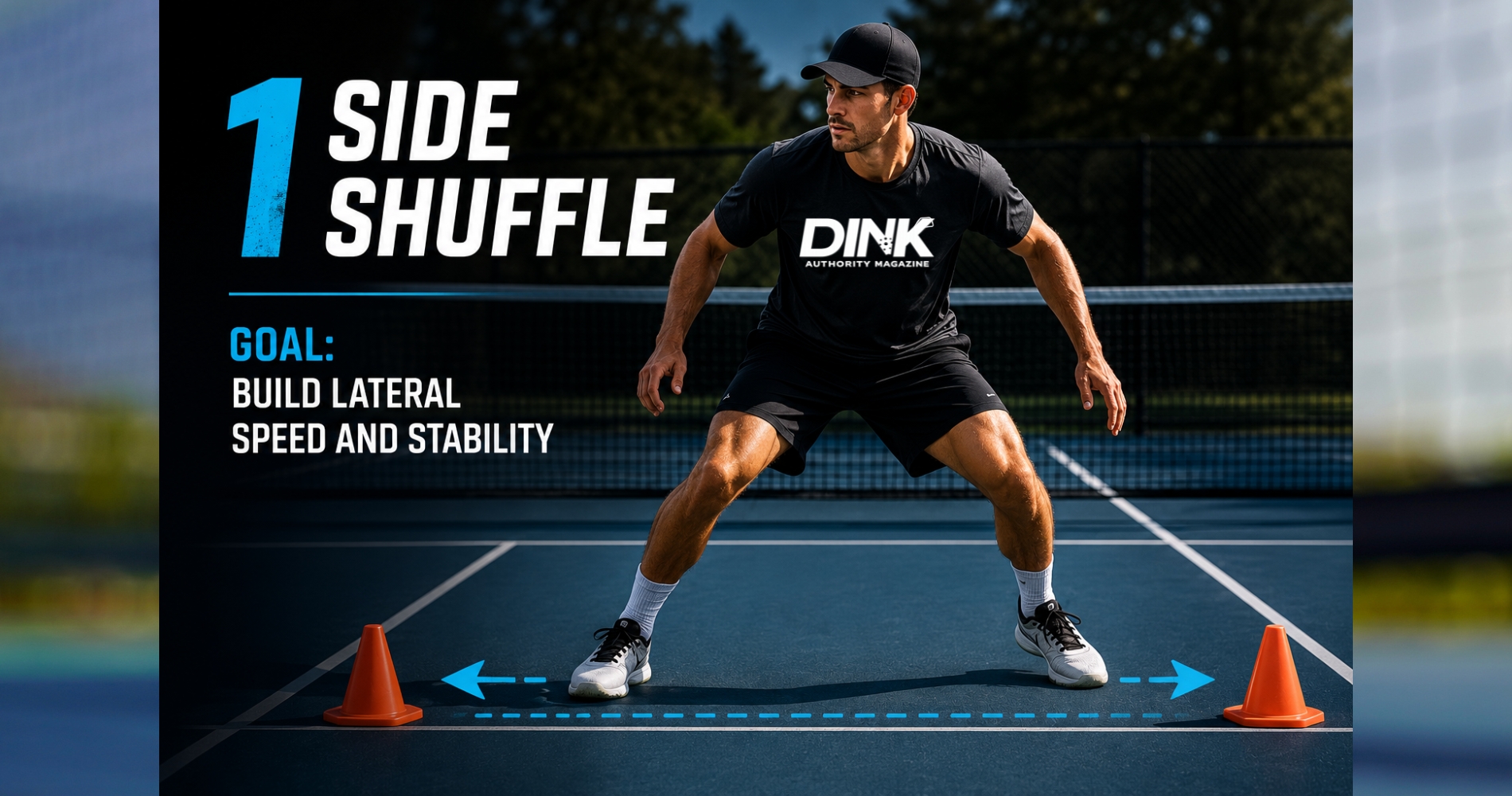
Drill 1: Side Shuffle
Goal: Build lateral speed and stability
This is the bread and butter of pickleball movement. Most of your court coverage happens side to side — covering the middle, moving to the sideline, recovering to the center — and the side shuffle is how you do it efficiently without crossing your feet and losing your athletic stance.
How to do it: Place two cones about 6 feet apart. Start in the center and shuffle side to side, touching each cone without crossing your feet. Keep your knees slightly bent, your weight on the balls of your feet, and your shoulders low. Don't stand up between shuffles — stay in your athletic stance the entire time. Do 3 sets of 30 seconds.
Why it matters: This drill trains the exact lateral movement you make when covering the net during a dink rally. The lower you stay, the more stable and explosive your movement becomes.
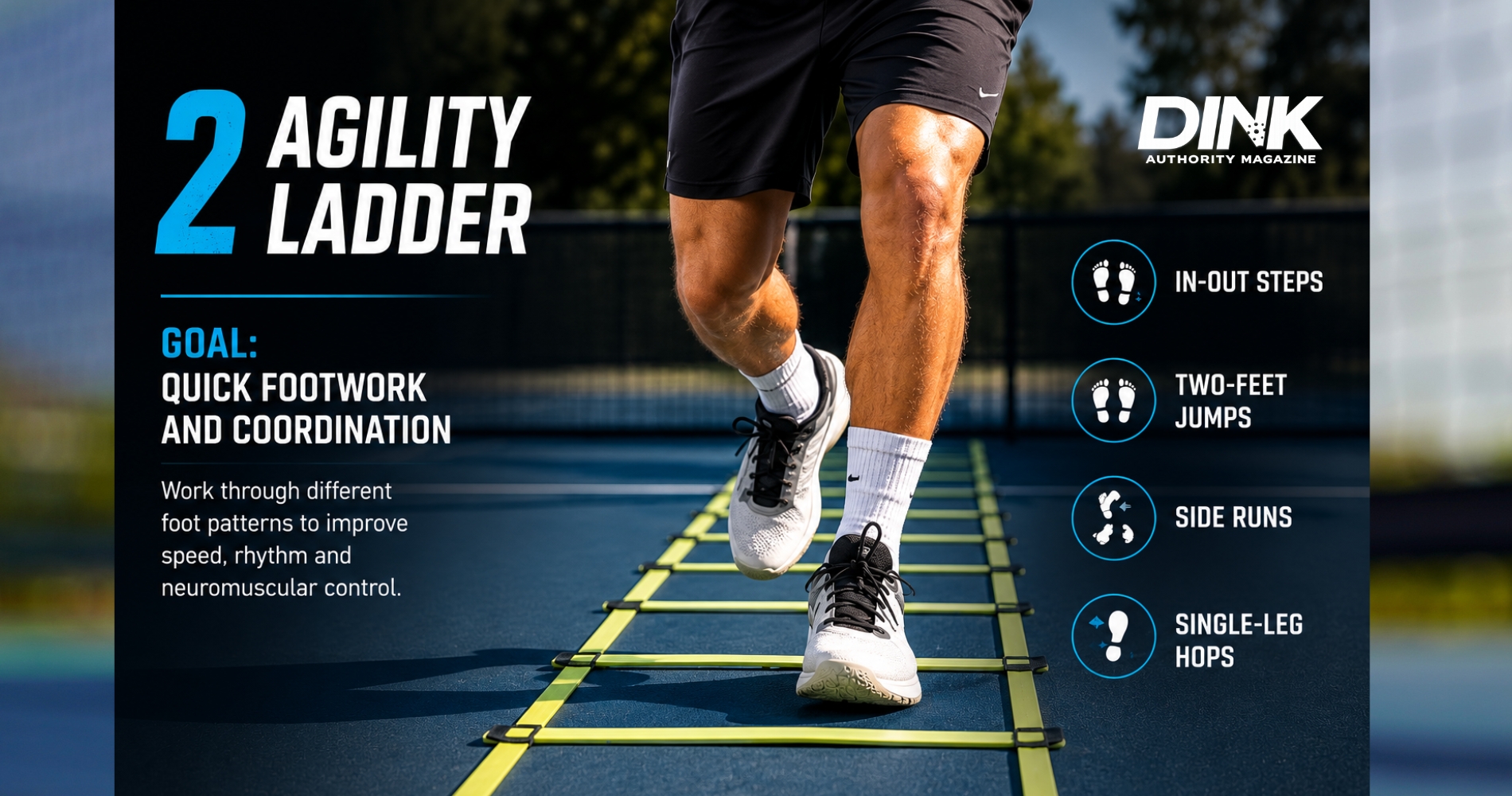
Drill 2: Agility Ladder
Goal: Quick footwork and coordination
If you've ever felt like your feet just can't keep up with the pace of the game, this drill is for you. The agility ladder forces your brain and your feet to communicate faster — and that communication is exactly what you need when the ball is coming at you quickly and you have to adjust your position in milliseconds.
How to do it: Use an agility ladder or mark one on the floor with tape. Work through different foot patterns — in-out steps, two-feet jumps, side runs, single-leg hops. Start slow and focus on accuracy before speed. As the patterns become natural, increase your pace. Do 3 passes through the ladder for each pattern.
LOVE PICKLEBALL?
Get Dink Authority Magazine updates, new editions, pro stories and event alerts.
We respect your privacy. Unsubscribe anytime.
Why it matters: Agility ladders don't just build speed — they build neuromuscular coordination, which means your body learns to move efficiently without you having to think about it. In a fast-paced point, you don't have time to think. Your feet need to react automatically.
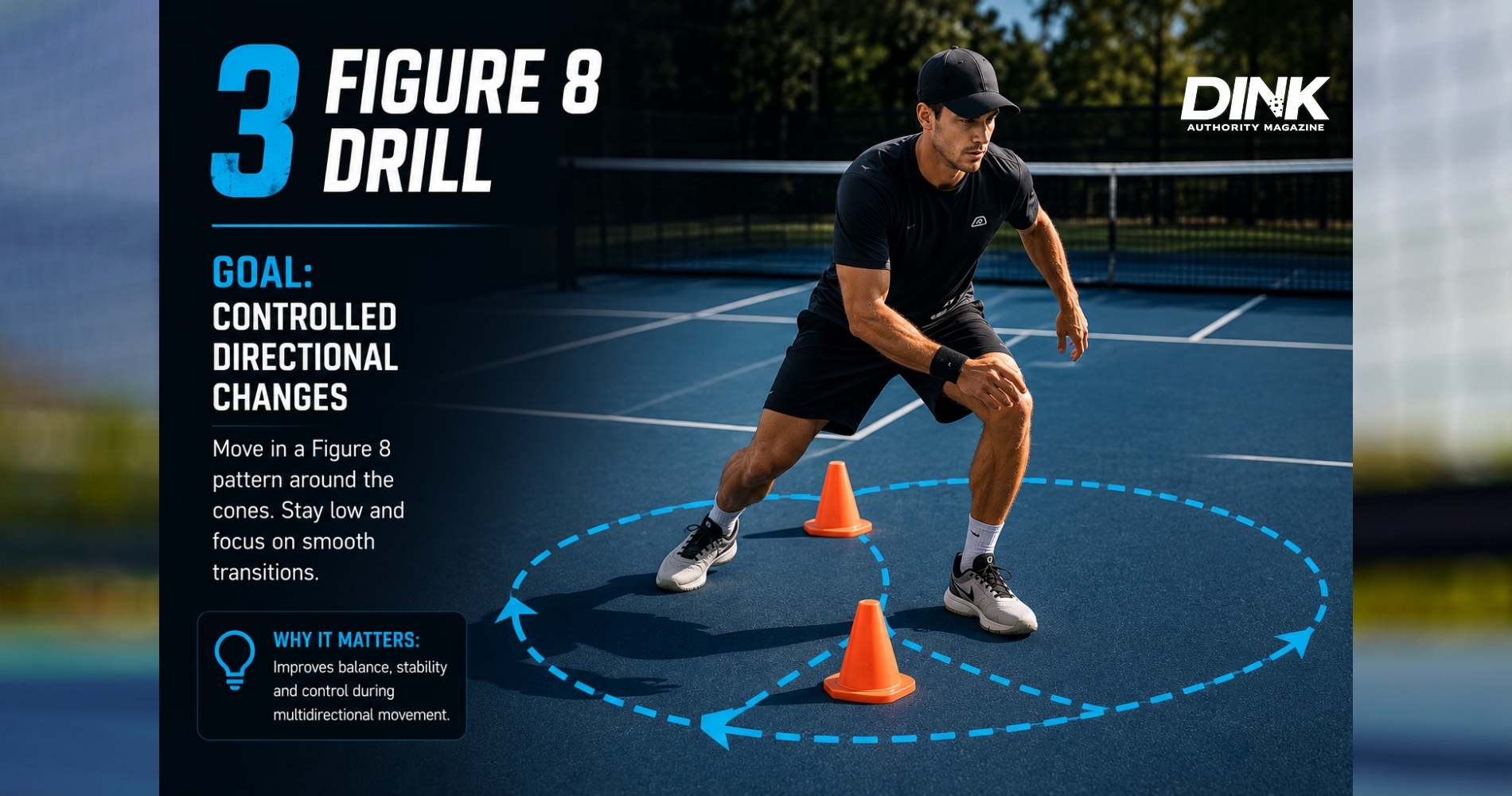
Drill 3: Figure 8 Drill
Goal: Controlled directional changes
Pickleball movement is rarely linear. You're constantly changing direction — moving forward to the kitchen, stepping back for a lob, cutting left, cutting right. The Figure 8 drill trains your body to handle those directional changes without losing balance or momentum.
How to do it: Place two cones about 6 feet apart. Move in a figure 8 pattern around them, keeping your body low and balanced throughout the entire movement. Focus on smooth transitions between directions — don't stop and restart, flow through the change. Do 5 complete figure 8s, rest, and repeat for 3 sets.
Why it matters: This drill recreates the curved, multi-directional movement you need when defending or attacking from the center of the court. It also strengthens the stabilizing muscles in your ankles and knees — which means fewer injuries over time.
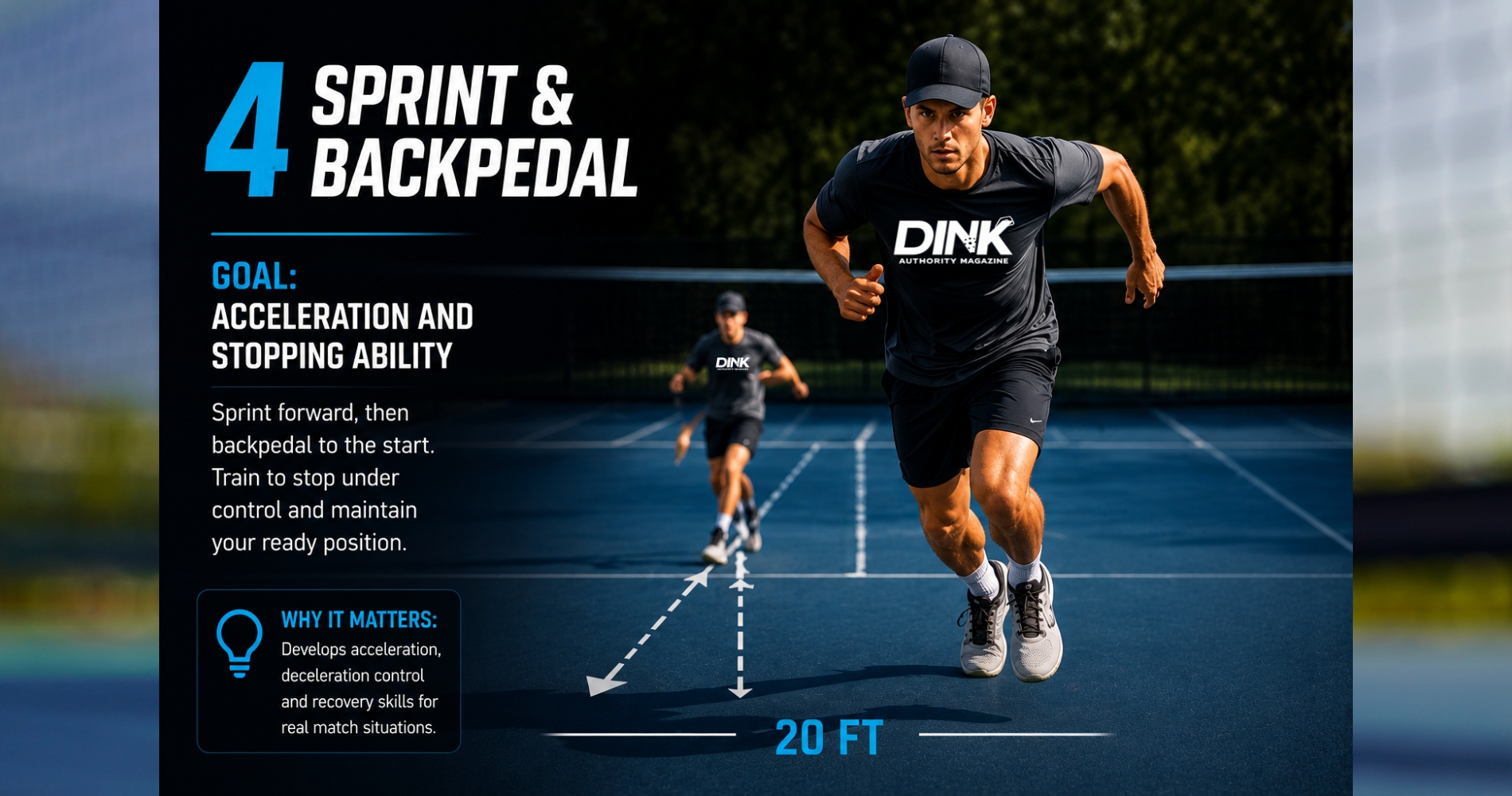
Drill 4: Sprint & Backpedal
Goal: Acceleration and stopping ability
One of the most underrated skills in pickleball is the ability to stop. Anyone can run forward — but stopping under control, at pace, without falling forward or losing your ready position, is something most recreational players never train. This drill fixes that.
How to do it: Mark two points about 20 feet apart. Sprint forward to the second point, then backpedal to the start. Do not turn around — always face forward, even when backpedaling. This forces you to develop real deceleration control and trains the muscle memory for recovering after moving forward to attack a drop shot. Do 5 rounds with 20 seconds of rest between each.
Why it matters: In match play, you'll constantly move forward to attack a short ball and then need to recover back if your opponent resets. Players who can backpedal efficiently and maintain their ready position are nearly impossible to lob.
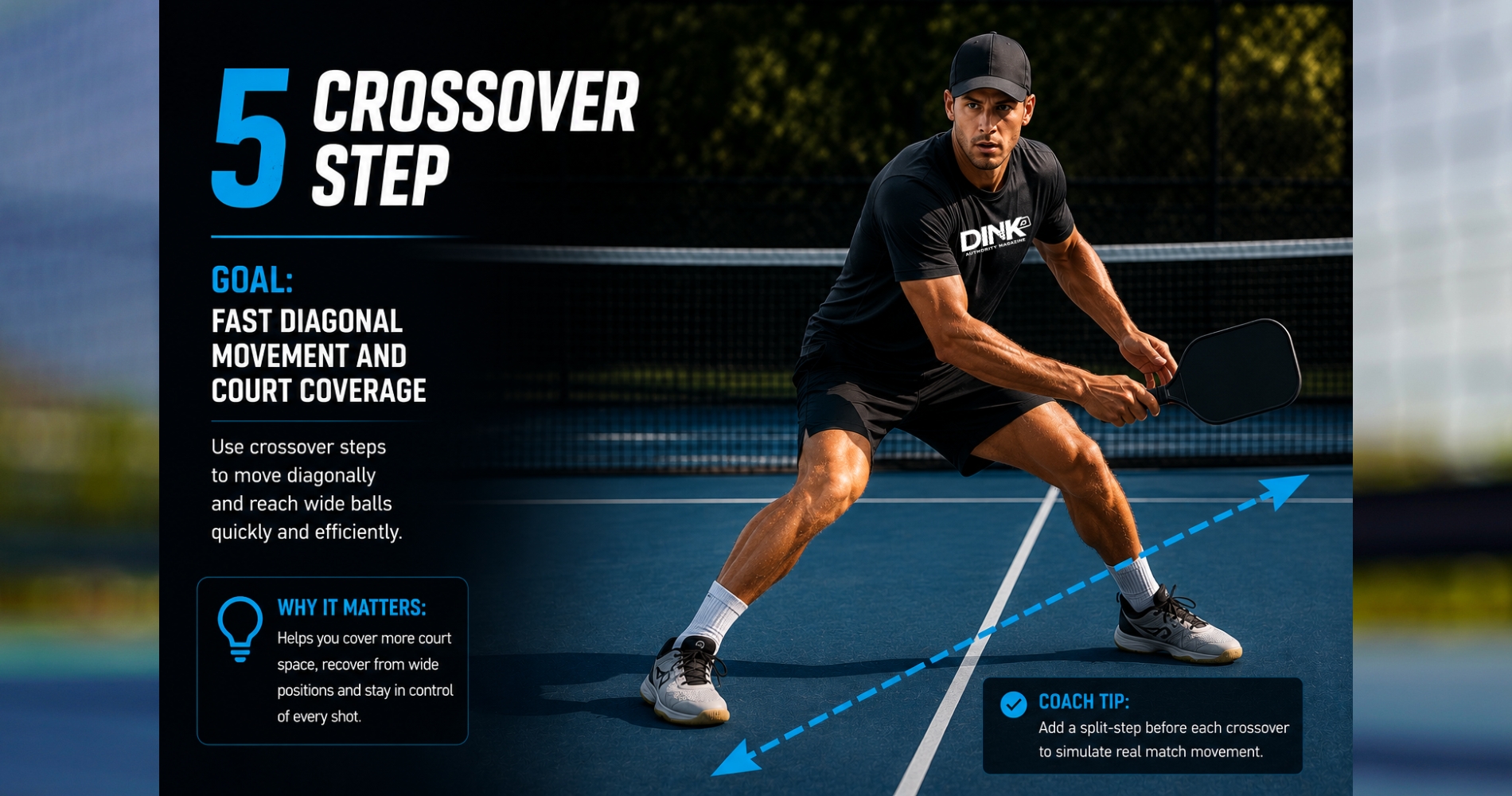
Drill 5: Crossover Step
Goal: Fast diagonal movement and court coverage
Sometimes the ball goes where a shuffle won't get you there fast enough. That's when the crossover step takes over — a single powerful diagonal stride that covers more ground than two shuffle steps and gets you to wide balls before they bounce twice.
How to do it: From a neutral, athletic stance, cross one leg in front of the other to move diagonally, then alternate sides. Practice moving to your forehand side, then your backhand side. Keep your hips low and your eyes forward. Add a split-step before each crossover to simulate real match movement. Do 3 sets of 10 crossovers on each side.
Why it matters: This step helps you reach deep shots, recover from wide positions, and shift quickly across the court without losing control of your body. Combined with the side shuffle, it gives you complete lateral coverage.
Final Practice Tips
Before you start any footwork session, warm up properly — five minutes of light jogging, leg swings, and dynamic stretching will prepare your joints and reduce injury risk.
During the drills, always focus on clean technique over speed. A sloppy fast shuffle is less useful than a controlled slow one. Speed will come naturally as the movement patterns become habit. There's no shortcut — the drills have to become second nature before they show up in your game.
Practice 2-3 times a week for consistent gains, and whenever possible, incorporate these movements directly into your shot routines. Finish a forehand shadow swing with a recovery shuffle. Combine a split-step with a crossover to your backhand. The more you connect the footwork to actual pickleball movements, the faster it transfers to the court.
Here's the truth: good footwork isn't a luxury. In pickleball, the player who gets to the ball in the right position first holds the advantage — every single time. With these five drills and a little consistency, that player can be you.
Pickleball is more than just hitting great shots. In fact, some of the best players you'll ever face won't overpower you with speed or spin — they'll simply always be in the right place at the right time. That's the secret nobody talks about enough: footwork.
Your feet are the foundation of every single shot you hit. Before your paddle even makes contact with the ball, your body positioning has already determined the quality of that shot. A player with elite footwork reaches the ball early, sets up in balance, and recovers quickly — while everyone else is scrambling, lunging, and hitting off their back foot. The difference between a 3.5 and a 4.5 player is often not the paddle or the technique. It's the feet.
The good news? Footwork is a skill, and skills can be trained. You don't need a court partner or a ball machine to improve it. All you need is a little space, some cones or tape, and the commitment to practice these five drills consistently. Add them to your warm-up routine two or three times a week and you'll feel the difference within a month.
Drill 1: Side Shuffle
Goal: Build lateral speed and stability
This is the bread and butter of pickleball movement. Most of your court coverage happens side to side — covering the middle, moving to the sideline, recovering to the center — and the side shuffle is how you do it efficiently without crossing your feet and losing your athletic stance.
How to do it: Place two cones about 6 feet apart. Start in the center and shuffle side to side, touching each cone without crossing your feet. Keep your knees slightly bent, your weight on the balls of your feet, and your shoulders low. Don't stand up between shuffles — stay in your athletic stance the entire time. Do 3 sets of 30 seconds.
Why it matters: This drill trains the exact lateral movement you make when covering the net during a dink rally. The lower you stay, the more stable and explosive your movement becomes.
Current Issue
Domenika Turkovic: Fighting Her Own Demons
Read Now →
Drill 2: Agility Ladder
Goal: Quick footwork and coordination
If you've ever felt like your feet just can't keep up with the pace of the game, this drill is for you. The agility ladder forces your brain and your feet to communicate faster — and that communication is exactly what you need when the ball is coming at you quickly and you have to adjust your position in milliseconds.
How to do it: Use an agility ladder or mark one on the floor with tape. Work through different foot patterns — in-out steps, two-feet jumps, side runs, single-leg hops. Start slow and focus on accuracy before speed. As the patterns become natural, increase your pace. Do 3 passes through the ladder for each pattern.
LOVE PICKLEBALL?
Get Dink Authority Magazine updates, new editions, pro stories and event alerts.
We respect your privacy. Unsubscribe anytime.
Why it matters: Agility ladders don't just build speed — they build neuromuscular coordination, which means your body learns to move efficiently without you having to think about it. In a fast-paced point, you don't have time to think. Your feet need to react automatically.
Drill 3: Figure 8 Drill
Goal: Controlled directional changes
Pickleball movement is rarely linear. You're constantly changing direction — moving forward to the kitchen, stepping back for a lob, cutting left, cutting right. The Figure 8 drill trains your body to handle those directional changes without losing balance or momentum.

How to do it: Place two cones about 6 feet apart. Move in a figure 8 pattern around them, keeping your body low and balanced throughout the entire movement. Focus on smooth transitions between directions — don't stop and restart, flow through the change. Do 5 complete figure 8s, rest, and repeat for 3 sets.
Why it matters: This drill recreates the curved, multi-directional movement you need when defending or attacking from the center of the court. It also strengthens the stabilizing muscles in your ankles and knees — which means fewer injuries over time.
Drill 4: Sprint & Backpedal
Goal: Acceleration and stopping ability
One of the most underrated skills in pickleball is the ability to stop. Anyone can run forward — but stopping under control, at pace, without falling forward or losing your ready position, is something most recreational players never train. This drill fixes that.
How to do it: Mark two points about 20 feet apart. Sprint forward to the second point, then backpedal to the start. Do not turn around — always face forward, even when backpedaling. This forces you to develop real deceleration control and trains the muscle memory for recovering after moving forward to attack a drop shot. Do 5 rounds with 20 seconds of rest between each.
Why it matters: In match play, you'll constantly move forward to attack a short ball and then need to recover back if your opponent resets. Players who can backpedal efficiently and maintain their ready position are nearly impossible to lob.
Drill 5: Crossover Step

Goal: Fast diagonal movement and court coverage
Sometimes the ball goes where a shuffle won't get you there fast enough. That's when the crossover step takes over — a single powerful diagonal stride that covers more ground than two shuffle steps and gets you to wide balls before they bounce twice.
How to do it: From a neutral, athletic stance, cross one leg in front of the other to move diagonally, then alternate sides. Practice moving to your forehand side, then your backhand side. Keep your hips low and your eyes forward. Add a split-step before each crossover to simulate real match movement. Do 3 sets of 10 crossovers on each side.
Why it matters: This step helps you reach deep shots, recover from wide positions, and shift quickly across the court without losing control of your body. Combined with the side shuffle, it gives you complete lateral coverage.
Final Practice Tips
Before you start any footwork session, warm up properly — five minutes of light jogging, leg swings, and dynamic stretching will prepare your joints and reduce injury risk.
During the drills, always focus on clean technique over speed. A sloppy fast shuffle is less useful than a controlled slow one. Speed will come naturally as the movement patterns become habit. There's no shortcut — the drills have to become second nature before they show up in your game.
Practice 2-3 times a week for consistent gains, and whenever possible, incorporate these movements directly into your shot routines. Finish a forehand shadow swing with a recovery shuffle. Combine a split-step with a crossover to your backhand. The more you connect the footwork to actual pickleball movements, the faster it transfers to the court.
Here's the truth: good footwork isn't a luxury. In pickleball, the player who gets to the ball in the right position first holds the advantage — every single time. With these five drills and a little consistency, that player can be you.
Gallery