Senior Pickleball: 3 Most Common Injuries and How to Prevent Them
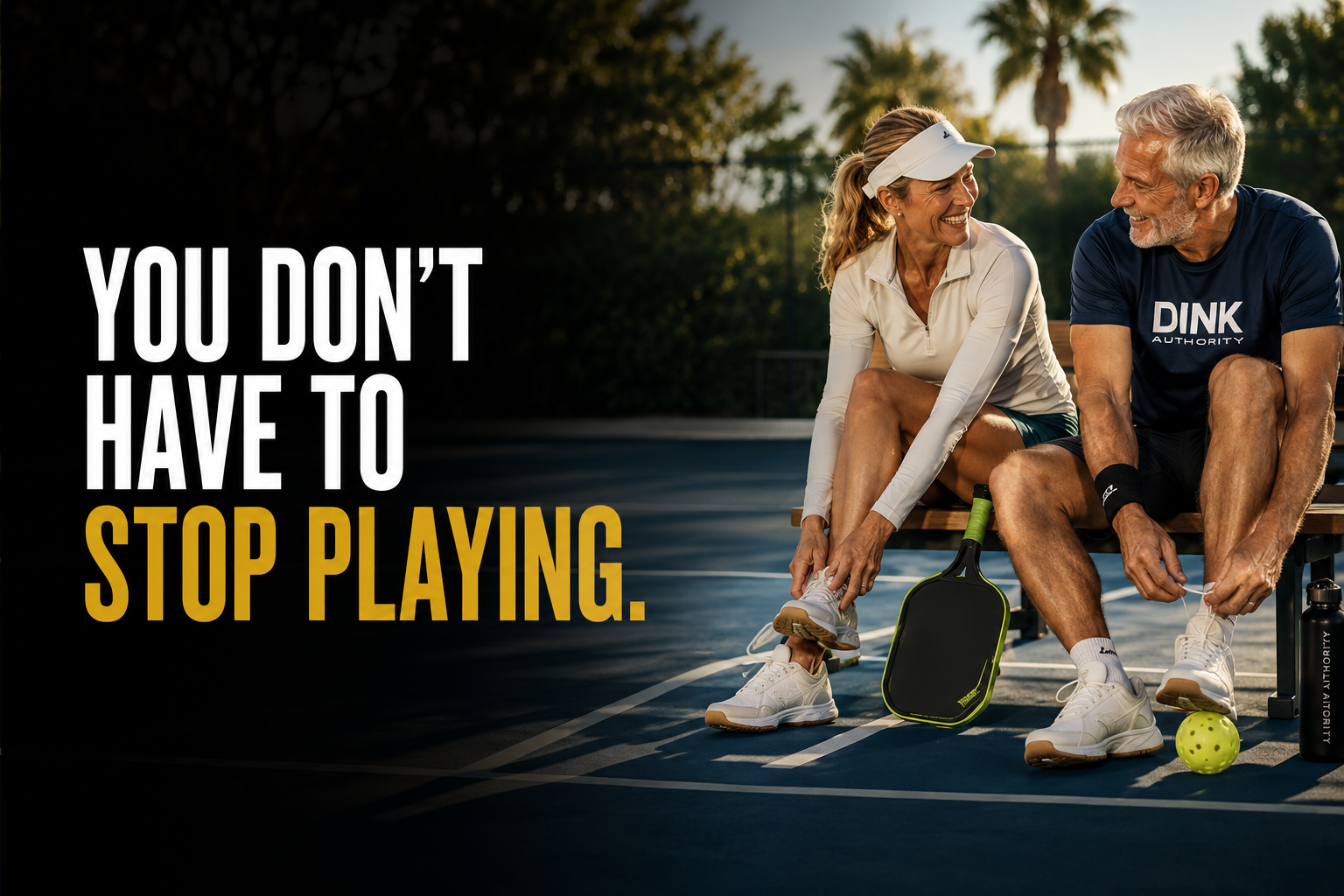
You don't have to stop playing. You have to start preparing.
Pickleball is one of the best sports you can play after 50. It is social, competitive and genuinely good for your body — when your body is ready for it. The problem is that most senior players step onto the court without preparing their bodies for what pickleball actually demands.
The result is a predictable set of injuries that show up again and again in the 50-plus population. Three of them account for the vast majority of time spent off the court.
Here is what they are, why they happen — and exactly how to prevent them.
Injury #1: Pickleball Elbow (Lateral Epicondylitis)
What it is:
The repetitive motion of dinking, driving and volleying places sustained stress on the tendons of the forearm. When those tendons are not properly conditioned or warmed up, inflammation builds and lateral epicondylitis develops — the condition most players know as pickleball elbow or tennis elbow.
Why senior players are more vulnerable:
Tendon elasticity decreases with age. The same repetitive motion that a 30-year-old body absorbs easily can accumulate into injury in a body that has less tissue resilience and slower recovery capacity.
Warning signs:
Pain on the outside of the elbow during or after play
Weakness when gripping the paddle
Discomfort that worsens with continued play and improves with rest
Morning stiffness in the forearm
How to prevent it:
Before every session, spend two minutes on wrist flexor and extensor stretches. Extend your arm forward, palm up, and gently pull your fingers back toward your body — hold 30 seconds. Repeat with palm down. This simple routine keeps the tendons of the forearm supple and ready for the demands of play.
Check your grip size. A grip that is too small forces the forearm muscles to work harder than necessary to control the paddle — one of the leading causes of pickleball elbow in recreational players.
Strengthen the forearm with light resistance exercises three times per week — wrist curls, reverse wrist curls and forearm pronation/supination. Five minutes, three times a week is enough to make a meaningful difference.
The rule: if you feel pain on the outside of your elbow during play, stop. Playing through early-stage pickleball elbow turns a two-week problem into a two-month one.
LOVE PICKLEBALL?
Get Dink Authority Magazine updates, new editions, pro stories and event alerts.
We respect your privacy. Unsubscribe anytime.
Injury #2: Rotator Cuff Strain
What it is:
The shoulder is the most complex joint used in pickleball — and one of the most vulnerable in players over 50. Overhead shots, serves and aggressive drives place significant demand on the four muscles of the rotator cuff, which naturally weaken with age if not actively maintained.
Why senior players are more vulnerable:
The rotator cuff muscles lose mass and strength progressively after 40 if not specifically trained. In players who have sedentary jobs or limited upper body activity outside of pickleball, the muscles may already be weakened before they step on the court — making them vulnerable to strain from the first session.
Warning signs:
Pain when lifting the arm above shoulder height
Weakness during overhead movements or serves
A deep aching sensation in the shoulder after play
Pain that disrupts sleep — particularly when lying on the affected shoulder
How to prevent it:
The single most effective prevention tool for the rotator cuff is the resistance band. External rotation exercises with a light resistance band — performed three times per week, 15 repetitions per set — directly strengthen the muscles most prone to strain in pickleball.
Before every session, warm up the shoulder with arm circles, cross-body stretches and slow windmill movements. Never start with hard drives or aggressive serves. Let the shoulder warm up through soft rallies before asking it to produce power.
Limit overhead volume in a single session. If you notice the shoulder beginning to fatigue, shift to a lower-trajectory game. Fatigue is when rotator cuff injuries happen — not at the beginning of a session.
The rule: shoulder pain that persists for more than a week after rest is not muscle soreness. See a professional before returning to play.
Injury #3: Knee Pain (Patellar Tendinitis)
What it is:
The quick lateral movements, split steps and sudden stops that define pickleball create repeated stress on the knee joint — particularly the patellar tendon that connects the kneecap to the shinbone. In players over 50, the cartilage and tendons around the knee are less resilient, making inflammation and wear more likely with repetitive loading.
Why senior players are more vulnerable:
Cartilage naturally thins with age. Players who carry additional body weight place proportionally greater stress on the knee with every lateral movement. Players who sit for extended periods during the day arrive on the court with stiff, underactivated quadriceps — making the knee joint absorb load that the muscles should be managing.
Warning signs:
Pain directly below the kneecap during or after play
Stiffness when getting up after sitting for extended periods
Swelling around the knee after a session
A sensation of the knee "giving way" during lateral movements
How to prevent it:
Strong quadriceps are the knee's best protection. A simple routine of bodyweight squats and step-downs — performed three times per week — significantly reduces patellar tendon load during play.
Before every session, activate the quadriceps and hamstrings with lateral side steps and mini squats. These movements wake up the muscles that protect the knee before the lateral demands of play begin.
Invest in proper court shoes. Pickleball shoes with lateral support keep the knee tracking correctly during side-to-side movements. Running shoes do not provide this support — and playing in them is one of the most common contributors to knee problems in recreational pickleball.
The rule: never play through sharp knee pain. Dull fatigue is acceptable. Sharp, localized pain during movement is not.
The 5-Minute Rule That Prevents Most Senior Injuries
The single most effective injury prevention habit for players over 50 is also the simplest: arrive five minutes early and move before you play.
Not static stretching. Movement. Arm circles, lateral steps, mini squats, wrist rotations. Five minutes of gentle, dynamic movement raises your core temperature, activates your muscles and tells your body that athletic demands are coming.
Most senior pickleball injuries happen in the first 20 minutes of play — when the body is cold and asked to perform movements it is not yet ready for. Five minutes of preparation before play costs almost nothing. The injuries it prevents can cost you months.
One Final Thought
The players who stay on the court longest are not always the most talented. They are the most consistent — and consistency requires a body that holds up over time.
Prepare before you play. Recover after. Rest when your body asks for it.
That is not a limitation. That is how you play pickleball at 50, 60 and beyond.
See you on the courts.
— Dink Authority Editorial Team
You don't have to stop playing. You have to start preparing.
Pickleball is one of the best sports you can play after 50. It is social, competitive and genuinely good for your body — when your body is ready for it. The problem is that most senior players step onto the court without preparing their bodies for what pickleball actually demands.
The result is a predictable set of injuries that show up again and again in the 50-plus population. Three of them account for the vast majority of time spent off the court.
Here is what they are, why they happen — and exactly how to prevent them.
Injury #1: Pickleball Elbow (Lateral Epicondylitis)
What it is:
The repetitive motion of dinking, driving and volleying places sustained stress on the tendons of the forearm. When those tendons are not properly conditioned or warmed up, inflammation builds and lateral epicondylitis develops — the condition most players know as pickleball elbow or tennis elbow.
Why senior players are more vulnerable:
Tendon elasticity decreases with age. The same repetitive motion that a 30-year-old body absorbs easily can accumulate into injury in a body that has less tissue resilience and slower recovery capacity.
Warning signs:
Current Issue

Domenika Turkovic: Fighting Her Own Demons
Read Now →
Pain on the outside of the elbow during or after play
Weakness when gripping the paddle
Discomfort that worsens with continued play and improves with rest
Morning stiffness in the forearm
How to prevent it:
Before every session, spend two minutes on wrist flexor and extensor stretches. Extend your arm forward, palm up, and gently pull your fingers back toward your body — hold 30 seconds. Repeat with palm down. This simple routine keeps the tendons of the forearm supple and ready for the demands of play.
Check your grip size. A grip that is too small forces the forearm muscles to work harder than necessary to control the paddle — one of the leading causes of pickleball elbow in recreational players.
Strengthen the forearm with light resistance exercises three times per week — wrist curls, reverse wrist curls and forearm pronation/supination. Five minutes, three times a week is enough to make a meaningful difference.
The rule: if you feel pain on the outside of your elbow during play, stop. Playing through early-stage pickleball elbow turns a two-week problem into a two-month one.
LOVE PICKLEBALL?
Get Dink Authority Magazine updates, new editions, pro stories and event alerts.
We respect your privacy. Unsubscribe anytime.
Injury #2: Rotator Cuff Strain
What it is:
The shoulder is the most complex joint used in pickleball — and one of the most vulnerable in players over 50. Overhead shots, serves and aggressive drives place significant demand on the four muscles of the rotator cuff, which naturally weaken with age if not actively maintained.
Why senior players are more vulnerable:
The rotator cuff muscles lose mass and strength progressively after 40 if not specifically trained. In players who have sedentary jobs or limited upper body activity outside of pickleball, the muscles may already be weakened before they step on the court — making them vulnerable to strain from the first session.
Warning signs:

Pain when lifting the arm above shoulder height
Weakness during overhead movements or serves
A deep aching sensation in the shoulder after play
Pain that disrupts sleep — particularly when lying on the affected shoulder
How to prevent it:
The single most effective prevention tool for the rotator cuff is the resistance band. External rotation exercises with a light resistance band — performed three times per week, 15 repetitions per set — directly strengthen the muscles most prone to strain in pickleball.
Before every session, warm up the shoulder with arm circles, cross-body stretches and slow windmill movements. Never start with hard drives or aggressive serves. Let the shoulder warm up through soft rallies before asking it to produce power.
Limit overhead volume in a single session. If you notice the shoulder beginning to fatigue, shift to a lower-trajectory game. Fatigue is when rotator cuff injuries happen — not at the beginning of a session.
The rule: shoulder pain that persists for more than a week after rest is not muscle soreness. See a professional before returning to play.
Injury #3: Knee Pain (Patellar Tendinitis)
What it is:
The quick lateral movements, split steps and sudden stops that define pickleball create repeated stress on the knee joint — particularly the patellar tendon that connects the kneecap to the shinbone. In players over 50, the cartilage and tendons around the knee are less resilient, making inflammation and wear more likely with repetitive loading.
Why senior players are more vulnerable:

Cartilage naturally thins with age. Players who carry additional body weight place proportionally greater stress on the knee with every lateral movement. Players who sit for extended periods during the day arrive on the court with stiff, underactivated quadriceps — making the knee joint absorb load that the muscles should be managing.
Warning signs:
Pain directly below the kneecap during or after play
Stiffness when getting up after sitting for extended periods
Swelling around the knee after a session
A sensation of the knee "giving way" during lateral movements
How to prevent it:
Strong quadriceps are the knee's best protection. A simple routine of bodyweight squats and step-downs — performed three times per week — significantly reduces patellar tendon load during play.
Before every session, activate the quadriceps and hamstrings with lateral side steps and mini squats. These movements wake up the muscles that protect the knee before the lateral demands of play begin.
Invest in proper court shoes. Pickleball shoes with lateral support keep the knee tracking correctly during side-to-side movements. Running shoes do not provide this support — and playing in them is one of the most common contributors to knee problems in recreational pickleball.
The rule: never play through sharp knee pain. Dull fatigue is acceptable. Sharp, localized pain during movement is not.
The 5-Minute Rule That Prevents Most Senior Injuries
The single most effective injury prevention habit for players over 50 is also the simplest: arrive five minutes early and move before you play.
Not static stretching. Movement. Arm circles, lateral steps, mini squats, wrist rotations. Five minutes of gentle, dynamic movement raises your core temperature, activates your muscles and tells your body that athletic demands are coming.
Most senior pickleball injuries happen in the first 20 minutes of play — when the body is cold and asked to perform movements it is not yet ready for. Five minutes of preparation before play costs almost nothing. The injuries it prevents can cost you months.
One Final Thought
The players who stay on the court longest are not always the most talented. They are the most consistent — and consistency requires a body that holds up over time.
Prepare before you play. Recover after. Rest when your body asks for it.
That is not a limitation. That is how you play pickleball at 50, 60 and beyond.
See you on the courts.
— Dink Authority Editorial Team