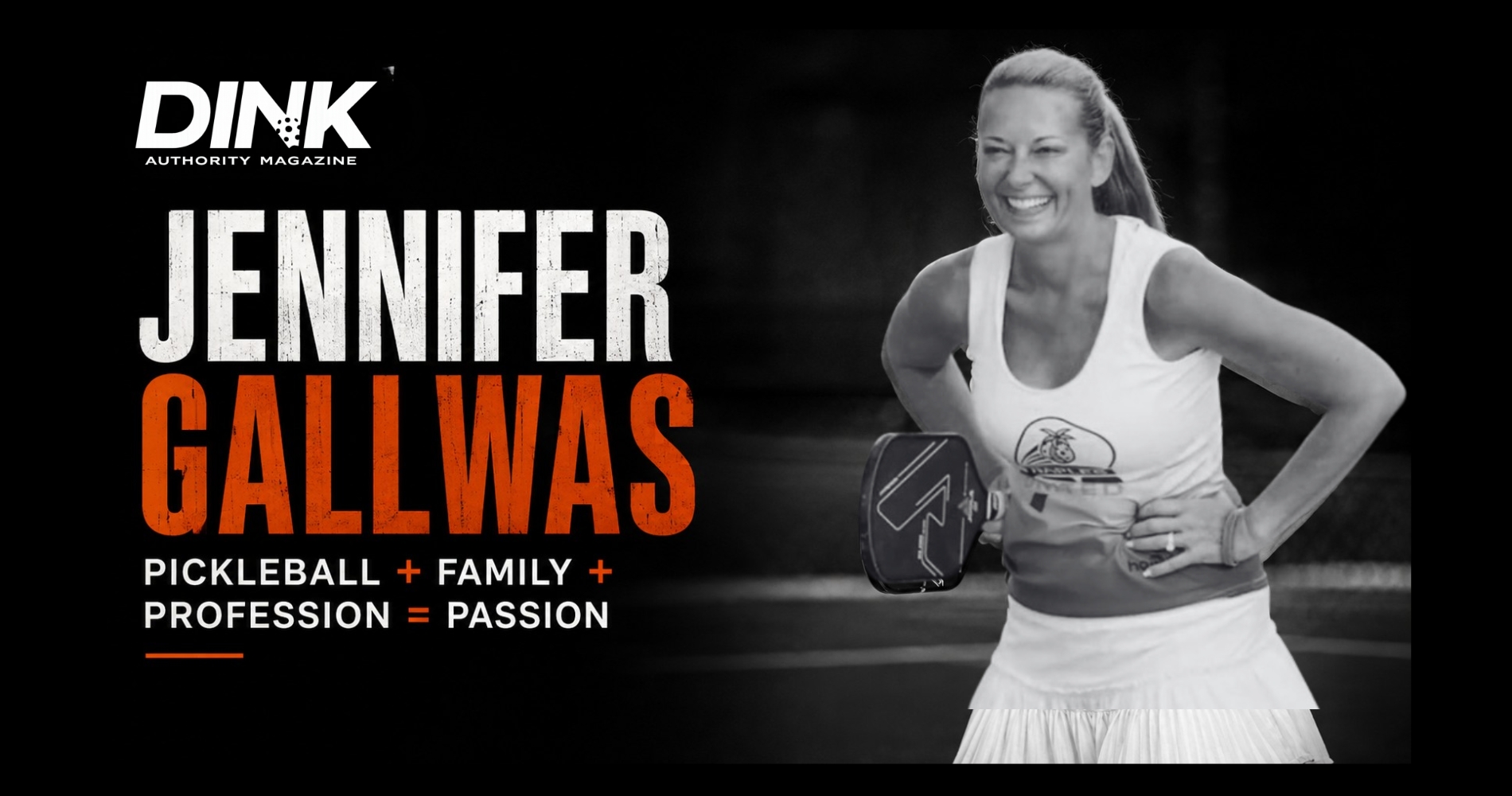
Jennifer Gallwas: Pickleball + Family + Profession = Passion
There are second-chance stories, and then there's Jennifer Gallwas' — where the second chance arrived disguised as a sport that didn't even exist when she was competing in college tennis.
A physical therapist by profession (with a Master's degree, not a doctorate — as she clarifies with a laugh: "there were no doctorates when I went to school, in 1996"), Gallwas feels deeply fortunate to be competing again right in this empty-nest phase of her life, with all three of her children now in their twenties — two graduated from college and working, the youngest a junior — and the house, for the first time in decades, quiet.
But far from sounding like loss, gratitude is what comes through in her voice. Beyond her love for the game, she says she's deeply grateful for the friendships and connections she's built through competing, traveling, and teaching. She's constantly inspired by her fellow players — many of them cancer survivors, others managing chronic illnesses or enduring their own personal difficulties. Getting to compete again, she says, feels like returning to college tennis. Playing and making new friends is, in her words, a true gift. Below, in her own words, Gallwas talks about the new generation, the impossible balance between her roles, and what she hopes her kids take away from watching her compete.
Today we're seeing players under 21 competing in professional team leagues. How do you see the current level of youth competitive pickleball — does it surprise you, worry you, or both?
"I think it's exciting more than anything. The athleticism of some of these young players is incredible, and they're pushing the sport forward in ways that didn't exist even a few years ago. The only thing I'd caution is making sure they're developing as complete athletes. Whether that's playing multiple sports, strength training appropriately, or taking care of their bodies, I think longevity is just as important as early success."
On the other end of the spectrum, pickleball has also become the favorite sport of the 50+ crowd. What advice would you give someone that age who's just starting out and wants to take it seriously without getting hurt in the process?
"As a physical therapist, my biggest advice is don't let your enthusiasm outpace your preparation. Everyone falls in love with the game and suddenly they're playing for hours a day, six days a week. Build up gradually, work on mobility and strength, and don't ignore little aches before they become bigger problems. The goal isn't just to play next month — it's to still be playing ten years from now. I like to use my love of competing in pickleball at a high level as motivation to get stronger and fitter."
You're a mother, wife, physical therapist, and professional athlete, all at the same time. Which of those four roles have you had to put on pause the most because of the other three, and how do you handle it when that happens?
"I am a very involved mother of three, but two of my children have graduated college, with one left in college. That leaves more time for pickleball-related activities and the demanding travel schedule. I wouldn't say any one role gets put on pause completely, but they definitely take turns demanding more of me. There are weeks where pickleball requires more travel, and weeks where my family or my patients need more of my attention. I've learned to stop chasing perfect balance every day. It's more about trying to be fully present wherever I am."
LOVE PICKLEBALL?
Get Dink Authority Magazine updates, new editions, pro stories and event alerts.
We respect your privacy. Unsubscribe anytime.
You've watched pickleball's explosion as a professional team sport up close. Comparing the energy of a league like MLP to what you had in college tennis or in your marathons, what feels different?
"MLP Champions is actually the closest thing I've experienced to college tennis. Tennis is still an individual sport — you win or lose your own match — but you're also pulling for your teammates every step of the way because the team's success depends on everyone. MLP has that same feeling. You're battling for your own court, but you're just as invested in every match your teammates play.
That's very different from marathon running, where so much of the experience is internal. In MLP, the energy is contagious. You're cheering, strategizing, celebrating big points, and picking each other up after tough ones. It's one of the reasons I think team pickleball has resonated so quickly with both players and fans. It brings together the intensity of individual competition with the camaraderie of being part of something bigger than yourself."
Is there a player — of any age, amateur or professional — who's surprised you recently, either with how they play or their attitude on court?
"One player who's really impressed me is Noe Khlif. I had the chance to play with him when he was in Chicago, and what stood out wasn't just his talent. It was how quietly competitive he is. He doesn't need to be the loudest person on the court. He just goes about his business, competes incredibly hard, and lets his game speak for itself. I really admire that. As our sport continues to grow, I hope we keep celebrating players who combine a high level of play with humility and respect."
Your kids watch you compete at a professional level. What do you think they're learning from watching you do this, beyond the sport itself?
"I hope they're learning that it's never too late to chase something you're passionate about. We should never stop playing and having fun. Pickleball has given adults a place to play again and make new friends. I also hope they see that hard work, setbacks, and perseverance are all part of the process. You don't have to be perfect — you just keep showing up."
If you had to choose between winning one more title or seeing the overall level of women's pickleball grow over the next five years, which would you choose, and why?
"I'd definitely choose seeing women's pickleball continue to grow. Growing the women's game means more opportunities, better competition, and more young girls seeing a future in this sport. That's something that lasts beyond any one tournament."
What do you think competitive pickleball will look like in ten years — in terms of skill level, the age of players, or even how it's broadcast and followed?
"I think we'll see even more specialized athletes coming into the sport at younger ages, while at the same time continuing to have incredible opportunities for older competitors. The younger generation didn't come from tennis or other racquet sports; they've grown up primarily playing pickleball. I also think the broadcasts will become much more sophisticated, helping viewers understand the strategy instead of just watching the ball. The game has a lot more depth than people realize."
Off the court and outside the clinic, what does Jennifer Gallwas do to fully disconnect from pickleball, even just for a bit?
"I'm happiest when I'm just spending time with my family. It doesn't have to be anything elaborate. I love when they're all back home and we play with the dog in the backyard or do something active together. Those moments help recharge me more than anything else."
If a younger version of you — the college tennis player, the marathon runner — could see you today competing professionally in a sport that didn't even exist back then, what do you think she'd think?
"I think she'd probably laugh and say, 'That's awesome, I get to compete again? How did that happen?' I never could have imagined this path, but boy am I happy. I also think she'd recognize that it's still built on the same things — working hard, staying curious, and enjoying competition. The sport changed, but those values didn't."
There are second-chance stories, and then there's Jennifer Gallwas' — where the second chance arrived disguised as a sport that didn't even exist when she was competing in college tennis.
A physical therapist by profession (with a Master's degree, not a doctorate — as she clarifies with a laugh: "there were no doctorates when I went to school, in 1996"), Gallwas feels deeply fortunate to be competing again right in this empty-nest phase of her life, with all three of her children now in their twenties — two graduated from college and working, the youngest a junior — and the house, for the first time in decades, quiet.
But far from sounding like loss, gratitude is what comes through in her voice. Beyond her love for the game, she says she's deeply grateful for the friendships and connections she's built through competing, traveling, and teaching. She's constantly inspired by her fellow players — many of them cancer survivors, others managing chronic illnesses or enduring their own personal difficulties. Getting to compete again, she says, feels like returning to college tennis. Playing and making new friends is, in her words, a true gift. Below, in her own words, Gallwas talks about the new generation, the impossible balance between her roles, and what she hopes her kids take away from watching her compete.
Today we're seeing players under 21 competing in professional team leagues. How do you see the current level of youth competitive pickleball — does it surprise you, worry you, or both?
"I think it's exciting more than anything. The athleticism of some of these young players is incredible, and they're pushing the sport forward in ways that didn't exist even a few years ago. The only thing I'd caution is making sure they're developing as complete athletes. Whether that's playing multiple sports, strength training appropriately, or taking care of their bodies, I think longevity is just as important as early success."
On the other end of the spectrum, pickleball has also become the favorite sport of the 50+ crowd. What advice would you give someone that age who's just starting out and wants to take it seriously without getting hurt in the process?
"As a physical therapist, my biggest advice is don't let your enthusiasm outpace your preparation. Everyone falls in love with the game and suddenly they're playing for hours a day, six days a week. Build up gradually, work on mobility and strength, and don't ignore little aches before they become bigger problems. The goal isn't just to play next month — it's to still be playing ten years from now. I like to use my love of competing in pickleball at a high level as motivation to get stronger and fitter."

You're a mother, wife, physical therapist, and professional athlete, all at the same time. Which of those four roles have you had to put on pause the most because of the other three, and how do you handle it when that happens?
"I am a very involved mother of three, but two of my children have graduated college, with one left in college. That leaves more time for pickleball-related activities and the demanding travel schedule. I wouldn't say any one role gets put on pause completely, but they definitely take turns demanding more of me. There are weeks where pickleball requires more travel, and weeks where my family or my patients need more of my attention. I've learned to stop chasing perfect balance every day. It's more about trying to be fully present wherever I am."
LOVE PICKLEBALL?
Get Dink Authority Magazine updates, new editions, pro stories and event alerts.
We respect your privacy. Unsubscribe anytime.
You've watched pickleball's explosion as a professional team sport up close. Comparing the energy of a league like MLP to what you had in college tennis or in your marathons, what feels different?
"MLP Champions is actually the closest thing I've experienced to college tennis. Tennis is still an individual sport — you win or lose your own match — but you're also pulling for your teammates every step of the way because the team's success depends on everyone. MLP has that same feeling. You're battling for your own court, but you're just as invested in every match your teammates play.
That's very different from marathon running, where so much of the experience is internal. In MLP, the energy is contagious. You're cheering, strategizing, celebrating big points, and picking each other up after tough ones. It's one of the reasons I think team pickleball has resonated so quickly with both players and fans. It brings together the intensity of individual competition with the camaraderie of being part of something bigger than yourself."
Is there a player — of any age, amateur or professional — who's surprised you recently, either with how they play or their attitude on court?

"One player who's really impressed me is Noe Khlif. I had the chance to play with him when he was in Chicago, and what stood out wasn't just his talent. It was how quietly competitive he is. He doesn't need to be the loudest person on the court. He just goes about his business, competes incredibly hard, and lets his game speak for itself. I really admire that. As our sport continues to grow, I hope we keep celebrating players who combine a high level of play with humility and respect."
Your kids watch you compete at a professional level. What do you think they're learning from watching you do this, beyond the sport itself?
"I hope they're learning that it's never too late to chase something you're passionate about. We should never stop playing and having fun. Pickleball has given adults a place to play again and make new friends. I also hope they see that hard work, setbacks, and perseverance are all part of the process. You don't have to be perfect — you just keep showing up."
If you had to choose between winning one more title or seeing the overall level of women's pickleball grow over the next five years, which would you choose, and why?
"I'd definitely choose seeing women's pickleball continue to grow. Growing the women's game means more opportunities, better competition, and more young girls seeing a future in this sport. That's something that lasts beyond any one tournament."

What do you think competitive pickleball will look like in ten years — in terms of skill level, the age of players, or even how it's broadcast and followed?
"I think we'll see even more specialized athletes coming into the sport at younger ages, while at the same time continuing to have incredible opportunities for older competitors. The younger generation didn't come from tennis or other racquet sports; they've grown up primarily playing pickleball. I also think the broadcasts will become much more sophisticated, helping viewers understand the strategy instead of just watching the ball. The game has a lot more depth than people realize."
Off the court and outside the clinic, what does Jennifer Gallwas do to fully disconnect from pickleball, even just for a bit?
"I'm happiest when I'm just spending time with my family. It doesn't have to be anything elaborate. I love when they're all back home and we play with the dog in the backyard or do something active together. Those moments help recharge me more than anything else."
If a younger version of you — the college tennis player, the marathon runner — could see you today competing professionally in a sport that didn't even exist back then, what do you think she'd think?
"I think she'd probably laugh and say, 'That's awesome, I get to compete again? How did that happen?' I never could have imagined this path, but boy am I happy. I also think she'd recognize that it's still built on the same things — working hard, staying curious, and enjoying competition. The sport changed, but those values didn't."