
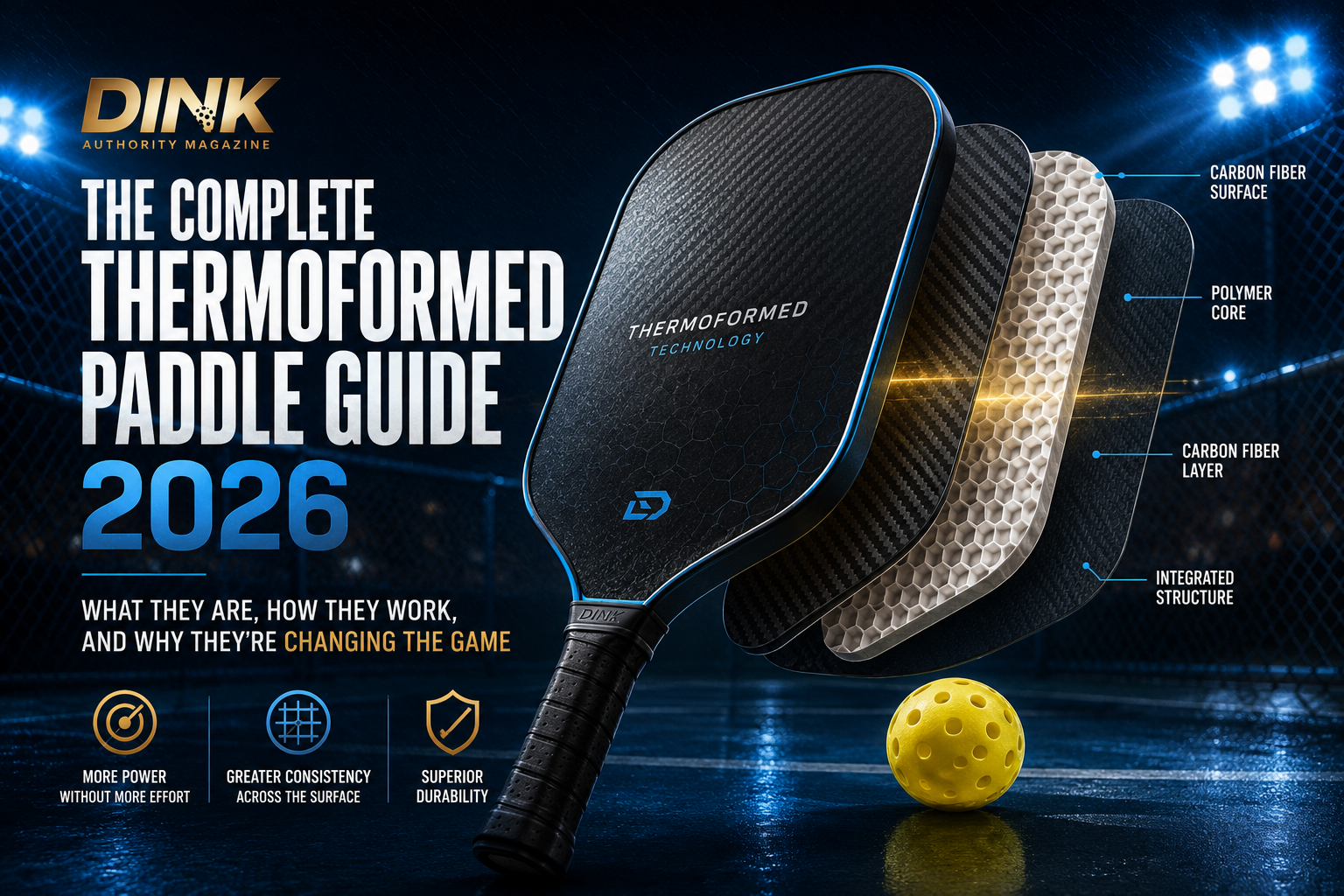
THE COMPLETE THERMOFORMED PADDLE GUIDE 2026: WHAT THEY ARE, HOW THEY WORK, AND WHY THEY'RE CHANGING THE GAME
If you've been following the pickleball world over the last two years, you've probably heard the word thermoformed more than once. At tournaments, on social media, in conversations between players. But what does it actually mean? Why is everyone talking about these paddles? And do they really make a difference on the court?
This guide answers all of those questions.
WHAT IS A THERMOFORMED PADDLE
A thermoformed paddle is one whose manufacturing process uses heat and pressure to completely fuse all of the paddle's materials into a single solid, uniform piece.
Unlike traditional paddles, which are built by gluing separate layers of materials together — a process that can create inconsistencies and weak points throughout the structure — thermoformed paddles are manufactured in a mold that applies temperature and pressure simultaneously to all components at once.
The result is a paddle that is denser, more solid, and more consistent across its entire hitting surface. No weak seams. No variation between one paddle and the next. No dead spots.
HOW THE PROCESS WORKS
The thermoforming process works like this:
First, the materials — typically layers of carbon fiber and a polymer core — are placed inside a mold shaped exactly like the finished paddle.
Then, the mold is subjected to high temperature and high pressure simultaneously for a set period of time.
This process fuses and solidifies all the materials together into a completely integrated structure — as if the paddle had been carved from a single solid piece rather than assembled from separate parts.
The final product is a paddle with greater structural consistency, greater power transmission, and greater durability than paddles built using traditional manufacturing methods.
WHY THERMOFORMED PADDLES ARE DIFFERENT
The most important difference between a thermoformed paddle and a conventional paddle is felt exactly where it matters most: at the point of contact with the ball.
Because the structure is completely uniform, the energy you generate with each swing transfers to the ball more efficiently. Less energy is lost in the paddle. More energy reaches the ball.
This translates into three concrete advantages that players notice quickly:
MORE POWER WITHOUT MORE EFFORT
LOVE PICKLEBALL?
Get Dink Authority Magazine updates, new editions, pro stories and event alerts.
We respect your privacy. Unsubscribe anytime.
More efficient energy transfer means you can generate more ball speed with the same swing. For players looking for more depth on their drives or more aggression on their attacks, this is a real and perceptible change.
GREATER CONSISTENCY ACROSS THE ENTIRE SURFACE
Thermoformed paddles tend to have a larger and more uniform sweet spot. This means that even slightly off-center contacts feel solid and controlled — rather than producing vibration or loss of direction.
SUPERIOR DURABILITY
Without glued layers that can separate over time, thermoformed paddles maintain their playing characteristics longer. The integrated structure handles repeated impacts and changes in temperature and humidity significantly better than conventionally built paddles.
DO THEY HAVE ANY DISADVANTAGES?
Like any technology, thermoformed paddles are not perfect for every player.
The main point of debate is control in the soft game. Some players — especially those whose game is heavily oriented around dinking and patient kitchen play — find that thermoformed paddles generate too much power for delicate soft shots.
The same density and energy transfer efficiency that are advantages in aggressive play can become a challenge when you need a gentle touch with minimal pace.
For that reason, these paddles tend to be more popular among players with aggressive, attack-oriented playing styles, while some control players prefer to stick with conventionally built paddles.
Price is another factor to consider. Thermoformed paddles generally have a higher production cost, which is reflected in their retail price. In 2026, most quality thermoformed options fall in the $150 to $250 range.
THE BRANDS LEADING THERMOFORMING IN 2026
The thermoformed paddle market has grown significantly over the last two years. These are the brands leading the category:
JOOLA was one of the first brands to massively popularize thermoformed technology with its Perseus line and later with its Propulsion Core technology — which became the center of a major legal dispute with other manufacturers, precisely because of its effectiveness and innovation in this space.
SELKIRK has integrated thermoforming processes into several of its premium paddles, combining the technology with its surface design expertise to balance power and control in ways that appeal to a wide range of players.
PADDLETEK has a significant presence in the thermoformed segment, particularly among competitive players on the APP circuit who prioritize consistency and power at the professional level.
FRANKLIN and other emerging brands are also developing thermoformed versions at more accessible price points, bringing the technology to players of all levels and budgets.
IS A THERMOFORMED PADDLE RIGHT FOR YOU?
The answer depends on your playing style and your competitive level.
If you are a 3.5-level player or above with a tendency toward aggressive play — deep drives, transition attacks, and pace-heavy rallies — a thermoformed paddle will likely give you a noticeable advantage in power and consistency.
If you are a player more oriented toward control, patience, and soft kitchen play, you may prefer a conventional paddle that gives you more feel on touch shots.
And if you are somewhere in between — which is where most players are — the recommendation is simple: try before you buy. Many specialty stores and pickleball clubs offer demo sessions. Take advantage of them before making a decision.
THE VERDICT
Thermoformed paddles are not a passing trend. They represent a real evolution in manufacturing technology that is changing how competitive pickleball is played in 2026.
The evidence is on the professional circuit, where the adoption of thermoformed paddles has grown significantly over the last two years. It is in the legal disputes that have emerged around the technology — nobody fights over something that doesn't work. And it is on the courts, where players at every level are reporting real differences in their game.
If you haven't tried a thermoformed paddle yet, 2026 is probably the right moment.
If you've been following the pickleball world over the last two years, you've probably heard the word thermoformed more than once. At tournaments, on social media, in conversations between players. But what does it actually mean? Why is everyone talking about these paddles? And do they really make a difference on the court?
This guide answers all of those questions.
WHAT IS A THERMOFORMED PADDLE
A thermoformed paddle is one whose manufacturing process uses heat and pressure to completely fuse all of the paddle's materials into a single solid, uniform piece.
Unlike traditional paddles, which are built by gluing separate layers of materials together — a process that can create inconsistencies and weak points throughout the structure — thermoformed paddles are manufactured in a mold that applies temperature and pressure simultaneously to all components at once.
The result is a paddle that is denser, more solid, and more consistent across its entire hitting surface. No weak seams. No variation between one paddle and the next. No dead spots.
HOW THE PROCESS WORKS
The thermoforming process works like this:
First, the materials — typically layers of carbon fiber and a polymer core — are placed inside a mold shaped exactly like the finished paddle.
Then, the mold is subjected to high temperature and high pressure simultaneously for a set period of time.
This process fuses and solidifies all the materials together into a completely integrated structure — as if the paddle had been carved from a single solid piece rather than assembled from separate parts.
The final product is a paddle with greater structural consistency, greater power transmission, and greater durability than paddles built using traditional manufacturing methods.
WHY THERMOFORMED PADDLES ARE DIFFERENT
The most important difference between a thermoformed paddle and a conventional paddle is felt exactly where it matters most: at the point of contact with the ball.
Because the structure is completely uniform, the energy you generate with each swing transfers to the ball more efficiently. Less energy is lost in the paddle. More energy reaches the ball.
This translates into three concrete advantages that players notice quickly:
MORE POWER WITHOUT MORE EFFORT
LOVE PICKLEBALL?
Get Dink Authority Magazine updates, new editions, pro stories and event alerts.
We respect your privacy. Unsubscribe anytime.

More efficient energy transfer means you can generate more ball speed with the same swing. For players looking for more depth on their drives or more aggression on their attacks, this is a real and perceptible change.
GREATER CONSISTENCY ACROSS THE ENTIRE SURFACE

Thermoformed paddles tend to have a larger and more uniform sweet spot. This means that even slightly off-center contacts feel solid and controlled — rather than producing vibration or loss of direction.
SUPERIOR DURABILITY

Without glued layers that can separate over time, thermoformed paddles maintain their playing characteristics longer. The integrated structure handles repeated impacts and changes in temperature and humidity significantly better than conventionally built paddles.
DO THEY HAVE ANY DISADVANTAGES?
Like any technology, thermoformed paddles are not perfect for every player.
The main point of debate is control in the soft game. Some players — especially those whose game is heavily oriented around dinking and patient kitchen play — find that thermoformed paddles generate too much power for delicate soft shots.
The same density and energy transfer efficiency that are advantages in aggressive play can become a challenge when you need a gentle touch with minimal pace.
For that reason, these paddles tend to be more popular among players with aggressive, attack-oriented playing styles, while some control players prefer to stick with conventionally built paddles.
Price is another factor to consider. Thermoformed paddles generally have a higher production cost, which is reflected in their retail price. In 2026, most quality thermoformed options fall in the $150 to $250 range.
THE BRANDS LEADING THERMOFORMING IN 2026
The thermoformed paddle market has grown significantly over the last two years. These are the brands leading the category:
JOOLA was one of the first brands to massively popularize thermoformed technology with its Perseus line and later with its Propulsion Core technology — which became the center of a major legal dispute with other manufacturers, precisely because of its effectiveness and innovation in this space.
SELKIRK has integrated thermoforming processes into several of its premium paddles, combining the technology with its surface design expertise to balance power and control in ways that appeal to a wide range of players.
PADDLETEK has a significant presence in the thermoformed segment, particularly among competitive players on the APP circuit who prioritize consistency and power at the professional level.
FRANKLIN and other emerging brands are also developing thermoformed versions at more accessible price points, bringing the technology to players of all levels and budgets.
IS A THERMOFORMED PADDLE RIGHT FOR YOU?
The answer depends on your playing style and your competitive level.
If you are a 3.5-level player or above with a tendency toward aggressive play — deep drives, transition attacks, and pace-heavy rallies — a thermoformed paddle will likely give you a noticeable advantage in power and consistency.
If you are a player more oriented toward control, patience, and soft kitchen play, you may prefer a conventional paddle that gives you more feel on touch shots.
And if you are somewhere in between — which is where most players are — the recommendation is simple: try before you buy. Many specialty stores and pickleball clubs offer demo sessions. Take advantage of them before making a decision.
THE VERDICT
Thermoformed paddles are not a passing trend. They represent a real evolution in manufacturing technology that is changing how competitive pickleball is played in 2026.
The evidence is on the professional circuit, where the adoption of thermoformed paddles has grown significantly over the last two years. It is in the legal disputes that have emerged around the technology — nobody fights over something that doesn't work. And it is on the courts, where players at every level are reporting real differences in their game.
If you haven't tried a thermoformed paddle yet, 2026 is probably the right moment.