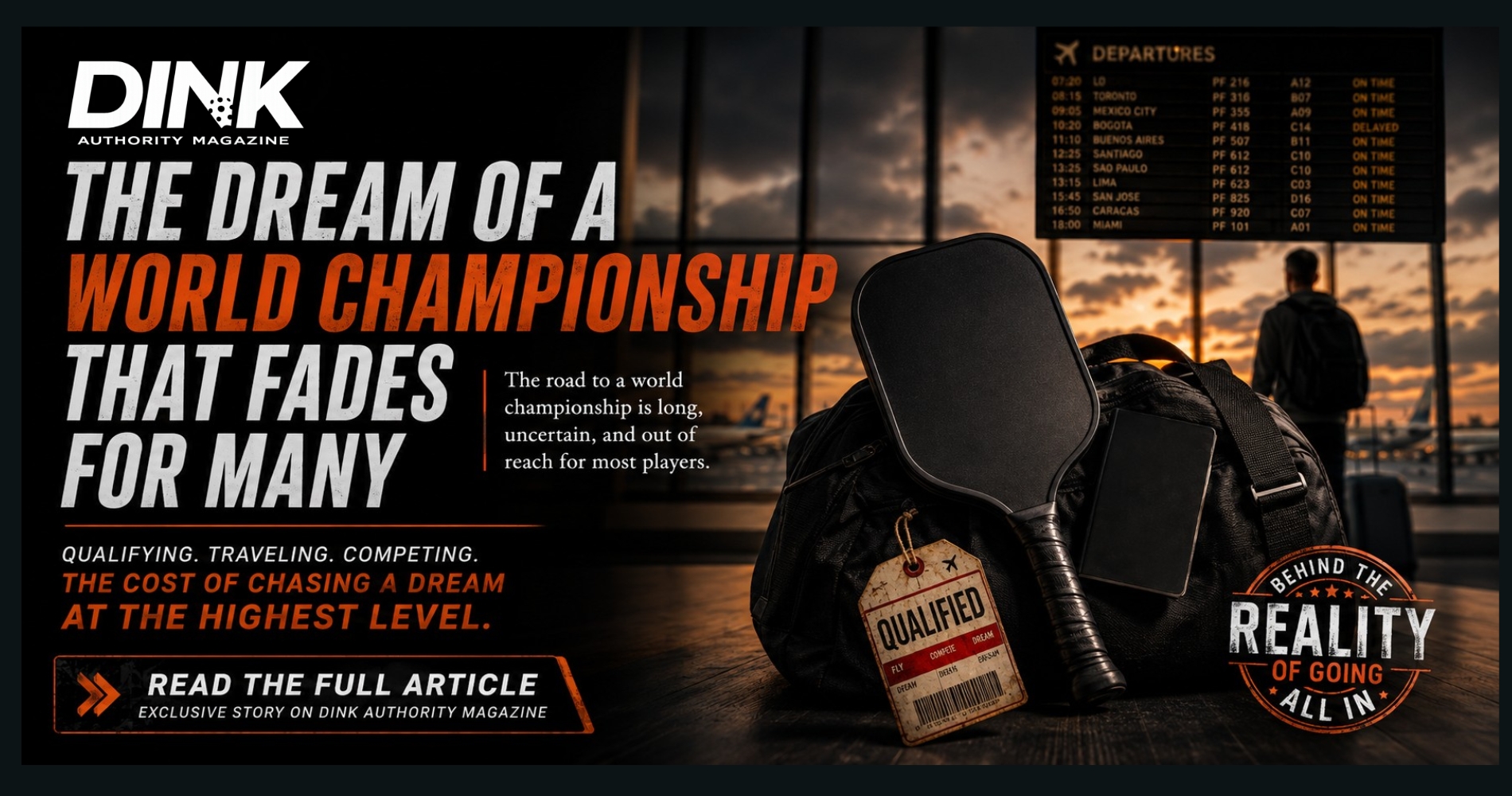
The Dream of a World Championship That Fades for Many
There's a question that's starting to circulate quietly in every corner where pickleball is growing, and one that almost no one dares to ask out loud: what are we really calling a "World Championship"?
In the coming weeks, thousands of players across dozens of countries will wrap up their local qualifiers, some celebrating the opportunity of a lifetime, still full of the excitement of representing their flag in an international tournament. The emotion is real. So is the effort. What deserves a closer look is everything that happens between that initial excitement and the moment someone actually has to board a plane.
For this article, Dink Authority Magazine spoke with association directors from multiple countries. Some requested anonymity because they continue working with the organizations involved. All of them echoed the same fact: they receive no financial support from tournament organizers. Everything that follows the invitation falls entirely on them.
Day One: The Invitation That Becomes a Burden
The pattern repeats with almost predictable consistency. Someone receives an email, a call, an invitation with an international letterhead and the word "World Championship" in bold. For the enthusiastic director of a small association — the kind of person who has given years of their life for free to grow this sport in their city — that invitation feels like enormous validation. It's the recognition they'd been waiting for, proof that the quiet work of running clinics, borrowing courts, and convincing neighbors to try a paddle finally means something on the international stage.
Then the real work begins, and it's almost entirely a solo effort.
Step one: spread the word. The director posts on social media, calls the strongest players in their community, organizes an informational meeting. The community gets excited fast — the word "World Championship" carries enormous symbolic weight in a sport still fighting to be taken seriously.
Step two: build the qualifier from scratch. They secure courts — often begging for favors, not paying fees — line up referees, set the format, print the brackets, and handle the logistics of a full tournament with zero assigned budget. People show up, play, compete. It all feels like a normal, well-run tournament, because that part is within the director's control.
Step three: the celebration, and the silence that follows. The winners are announced — the ones who "deserve" to go. There are hugs, flags, photos for social media. And right there, at the moment of peak excitement, is when the director has to start the most uncomfortable conversation of the entire process: explaining to their own athletes that winning the spot doesn't mean anyone else is going to pay to get them there.
What It Actually Costs to Represent Your Country
This is where the dream collides with arithmetic. Based on budgets circulating among the delegations themselves for seven nights of lodging — flight plus hotel, calculated at the most economical option available — the numbers vary sharply depending on the country of origin:
LOVE PICKLEBALL?
Get Dink Authority Magazine updates, new editions, pro stories and event alerts.
We respect your privacy. Unsubscribe anytime.
Spain: $1,150 – $1,520
Puerto Rico: $1,250 – $1,720
United States: $1,250 – $1,720
Mexico: $1,545 – $1,920
Venezuela: $1,745 – $2,220
Argentina: $1,945 – $2,920
And that's just flight and lodging. No player lives eight days in a foreign country on that alone.
The real day-by-day estimate is another story. Adding local transportation (taxis, rideshare apps, or public transit to get to the venues every day), basic meals across eight days, and without accounting for a single unexpected expense — not the extra sandwich after a long match, not the bottle of water bought because the hotel's ran out, not a tip, not a souvenir to bring home — the per-player calculation grows like this:
Category Estimate (8 days)
Local transportation $120 – $200
Basic meals $200 – $320
Incidentals and minor expenses $80 – $120
Additional subtotal $400 – $640
Adding this to the flight and lodging already calculated, the total estimated cost per player for eight days — not including tournament registration or tickets for family to attend — comes out to:
Country of Origin Total Estimated Cost (8 days)
Spain $1,550 – $2,160
Puerto Rico / USA $1,650 – $2,360
Mexico $1,945 – $2,560
Venezuela $2,145 – $2,860
Argentina $2,345 – $3,560
For the average amateur player in Latin America, these figures represent months — sometimes more than a year — of savings. And all of this before accounting for any tournament entry fee.
This is where the association director stops being a sports organizer and becomes, overnight, a fundraiser.
The Tournament Within the Tournament
What follows is, at best, admirable: selling t-shirts, raffles, empanadas, juice, improvised charity tournaments to raise funds, occasional sponsors chipping in whatever they can. The director themselves is often the one investing the most time into this — seeking out local businesses willing to put their logo on a shirt in exchange for a contribution, organizing bingo nights, knocking on doors they've already knocked on a thousand times for other club causes. Entire communities carrying the weight of representing a country on their shoulders, with no real institutional backing behind them — not from the tournament organizers, and often not even from their own national federations, which also lack the budget for this kind of event.
At worst, dropout becomes inevitable. Someone who fairly won their spot, on the court, simply can't raise two or three thousand dollars in two or three months. When that happens, the spot doesn't disappear — it goes to whoever can afford to pay for it, whether or not they have the level to deserve it. Association directors, who see this process up close, one player at a time, are the ones who confirm it most consistently.
The system rewards those who can pay. That's not a fact in itself — it's the conclusion these directors keep arriving at, independently of one another, based on what they've watched happen year after year.
When winning a qualifier doesn't guarantee you can afford to represent your country, qualification stops being the finish line and becomes the beginning of another competition.
What Actually Works in Other Models — and What Could Be Copied
You don't have to look far to find uncomfortable comparisons. The soccer World Cup that just wrapped up had, for many, serious organizational problems, and FIFA is far from a perfect example to follow in every respect. But there's one thing it has figured out, and it's worth copying: the money flows downward. There are real prizes. There's an economic engine — with all its imperfections — that sustains local federations, not just the central event.
That's exactly the kind of structure missing from much of the growing "World Championship" ecosystem in pickleball. Big partnerships get built, impressive participation numbers get announced, heavyweight sponsors get signed, ever-larger commercial partners keep joining — and all of that is genuinely good for the sport's growth. But while the business at the top keeps expanding, the base remains exactly where it's always been: an association director alone in front of a spreadsheet, trying to figure out how to get their players to play for their country.
A Business Is a Business
There is nothing inherently wrong with operating an international event as a business. The challenge arises when expectations among players and local associations differ from the financial realities of participation. Organizing an international event, seeking sponsorships, building a global brand around the word "World Championship" — that's a valid business strategy, and pickleball needs investment and vision to keep growing. The gap isn't in the business model itself. It's in the distance between what an invitation promises emotionally and what it actually requires financially — a distance that, right now, falls entirely on the smallest associations and the players with the fewest resources.
A world championship should first identify the best players on the court. If too many qualified athletes are forced to give up their place because they cannot afford the journey, then the sport is no longer testing only skill and preparation — it is also testing financial capacity. That is a conversation worth having, not to diminish the value of international competition, but to help it become more accessible and more representative in the future.
There's a question that's starting to circulate quietly in every corner where pickleball is growing, and one that almost no one dares to ask out loud: what are we really calling a "World Championship"?
In the coming weeks, thousands of players across dozens of countries will wrap up their local qualifiers, some celebrating the opportunity of a lifetime, still full of the excitement of representing their flag in an international tournament. The emotion is real. So is the effort. What deserves a closer look is everything that happens between that initial excitement and the moment someone actually has to board a plane.
For this article, Dink Authority Magazine spoke with association directors from multiple countries. Some requested anonymity because they continue working with the organizations involved. All of them echoed the same fact: they receive no financial support from tournament organizers. Everything that follows the invitation falls entirely on them.
Day One: The Invitation That Becomes a Burden
The pattern repeats with almost predictable consistency. Someone receives an email, a call, an invitation with an international letterhead and the word "World Championship" in bold. For the enthusiastic director of a small association — the kind of person who has given years of their life for free to grow this sport in their city — that invitation feels like enormous validation. It's the recognition they'd been waiting for, proof that the quiet work of running clinics, borrowing courts, and convincing neighbors to try a paddle finally means something on the international stage.
Then the real work begins, and it's almost entirely a solo effort.
Step one: spread the word. The director posts on social media, calls the strongest players in their community, organizes an informational meeting. The community gets excited fast — the word "World Championship" carries enormous symbolic weight in a sport still fighting to be taken seriously.

Step two: build the qualifier from scratch. They secure courts — often begging for favors, not paying fees — line up referees, set the format, print the brackets, and handle the logistics of a full tournament with zero assigned budget. People show up, play, compete. It all feels like a normal, well-run tournament, because that part is within the director's control.
Step three: the celebration, and the silence that follows. The winners are announced — the ones who "deserve" to go. There are hugs, flags, photos for social media. And right there, at the moment of peak excitement, is when the director has to start the most uncomfortable conversation of the entire process: explaining to their own athletes that winning the spot doesn't mean anyone else is going to pay to get them there.
What It Actually Costs to Represent Your Country
This is where the dream collides with arithmetic. Based on budgets circulating among the delegations themselves for seven nights of lodging — flight plus hotel, calculated at the most economical option available — the numbers vary sharply depending on the country of origin:
LOVE PICKLEBALL?
Get Dink Authority Magazine updates, new editions, pro stories and event alerts.
We respect your privacy. Unsubscribe anytime.
Spain: $1,150 – $1,520
Puerto Rico: $1,250 – $1,720
United States: $1,250 – $1,720
Mexico: $1,545 – $1,920
Venezuela: $1,745 – $2,220
Argentina: $1,945 – $2,920
And that's just flight and lodging. No player lives eight days in a foreign country on that alone.
The real day-by-day estimate is another story. Adding local transportation (taxis, rideshare apps, or public transit to get to the venues every day), basic meals across eight days, and without accounting for a single unexpected expense — not the extra sandwich after a long match, not the bottle of water bought because the hotel's ran out, not a tip, not a souvenir to bring home — the per-player calculation grows like this:
Category Estimate (8 days)
Local transportation $120 – $200
Basic meals $200 – $320
Incidentals and minor expenses $80 – $120
Additional subtotal $400 – $640

Adding this to the flight and lodging already calculated, the total estimated cost per player for eight days — not including tournament registration or tickets for family to attend — comes out to:
Country of Origin Total Estimated Cost (8 days)
Spain $1,550 – $2,160
Puerto Rico / USA $1,650 – $2,360
Mexico $1,945 – $2,560
Venezuela $2,145 – $2,860
Argentina $2,345 – $3,560
For the average amateur player in Latin America, these figures represent months — sometimes more than a year — of savings. And all of this before accounting for any tournament entry fee.
This is where the association director stops being a sports organizer and becomes, overnight, a fundraiser.
The Tournament Within the Tournament
What follows is, at best, admirable: selling t-shirts, raffles, empanadas, juice, improvised charity tournaments to raise funds, occasional sponsors chipping in whatever they can. The director themselves is often the one investing the most time into this — seeking out local businesses willing to put their logo on a shirt in exchange for a contribution, organizing bingo nights, knocking on doors they've already knocked on a thousand times for other club causes. Entire communities carrying the weight of representing a country on their shoulders, with no real institutional backing behind them — not from the tournament organizers, and often not even from their own national federations, which also lack the budget for this kind of event.
At worst, dropout becomes inevitable. Someone who fairly won their spot, on the court, simply can't raise two or three thousand dollars in two or three months. When that happens, the spot doesn't disappear — it goes to whoever can afford to pay for it, whether or not they have the level to deserve it. Association directors, who see this process up close, one player at a time, are the ones who confirm it most consistently.

The system rewards those who can pay. That's not a fact in itself — it's the conclusion these directors keep arriving at, independently of one another, based on what they've watched happen year after year.
When winning a qualifier doesn't guarantee you can afford to represent your country, qualification stops being the finish line and becomes the beginning of another competition.
What Actually Works in Other Models — and What Could Be Copied
You don't have to look far to find uncomfortable comparisons. The soccer World Cup that just wrapped up had, for many, serious organizational problems, and FIFA is far from a perfect example to follow in every respect. But there's one thing it has figured out, and it's worth copying: the money flows downward. There are real prizes. There's an economic engine — with all its imperfections — that sustains local federations, not just the central event.
That's exactly the kind of structure missing from much of the growing "World Championship" ecosystem in pickleball. Big partnerships get built, impressive participation numbers get announced, heavyweight sponsors get signed, ever-larger commercial partners keep joining — and all of that is genuinely good for the sport's growth. But while the business at the top keeps expanding, the base remains exactly where it's always been: an association director alone in front of a spreadsheet, trying to figure out how to get their players to play for their country.
A Business Is a Business
There is nothing inherently wrong with operating an international event as a business. The challenge arises when expectations among players and local associations differ from the financial realities of participation. Organizing an international event, seeking sponsorships, building a global brand around the word "World Championship" — that's a valid business strategy, and pickleball needs investment and vision to keep growing. The gap isn't in the business model itself. It's in the distance between what an invitation promises emotionally and what it actually requires financially — a distance that, right now, falls entirely on the smallest associations and the players with the fewest resources.
A world championship should first identify the best players on the court. If too many qualified athletes are forced to give up their place because they cannot afford the journey, then the sport is no longer testing only skill and preparation — it is also testing financial capacity. That is a conversation worth having, not to diminish the value of international competition, but to help it become more accessible and more representative in the future.