19.8 Million Players, an Average Age of 35, and an Industry Headed for $4.4 Billion
Pickleball isn't a retirees' game anymore — the numbers, the tours, the stars, and the neighborhood courts that tell the real story
There was a time, not so long ago, when saying "pickleball" was almost synonymous with saying "retirement community in Florida." An easy, comfortable image — and, as the numbers show, completely out of date.
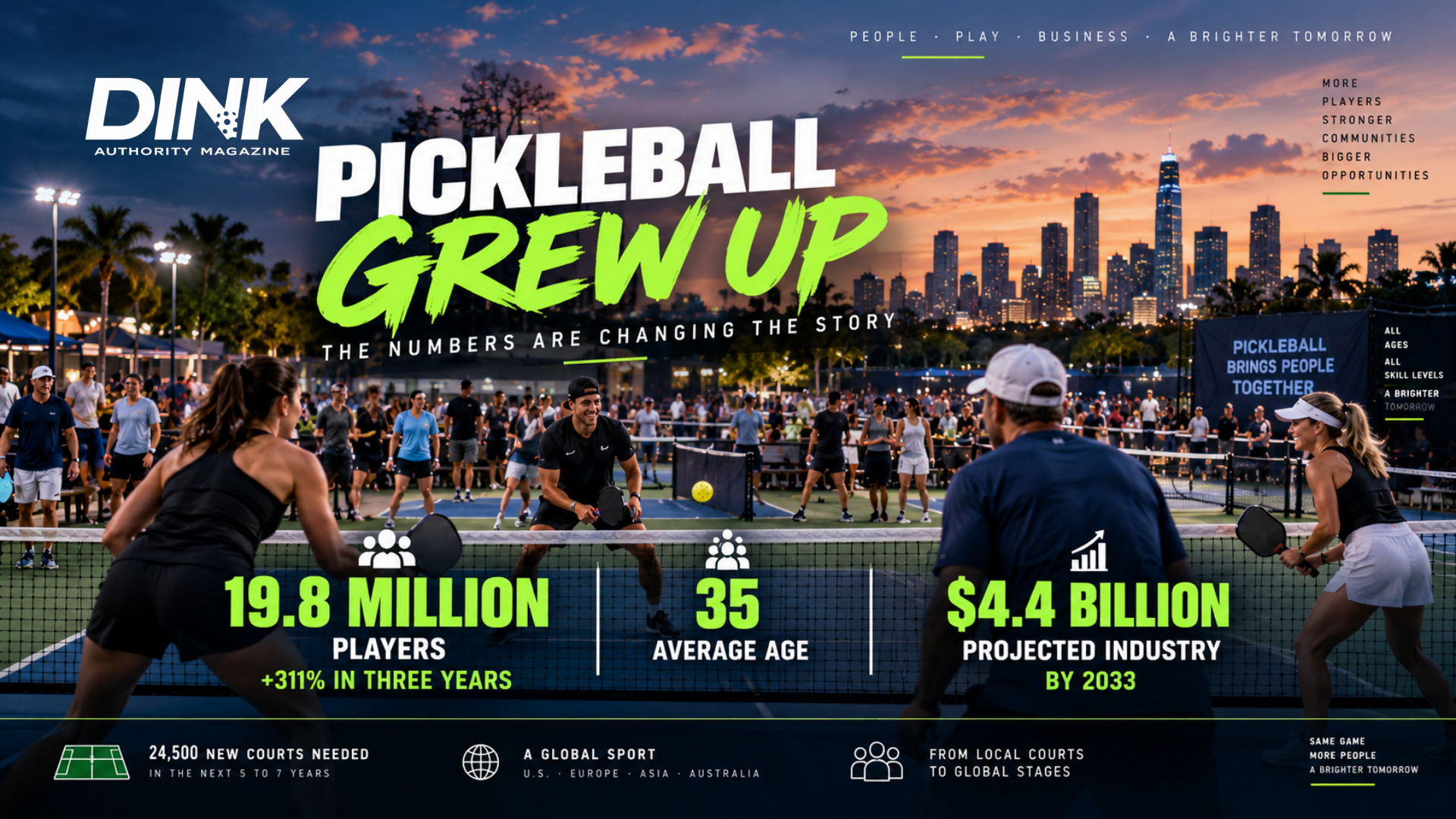
Today, in the United States, 19.8 million people play pickleball. To put that in perspective: that's 311% growth in just three years. That's not a curve going up — it's one that shot straight up, making pickleball the fastest-growing sport in the country for the third year running.
But the number that really changes the narrative isn't how many people play. It's who plays.
The court doesn't look the same anymore
The average pickleball player today is 35 years old. And the 25-to-34 age group — people in the thick of their careers, building their professional lives, often with young kids — is already the largest segment of all.
Read that again: the largest segment isn't the retirees who gave the sport its original reputation. It's young people looking for something social, competitive, and accessible, who found exactly that in pickleball. The image of a grandparent hitting a yellow ball around a gated community hasn't disappeared — it just stopped being the main story. Now that grandparent shares the court with millennials and Gen Z.
The stars making people pick up a paddle
And here's the piece that completes the puzzle: behind every one of those 19.8 million new players is a name that inspired them to try. Megan Fudge, Dominika Turkovic, Jack Munro, Livornese Jr., Dustyn Boyer, Noe Khlif, Anna Leigh Waters, Anna Bright, Gabe Tardio, Ben Johns, Danni-Elle Townsend, Federico Staksrud, Pablo Tellez, Kate Fahey — these are just a few of the names filling stands, generating viral clips, and turning an ordinary Sunday broadcast into a family event. Professional pickleball has stopped being a small group of pioneers competing in near-obscurity. It's become a real star system, with recognizable faces, rivalries fans follow week to week, and a level of play that surprises even those who've been watching for years.
LOVE PICKLEBALL?
Get Dink Authority Magazine updates, new editions, pro stories and event alerts.
We respect your privacy. Unsubscribe anytime.
And that level isn't confined to the United States. The APP Tour, PPA Tour, and MLP are no longer just national tournaments — they're becoming genuinely global circuits. Asia is already hosting championships at a level that surprises anyone seeing them for the first time. Europe and Australia are adding their own leagues and tour stops. Pickleball is doing, at breakneck speed, what took other sports decades: building a truly international competitive infrastructure.
How the next generation gets built
None of these stars appeared out of nowhere, and the leagues know it. That's why APP NEXT exists — the APP Tour's development circuit, designed specifically to give the sport's future names a clear path between playing at their local court and reaching a Championship Sunday broadcast on national TV. It's proof these organizations aren't just thinking about the sport's present — they're deliberately building who will fill those courts five or ten years from now.
The business behind the excitement
This is where pickleball gets truly interesting as a business phenomenon, not just as a sport. The APP Tour bet on total accessibility, streaming its events free on YouTube, building a massive audience with zero friction — no paywall, no excuse not to watch. It's a volume strategy: the more eyes on the level of play, the more people are inspired to try the sport themselves, and the bigger the base grows.
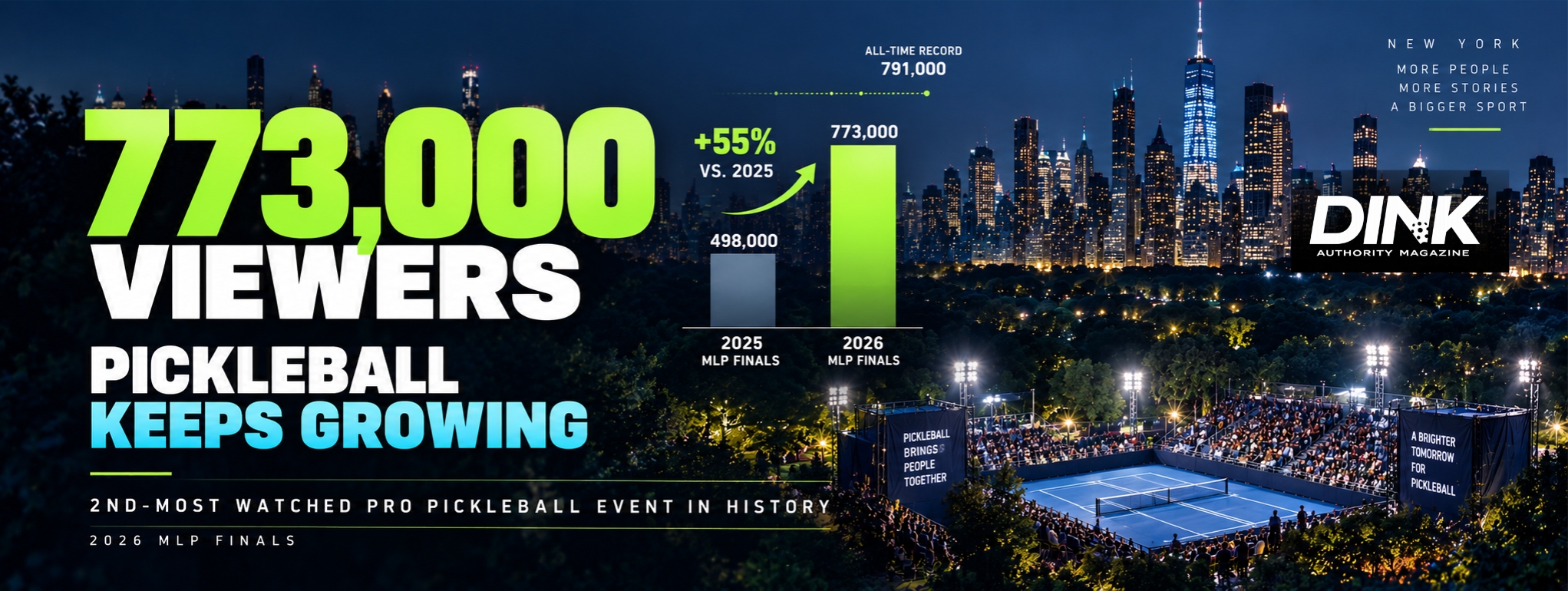
MLP and PPA, on the other hand, bet on a different but equally smart model: exclusive broadcasts on CBS for the biggest moments — the Finals, the Championship Sundays — paired with PickleballTV as their own channel for everything else. The logic is simple and effective: you generate mass excitement with a free broadcast on network television, and that excitement converts into subscriptions to the platform where fans can follow everything else the rest of the year. It's no coincidence the MLP Final on CBS drew 773,000 viewers — that Sunday isn't just a match, it's the most effective marketing funnel the industry has.
But the real heartbeat of the sport lives somewhere else
For all the record-breaking numbers, national broadcasts, and stars filling stadiums, pickleball's true engine doesn't live in Central Park or a CBS studio. It lives in the thousands of tournaments played every single weekend, in practically every city across the United States — from the neighborhood club to the municipal rec center — where every level shows up: the beginner who just learned how to dink, the intermediate player fighting to climb their rating, and the serious competitor dreaming of one day reaching the same pro circuits they watch on TV. That massive ecosystem of local tournaments is, at bottom, the reason all the other numbers exist in the first place.
The problem with growing this fast
All that growth brings a very concrete problem, one every player recognizes the moment they show up at their local court on a Saturday morning: there aren't enough courts.
Projections show the U.S. needs 24,500 new courts over the next 5 to 7 years — requiring an investment of nearly $900 million. That's the gap between a sport whose demand keeps exploding and an infrastructure that still hasn't caught up. It's also, for anyone reading it right, an opportunity: cities, real estate developers, private clubs, and even residential communities are starting to invest in dedicated facilities, because the market's message is clear — whoever builds courts today builds guaranteed demand tomorrow.
The number that puts it all in perspective
And behind all of this, the figure that ties the whole story together: the pickleball industry is projected to reach $4.4 billion by 2033.
That's not the projection of a passing fad. It's the projection of an industry that's stopped debating whether it will consolidate, and started debating how big it can actually get. Paddles, courts, apparel, technology, pro leagues, specialized media, international tournaments, youth development circuits — every piece of that ecosystem is growing at the same time, feeding off each other.
What this all means, in one sentence
Pickleball has stopped being a gated-community anecdote and become a real demographic and commercial phenomenon, with its own stars, international tours, a broadcast business model that's already proven itself, and a local base of thousands of weekly tournaments that keeps feeding everything else. The next time someone says, with a bit of condescension, that pickleball is "the retirees' sport," it's worth reminding them of one simple fact: today's average player is 35 years old, their idols fill stadiums and set record numbers on national television, and behind all of it stands an entire industry betting billions of dollars that this is just getting started.
Pickleball isn't a retirees' game anymore — the numbers, the tours, the stars, and the neighborhood courts that tell the real story
There was a time, not so long ago, when saying "pickleball" was almost synonymous with saying "retirement community in Florida." An easy, comfortable image — and, as the numbers show, completely out of date.
Today, in the United States, 19.8 million people play pickleball. To put that in perspective: that's 311% growth in just three years. That's not a curve going up — it's one that shot straight up, making pickleball the fastest-growing sport in the country for the third year running.
But the number that really changes the narrative isn't how many people play. It's who plays.
The court doesn't look the same anymore
The average pickleball player today is 35 years old. And the 25-to-34 age group — people in the thick of their careers, building their professional lives, often with young kids — is already the largest segment of all.

Read that again: the largest segment isn't the retirees who gave the sport its original reputation. It's young people looking for something social, competitive, and accessible, who found exactly that in pickleball. The image of a grandparent hitting a yellow ball around a gated community hasn't disappeared — it just stopped being the main story. Now that grandparent shares the court with millennials and Gen Z.
The stars making people pick up a paddle
And here's the piece that completes the puzzle: behind every one of those 19.8 million new players is a name that inspired them to try. Megan Fudge, Dominika Turkovic, Jack Munro, Livornese Jr., Dustyn Boyer, Noe Khlif, Anna Leigh Waters, Anna Bright, Gabe Tardio, Ben Johns, Danni-Elle Townsend, Federico Staksrud, Pablo Tellez, Kate Fahey — these are just a few of the names filling stands, generating viral clips, and turning an ordinary Sunday broadcast into a family event. Professional pickleball has stopped being a small group of pioneers competing in near-obscurity. It's become a real star system, with recognizable faces, rivalries fans follow week to week, and a level of play that surprises even those who've been watching for years.
LOVE PICKLEBALL?
Get Dink Authority Magazine updates, new editions, pro stories and event alerts.
We respect your privacy. Unsubscribe anytime.
And that level isn't confined to the United States. The APP Tour, PPA Tour, and MLP are no longer just national tournaments — they're becoming genuinely global circuits. Asia is already hosting championships at a level that surprises anyone seeing them for the first time. Europe and Australia are adding their own leagues and tour stops. Pickleball is doing, at breakneck speed, what took other sports decades: building a truly international competitive infrastructure.
How the next generation gets built
None of these stars appeared out of nowhere, and the leagues know it. That's why APP NEXT exists — the APP Tour's development circuit, designed specifically to give the sport's future names a clear path between playing at their local court and reaching a Championship Sunday broadcast on national TV. It's proof these organizations aren't just thinking about the sport's present — they're deliberately building who will fill those courts five or ten years from now.

The business behind the excitement
This is where pickleball gets truly interesting as a business phenomenon, not just as a sport. The APP Tour bet on total accessibility, streaming its events free on YouTube, building a massive audience with zero friction — no paywall, no excuse not to watch. It's a volume strategy: the more eyes on the level of play, the more people are inspired to try the sport themselves, and the bigger the base grows.
MLP and PPA, on the other hand, bet on a different but equally smart model: exclusive broadcasts on CBS for the biggest moments — the Finals, the Championship Sundays — paired with PickleballTV as their own channel for everything else. The logic is simple and effective: you generate mass excitement with a free broadcast on network television, and that excitement converts into subscriptions to the platform where fans can follow everything else the rest of the year. It's no coincidence the MLP Final on CBS drew 773,000 viewers — that Sunday isn't just a match, it's the most effective marketing funnel the industry has.
But the real heartbeat of the sport lives somewhere else
For all the record-breaking numbers, national broadcasts, and stars filling stadiums, pickleball's true engine doesn't live in Central Park or a CBS studio. It lives in the thousands of tournaments played every single weekend, in practically every city across the United States — from the neighborhood club to the municipal rec center — where every level shows up: the beginner who just learned how to dink, the intermediate player fighting to climb their rating, and the serious competitor dreaming of one day reaching the same pro circuits they watch on TV. That massive ecosystem of local tournaments is, at bottom, the reason all the other numbers exist in the first place.
The problem with growing this fast

All that growth brings a very concrete problem, one every player recognizes the moment they show up at their local court on a Saturday morning: there aren't enough courts.
Projections show the U.S. needs 24,500 new courts over the next 5 to 7 years — requiring an investment of nearly $900 million. That's the gap between a sport whose demand keeps exploding and an infrastructure that still hasn't caught up. It's also, for anyone reading it right, an opportunity: cities, real estate developers, private clubs, and even residential communities are starting to invest in dedicated facilities, because the market's message is clear — whoever builds courts today builds guaranteed demand tomorrow.
The number that puts it all in perspective
And behind all of this, the figure that ties the whole story together: the pickleball industry is projected to reach $4.4 billion by 2033.
That's not the projection of a passing fad. It's the projection of an industry that's stopped debating whether it will consolidate, and started debating how big it can actually get. Paddles, courts, apparel, technology, pro leagues, specialized media, international tournaments, youth development circuits — every piece of that ecosystem is growing at the same time, feeding off each other.
What this all means, in one sentence
Pickleball has stopped being a gated-community anecdote and become a real demographic and commercial phenomenon, with its own stars, international tours, a broadcast business model that's already proven itself, and a local base of thousands of weekly tournaments that keeps feeding everything else. The next time someone says, with a bit of condescension, that pickleball is "the retirees' sport," it's worth reminding them of one simple fact: today's average player is 35 years old, their idols fill stadiums and set record numbers on national television, and behind all of it stands an entire industry betting billions of dollars that this is just getting started.