The Pickleball Brain: What Science Says About What Happens to Your Mind Every Time You Play
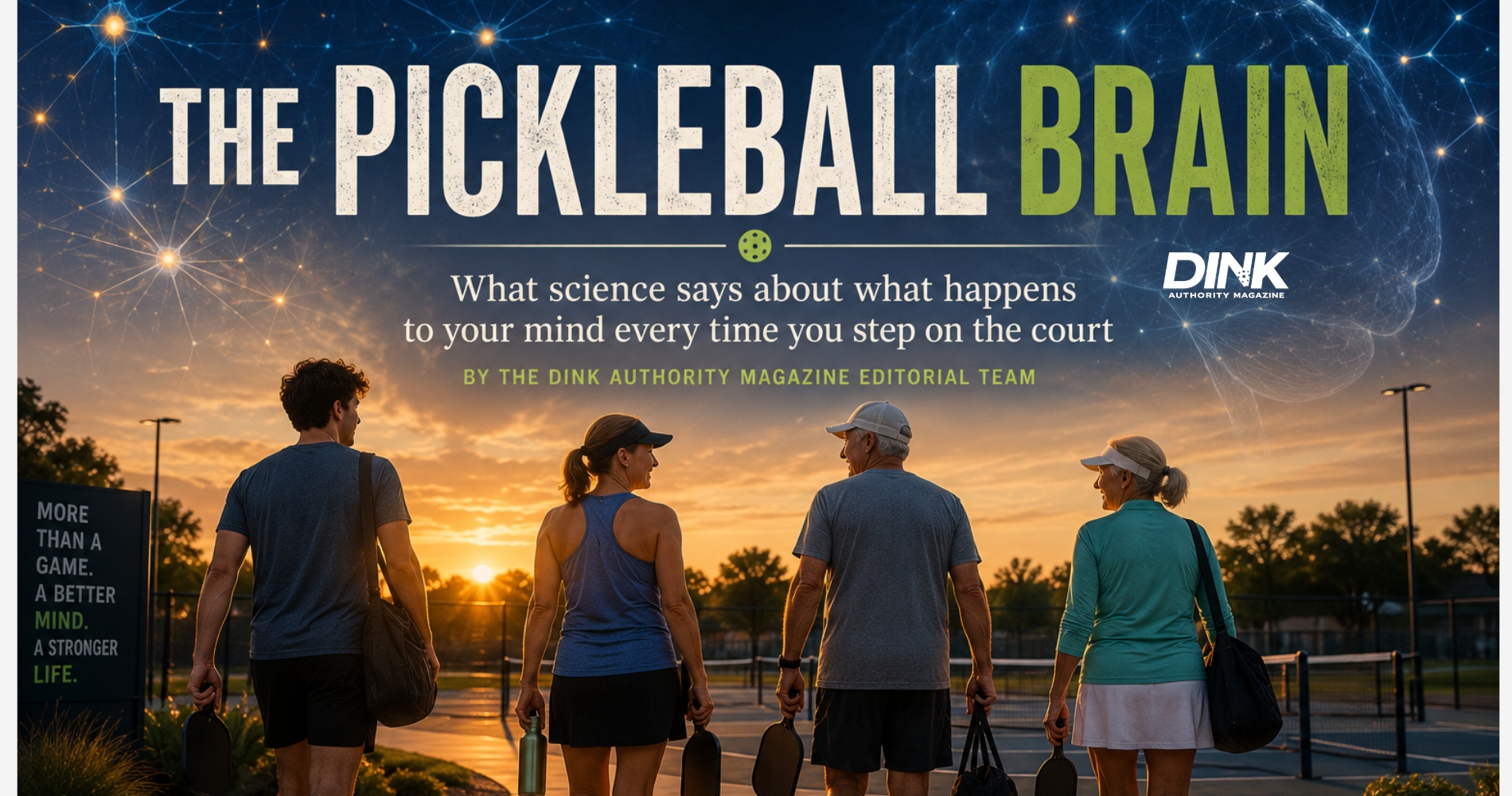
The Pickleball Brain
What science says about what happens to your mind every time you step on the court
By the Dink Authority Magazine Editorial Team
There is a conversation pickleball hasn't quite had with itself yet. We talk a lot about tournaments, rankings, contracts, and the young players redefining the sport. But we rarely stop to talk about what happens in the mind of the person who simply shows up to the court on Tuesday and Thursday afternoons — not to win a championship, but because something about that ritual makes them feel better.
Science has a lot to say about that.
The Closest Relative Has Decades of Evidence
Specific studies on pickleball and mental health are still limited — the sport is too new for scientific research to have fully caught up. But there is a direct relative with decades of accumulated evidence: tennis. And what that evidence shows is compelling enough to pay attention to.
A 2025 review that analyzed 16 peer-reviewed studies across PubMed, Web of Science and Scopus concluded that tennis participation is associated with reductions in depressive and anxiety symptoms, improved self-confidence, and enhanced resilience. These are not minor benefits — they are the same goals that years of psychological therapy pursue.
There is more. According to Harvard Medical School, the combination of physical movement, social interaction, and mental strategy — exactly what happens on a tennis or pickleball court — boosts endorphin levels and enhances cognitive function. The science is not pointing in one direction by coincidence.
Pickleball Has Something Tennis Doesn't
Here is the interesting twist: pickleball is not simply tennis on a smaller court. It has characteristics that make it potentially more powerful as a mental wellness tool — and research is beginning to confirm it.
LOVE PICKLEBALL?
Get Dink Authority Magazine updates, new editions, pro stories and event alerts.
We respect your privacy. Unsubscribe anytime.
Racket sports offer health benefits superior to many other physical activities precisely because they combine aerobic and anaerobic effort, coordination demands, and social connection in a single sport. But pickleball takes that formula one step further: the court is smaller, the ball slower, the learning curve more accessible. That means more people can practice it for longer — and consistency is exactly what allows mental health benefits to materialize.
According to research published in Frontiers in Psychology (Sun et al., 2025), the social environment of sport is a key element that bolsters perceived social support and promotes pro-social behaviors among players. In pickleball specifically, players who get on the court three or more times per week — with sessions of at least two hours — score significantly higher on mental wellbeing tests than those who play once or twice. The combination of physical activity and social connection appears to be the key. What researchers describe as the "cocktail of benefits" that pickleball uniquely delivers.
The Silent Epidemic Pickleball Is Fighting
There is a public health problem that governments around the world have been trying to solve without much success: loneliness. Not occasional sadness — but the chronic isolation that affects millions of people, especially after age 50, and carries medical consequences as serious as smoking.
Pickleball may be part of the solution. And the research backs it up.
According to the National Institutes of Health (NIH), pickleball is particularly well suited for older adults because it reduces barriers to entry in terms of capability, opportunity, and motivation — factors that together make long-term practice sustainable in ways that other sports simply are not.
A longitudinal study found that regular pickleball players reported 60% less loneliness than their non-playing peers, and those social connections correlated directly with lower rates of depression and anxiety. Sixty percent. That is not a marginal number — that is a life-changing difference.
What Happens in Your Head During a Match
You don't need a laboratory to understand it. Just pay attention the next time you're at the kitchen line deciding whether to attack or dink.
Every match is a mini strategy game: anticipating your opponent's move, planning your own, adjusting in real time. According to the National Institutes of Health (NIH), older adults who regularly participate in racket sports have a lower risk of developing cognitive decline and dementia. Pickleball doesn't just make you feel better today — it protects your brain for tomorrow.
And then there is the part every regular player recognizes without needing a study: that feeling at the end of a match. The mix of physical tiredness, tactical satisfaction, and conversation at the net. Researchers believe that is part of the magic — the combination of physical movement and social connection that makes pickleball something genuinely rare among modern recreational activities. Even when you didn't burn many calories, you leave the court lighter.
The Question Nobody Is Asking
All of this leads to a question that pickleball as an industry is not yet asking loudly enough: are we aware of what we are building?
Because what is happening on pickleball courts around the world is not just a sport growing in popularity. It is a network of human connections fighting loneliness. It is a weekly ritual that provides structure and purpose. It is a space where people of 20, 50, and 80 share a court and a conversation. It is, in many ways, exactly what the modern world needs and increasingly lacks.
The scientific evidence points in one clear direction. Tennis spent decades building that argument. And pickleball — more accessible, more social, easier to sustain over time — can take it further still.
It was never just a sport. It never was.
Sources: Frontiers in Psychology (Sun et al., 2025) | Harvard Medical School | NIH — National Institutes of Health
The Pickleball Brain
What science says about what happens to your mind every time you step on the court
By the Dink Authority Magazine Editorial Team
There is a conversation pickleball hasn't quite had with itself yet. We talk a lot about tournaments, rankings, contracts, and the young players redefining the sport. But we rarely stop to talk about what happens in the mind of the person who simply shows up to the court on Tuesday and Thursday afternoons — not to win a championship, but because something about that ritual makes them feel better.
Science has a lot to say about that.
The Closest Relative Has Decades of Evidence
Specific studies on pickleball and mental health are still limited — the sport is too new for scientific research to have fully caught up. But there is a direct relative with decades of accumulated evidence: tennis. And what that evidence shows is compelling enough to pay attention to.
A 2025 review that analyzed 16 peer-reviewed studies across PubMed, Web of Science and Scopus concluded that tennis participation is associated with reductions in depressive and anxiety symptoms, improved self-confidence, and enhanced resilience. These are not minor benefits — they are the same goals that years of psychological therapy pursue.
Current Issue

Domenika Turkovic: Fighting Her Own Demons
Read Now →
There is more. According to Harvard Medical School, the combination of physical movement, social interaction, and mental strategy — exactly what happens on a tennis or pickleball court — boosts endorphin levels and enhances cognitive function. The science is not pointing in one direction by coincidence.
Pickleball Has Something Tennis Doesn't
Here is the interesting twist: pickleball is not simply tennis on a smaller court. It has characteristics that make it potentially more powerful as a mental wellness tool — and research is beginning to confirm it.
LOVE PICKLEBALL?
Get Dink Authority Magazine updates, new editions, pro stories and event alerts.
We respect your privacy. Unsubscribe anytime.
Racket sports offer health benefits superior to many other physical activities precisely because they combine aerobic and anaerobic effort, coordination demands, and social connection in a single sport. But pickleball takes that formula one step further: the court is smaller, the ball slower, the learning curve more accessible. That means more people can practice it for longer — and consistency is exactly what allows mental health benefits to materialize.
According to research published in Frontiers in Psychology (Sun et al., 2025), the social environment of sport is a key element that bolsters perceived social support and promotes pro-social behaviors among players. In pickleball specifically, players who get on the court three or more times per week — with sessions of at least two hours — score significantly higher on mental wellbeing tests than those who play once or twice. The combination of physical activity and social connection appears to be the key. What researchers describe as the "cocktail of benefits" that pickleball uniquely delivers.
The Silent Epidemic Pickleball Is Fighting
There is a public health problem that governments around the world have been trying to solve without much success: loneliness. Not occasional sadness — but the chronic isolation that affects millions of people, especially after age 50, and carries medical consequences as serious as smoking.

Pickleball may be part of the solution. And the research backs it up.
According to the National Institutes of Health (NIH), pickleball is particularly well suited for older adults because it reduces barriers to entry in terms of capability, opportunity, and motivation — factors that together make long-term practice sustainable in ways that other sports simply are not.
A longitudinal study found that regular pickleball players reported 60% less loneliness than their non-playing peers, and those social connections correlated directly with lower rates of depression and anxiety. Sixty percent. That is not a marginal number — that is a life-changing difference.
What Happens in Your Head During a Match
You don't need a laboratory to understand it. Just pay attention the next time you're at the kitchen line deciding whether to attack or dink.
Every match is a mini strategy game: anticipating your opponent's move, planning your own, adjusting in real time. According to the National Institutes of Health (NIH), older adults who regularly participate in racket sports have a lower risk of developing cognitive decline and dementia. Pickleball doesn't just make you feel better today — it protects your brain for tomorrow.

And then there is the part every regular player recognizes without needing a study: that feeling at the end of a match. The mix of physical tiredness, tactical satisfaction, and conversation at the net. Researchers believe that is part of the magic — the combination of physical movement and social connection that makes pickleball something genuinely rare among modern recreational activities. Even when you didn't burn many calories, you leave the court lighter.
The Question Nobody Is Asking
All of this leads to a question that pickleball as an industry is not yet asking loudly enough: are we aware of what we are building?
Because what is happening on pickleball courts around the world is not just a sport growing in popularity. It is a network of human connections fighting loneliness. It is a weekly ritual that provides structure and purpose. It is a space where people of 20, 50, and 80 share a court and a conversation. It is, in many ways, exactly what the modern world needs and increasingly lacks.
The scientific evidence points in one clear direction. Tennis spent decades building that argument. And pickleball — more accessible, more social, easier to sustain over time — can take it further still.
It was never just a sport. It never was.
Sources: Frontiers in Psychology (Sun et al., 2025) | Harvard Medical School | NIH — National Institutes of Health