
Nike Exits the S&P 100 After 18 Years: An Icon's Fall, in Numbers
Nike Exits the S&P 100 After 18 Years: An Icon's Fall, in Numbers
After nearly 18 years as part of the S&P 100 — the index tracking the 100 largest and most established companies in the United States — Nike is out, effective before market open on September 21, 2026. The company keeps its spot in the broader S&P 500, but loses the seat among blue-chip giants it had held since December 2008.
Nike didn't exit alone. Honeywell Aerospace, Simon Property Group, and Colgate-Palmolive were also removed in the same quarterly rebalance by S&P Dow Jones Indices, announced September 4. Taking their place: Dell Technologies, Palo Alto Networks, Arista Networks, and SanDisk — all four from the technology sector, tied to chips, cloud infrastructure, and cybersecurity.
The Numbers Behind the Exit
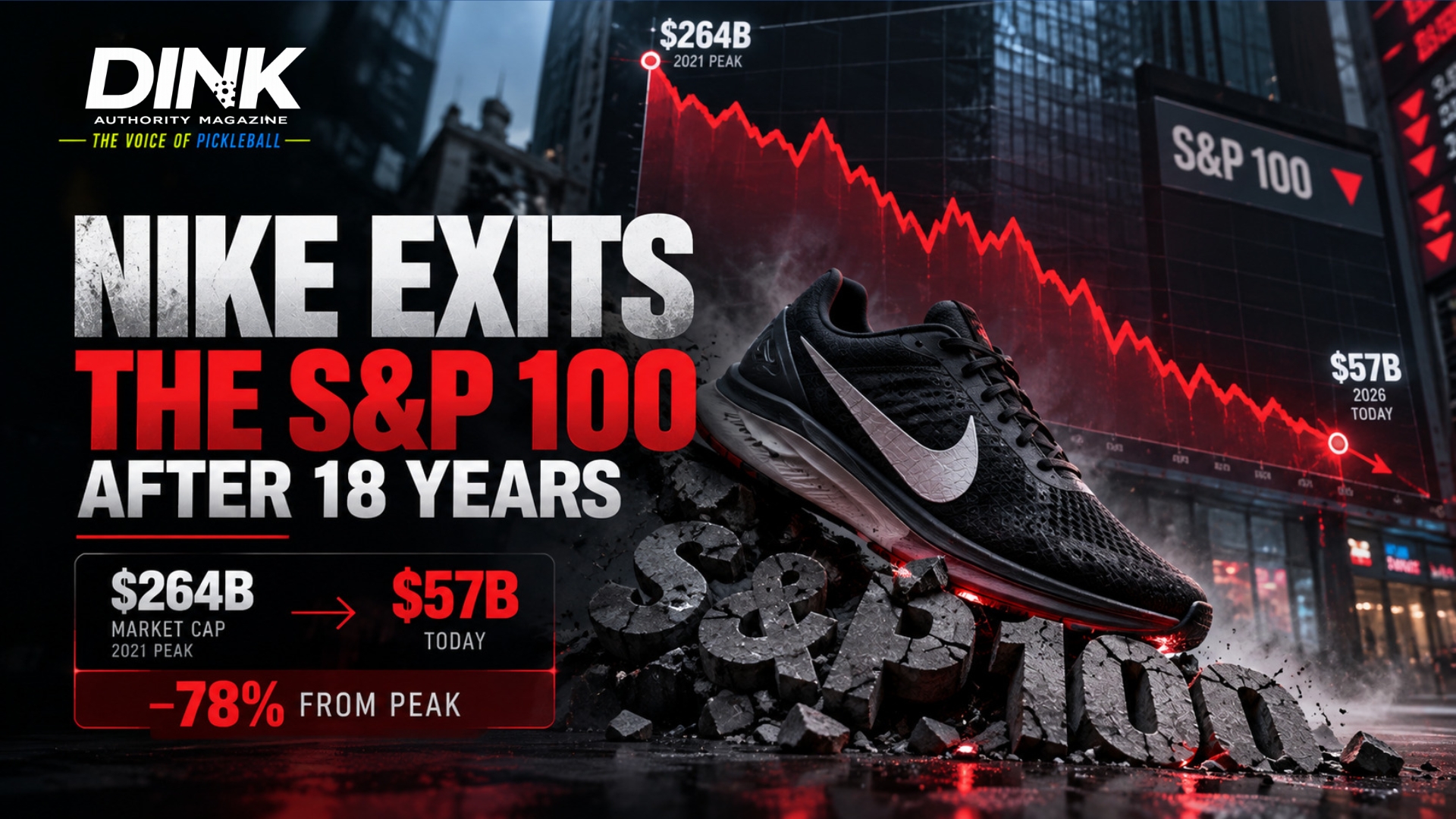
The number that sums it all up: Nike's market capitalization fell from roughly $264 billion at the end of 2021 to about $57 billion today — a loss of nearly $220 billion in value, and a drop of 78% from its all-time peak.
LOVE PICKLEBALL?
Get Dink Authority Magazine updates, new editions, pro stories and event alerts.
We respect your privacy. Unsubscribe anytime.
Meanwhile, the very S&P 100 index that just removed Nike climbed roughly 83% over that same five-year span. In other words, it's not just that Nike fell — it fell while the rest of America's largest companies were climbing hard.
On the operating side, fiscal year 2026 closed with revenue of $46.4 billion, essentially flat, with specific declines in Nike Direct (direct-to-consumer sales), online sales, and its China business.
What Happened?
The explanation financial analysts offer has a clear logic to it. In 2017, under then-CEO John Donahoe — a technology executive who had previously run eBay and ServiceNow, hired in January 2020 to transform Nike into a digital-first company — the company bet heavily on reducing its wholesale partnerships and supply to major retailers like Foot Locker, prioritizing direct-to-consumer sales through its own stores and apps.
The problem: the shelf space Nike abandoned in those wholesale channels didn't stay empty. Hoka, On, and New Balance filled it. Hoka grew revenue 15.9% to $2.6 billion; On grew 30% to $3 billion; New Balance rose 19% to $9.2 billion — all of them building their audience precisely in the wholesale channels Nike decided it no longer needed.
Elliott Hill, who took over as CEO in October 2024, has been working to repair those wholesale relationships and rebuild distribution. There are signs some new products are working — the Vomero 18, for instance, became a $100 million-plus franchise in its first 90 days on the market. But Nike's stock has fallen 56% since Hill took the role, a sign that the market still isn't convinced the turnaround is happening fast enough.
Editorial Analysis: A Lesson About Distribution Channels
Beyond the numbers, Nike's story leaves a business lesson that transcends the brand itself: the distribution channel isn't an operational detail — it's a strategic decision with long-term consequences.
When a brand decides to step away from the places where its customers discover it, it takes on a risk that's rarely measured well in advance: that by the time it wants to come back, someone else will have already taken that space. That's exactly what happened to Nike. It walked away from wholesale shelves chasing higher direct-to-consumer margins, and when it wanted to return, competitors had already built their own customer base there.
It's a reminder that short-term growth and margin aren't always compatible with long-term market position — and that even the most dominant brands in their category aren't immune to losing ground when they make structural decisions without properly accounting for the opportunity cost of being absent.
Nike remains, by a wide margin, a global-scale brand with history, recognition, and the capacity to reinvent itself. But its exit from the S&P 100 — the first stumble of this kind for a brand that once defined what it meant to be a blue-chip consumer stock — is a signal that's hard to ignore: not even the most established icon is exempt from the consequences of its own strategic decisions.
Nike Exits the S&P 100 After 18 Years: An Icon's Fall, in Numbers
After nearly 18 years as part of the S&P 100 — the index tracking the 100 largest and most established companies in the United States — Nike is out, effective before market open on September 21, 2026. The company keeps its spot in the broader S&P 500, but loses the seat among blue-chip giants it had held since December 2008.
Nike didn't exit alone. Honeywell Aerospace, Simon Property Group, and Colgate-Palmolive were also removed in the same quarterly rebalance by S&P Dow Jones Indices, announced September 4. Taking their place: Dell Technologies, Palo Alto Networks, Arista Networks, and SanDisk — all four from the technology sector, tied to chips, cloud infrastructure, and cybersecurity.
The Numbers Behind the Exit

The number that sums it all up: Nike's market capitalization fell from roughly $264 billion at the end of 2021 to about $57 billion today — a loss of nearly $220 billion in value, and a drop of 78% from its all-time peak.
LOVE PICKLEBALL?
Get Dink Authority Magazine updates, new editions, pro stories and event alerts.
We respect your privacy. Unsubscribe anytime.
Meanwhile, the very S&P 100 index that just removed Nike climbed roughly 83% over that same five-year span. In other words, it's not just that Nike fell — it fell while the rest of America's largest companies were climbing hard.
On the operating side, fiscal year 2026 closed with revenue of $46.4 billion, essentially flat, with specific declines in Nike Direct (direct-to-consumer sales), online sales, and its China business.
What Happened?

The explanation financial analysts offer has a clear logic to it. In 2017, under then-CEO John Donahoe — a technology executive who had previously run eBay and ServiceNow, hired in January 2020 to transform Nike into a digital-first company — the company bet heavily on reducing its wholesale partnerships and supply to major retailers like Foot Locker, prioritizing direct-to-consumer sales through its own stores and apps.
The problem: the shelf space Nike abandoned in those wholesale channels didn't stay empty. Hoka, On, and New Balance filled it. Hoka grew revenue 15.9% to $2.6 billion; On grew 30% to $3 billion; New Balance rose 19% to $9.2 billion — all of them building their audience precisely in the wholesale channels Nike decided it no longer needed.
Elliott Hill, who took over as CEO in October 2024, has been working to repair those wholesale relationships and rebuild distribution. There are signs some new products are working — the Vomero 18, for instance, became a $100 million-plus franchise in its first 90 days on the market. But Nike's stock has fallen 56% since Hill took the role, a sign that the market still isn't convinced the turnaround is happening fast enough.
Editorial Analysis: A Lesson About Distribution Channels

Beyond the numbers, Nike's story leaves a business lesson that transcends the brand itself: the distribution channel isn't an operational detail — it's a strategic decision with long-term consequences.
When a brand decides to step away from the places where its customers discover it, it takes on a risk that's rarely measured well in advance: that by the time it wants to come back, someone else will have already taken that space. That's exactly what happened to Nike. It walked away from wholesale shelves chasing higher direct-to-consumer margins, and when it wanted to return, competitors had already built their own customer base there.
It's a reminder that short-term growth and margin aren't always compatible with long-term market position — and that even the most dominant brands in their category aren't immune to losing ground when they make structural decisions without properly accounting for the opportunity cost of being absent.
Nike remains, by a wide margin, a global-scale brand with history, recognition, and the capacity to reinvent itself. But its exit from the S&P 100 — the first stumble of this kind for a brand that once defined what it meant to be a blue-chip consumer stock — is a signal that's hard to ignore: not even the most established icon is exempt from the consequences of its own strategic decisions.