Pilgrimage to Bainbridge Island: The Court Where It All Began
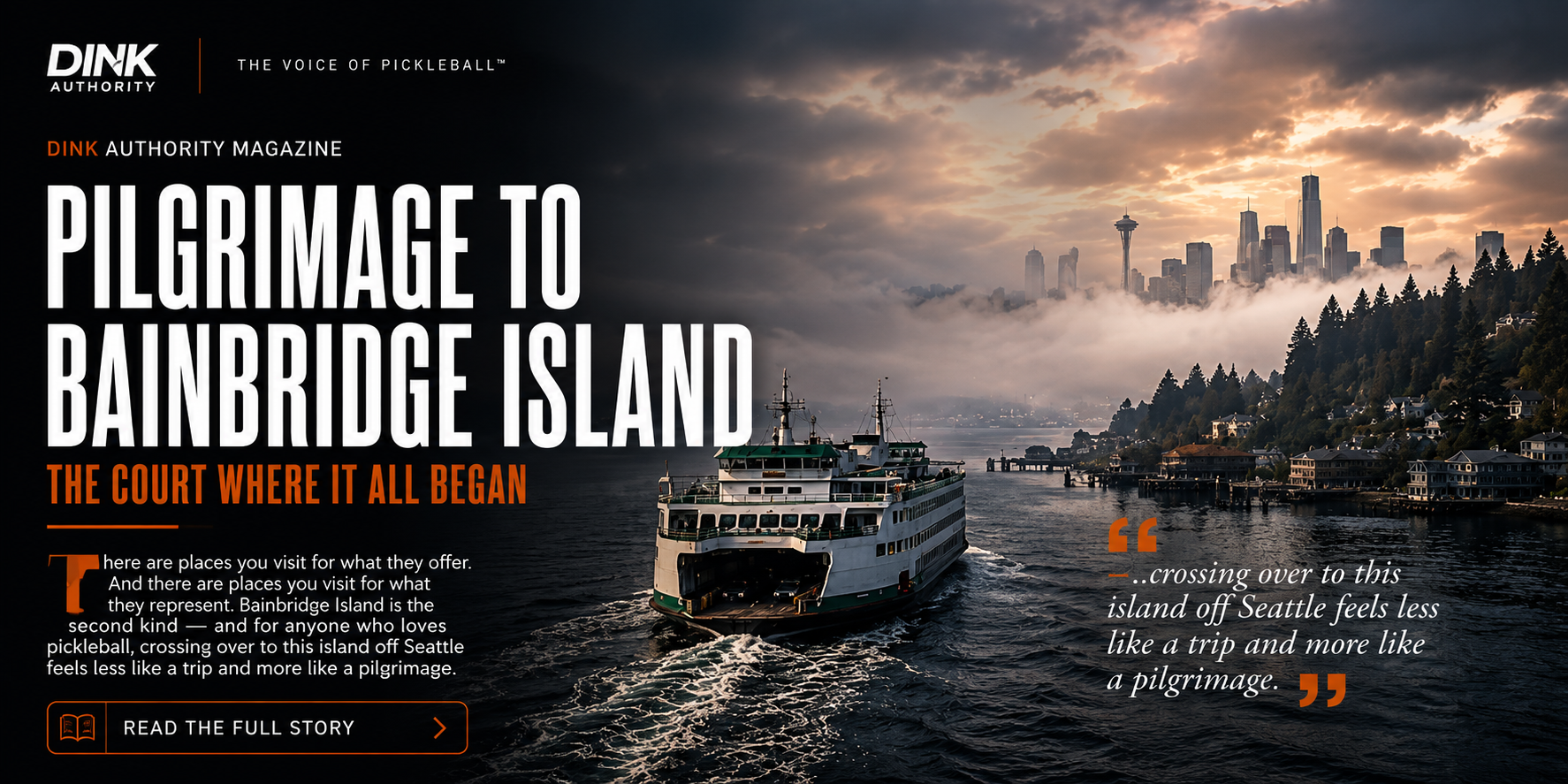
There are places you visit for what they offer. And there are places you visit for what they represent. Bainbridge Island is the second kind — and for anyone who loves pickleball, crossing over to this island off Seattle feels less like a trip and more like a pilgrimage.
The Ferry as Prelude
It all starts at Pier 52 in downtown Seattle. A 35-minute crossing over the gray waters of Puget Sound, with the city skyline shrinking behind you and the Olympic Mountains rising ahead. It's a deliberate journey, almost ceremonial: you don't arrive at Bainbridge all at once — you arrive by leaving the city behind bit by bit, as if the landscape itself is preparing you for what's on the other side.
Stepping off in Winslow, the island's main town, pickleball is already everywhere before you've even picked up a paddle. Gift shops along Winslow Way display sport merchandise in their windows. There's no need to ask where to play — the whole island already knows the answer.
Battle Point Park: 90 Acres With a War Scar and a Birth
The Founders Courts aren't hidden or hard to find. They sit inside Battle Point Park, a 90-acre park that was once a WWII naval radio transmission station — an 800-foot antenna once sent coded messages to the Pacific Fleet until the station was deactivated in 1959. Today, the remnants of that military history coexist with ponds, jogging trails, a disc golf course, and, at the heart of the park, six courts dedicated entirely to honoring the birth of a sport.
It's a strange, beautiful combination: a place that once existed for war now exists, almost as an act of redemption, for the game.
The Path That Tells the Story Before You Reach the Net
LOVE PICKLEBALL?
Get Dink Authority Magazine updates, new editions, pro stories and event alerts.
We respect your privacy. Unsubscribe anytime.
What sets the Founders Courts apart from any other public court in the world is the entrance path. Along the walkway leading to the courts are interpretive displays and historical kiosks that narrate, step by step, how a backyard game improvised in 1965 became the fastest-growing sport in the United States. Custom bricks engraved with the names of those who helped fund the project are embedded right into the path — every step toward the court is, literally, a step over the community that made it possible.
The story those kiosks tell is almost too simple to be true. One summer day in 1965, three dads — Joel Pritchard, a congressman and future Washington lieutenant governor; Bill Bell; and Barney McCallum — found themselves with bored kids and nothing to do. There was an old badminton court on the property, but they couldn't find a complete set of rackets. They improvised: lowered the net, grabbed ping-pong paddles and a perforated plastic ball. The following weekend, they noticed the ball bounced better on the asphalt, and lowered the net to 36 inches. That almost accidental adjustment ended up being one of the founding decisions of a sport now played in more than sixty countries.
Reaching the Court
And then you arrive. Six dedicated courts, immaculate surface, completely free and first-come-first-served — no reservations, no membership, nothing standing between the visitor and the game. Below, six additional courts with portable nets set up on the old tennis courts, ready for whenever demand overflows, which — according to the locals — happens more often than you'd expect on an island of barely 25,000 residents.
What surprises you isn't the infrastructure. It's the mix of people. On the same six courts you'll find retirees who've been playing since before the sport had an official name, families who came over by ferry just for the day, and players who traveled from other states — or other countries — specifically so they could say they played on the exact spot where pickleball was born. The background music jumps with no apparent logic between decades and genres, as if the soundtrack itself reflected who might show up at that court at any given moment: teenagers in pajama pants, sport devotees dressed head to toe in technical gear, curious onlookers who never played and end up staying all afternoon.
More Than a Court: A Sanctuary the Community Maintains Together
The Founders Courts aren't maintained by a company or a sponsor. They're cared for by a nonprofit, the Bainbridge Island Pickleball Club, in partnership with the island's parks department — community taking care of what the community built. Every year, the island hosts the Bainbridge Island Founders Tournament, an event that functions as both a fundraiser and, above all, an annual tribute to the three men who invented the game without asking for anything in return.
Washington, the state where the island sits, officially made pickleball its state sport. That's no coincidence. It's the recognition of a place that understood, before anyone else, what this game represented.
The Reflection on the Way Back
Back on the ferry, with Seattle rising on the horizon again, it's hard not to think about the distance between that backyard in 1965 and the professional sport DINK Authority covers month after month: the international circuits, the contracts, the live broadcasts, an ecosystem growing every year at a pace nobody anticipated. All of it came from three dads trying to solve a much humbler problem: what to do with bored kids on a summer Saturday.
Bainbridge Island doesn't sell nostalgia. It lives it, cares for it, and shares it for free with anyone willing to cross the water to find it. For any player who takes this sport seriously, going once isn't a luxury. It's simply going back to the roots.
How to get there: Ferry from Pier 52 in downtown Seattle to Winslow, Bainbridge Island (35 minutes, approximately $9 USD round-trip per foot passenger). The Founders Courts are located at Battle Point Park, 11299 Arrow Point Drive NE — about a 10-minute bike ride or drive from the ferry terminal. Free access, no reservation required.
This, before long, is going to become a required pilgrimage for fans of this sport. We asked ourselves in our editorial meeting: how many of the top 20 players across the different leagues actually know about this? This is history, gentlemen. Just as baseball has a place where it all began — Cooperstown — soccer, thinking about it, doesn't really have that same single reference point: the sport was formalized in an era when documenting its origin with this kind of precision was nearly impossible. But most already-developed sports do have a clear historical reference point. Well, this is pickleball's.
How many of the top 10 players across the different leagues have actually come to learn this history? It wouldn't take a grand gesture. It wouldn't even take playing a single point. It would be enough to snap a simple selfie standing in front of that net, with a message as simple as: "Hey, I'm here, where it all started." And yet, as far as we know, that photo still doesn't exist.
Did you already know?
There are places you visit for what they offer. And there are places you visit for what they represent. Bainbridge Island is the second kind — and for anyone who loves pickleball, crossing over to this island off Seattle feels less like a trip and more like a pilgrimage.
The Ferry as Prelude
It all starts at Pier 52 in downtown Seattle. A 35-minute crossing over the gray waters of Puget Sound, with the city skyline shrinking behind you and the Olympic Mountains rising ahead. It's a deliberate journey, almost ceremonial: you don't arrive at Bainbridge all at once — you arrive by leaving the city behind bit by bit, as if the landscape itself is preparing you for what's on the other side.
Stepping off in Winslow, the island's main town, pickleball is already everywhere before you've even picked up a paddle. Gift shops along Winslow Way display sport merchandise in their windows. There's no need to ask where to play — the whole island already knows the answer.
Battle Point Park: 90 Acres With a War Scar and a Birth
Current Issue

Domenika Turkovic: Fighting Her Own Demons
Read Now →
The Founders Courts aren't hidden or hard to find. They sit inside Battle Point Park, a 90-acre park that was once a WWII naval radio transmission station — an 800-foot antenna once sent coded messages to the Pacific Fleet until the station was deactivated in 1959. Today, the remnants of that military history coexist with ponds, jogging trails, a disc golf course, and, at the heart of the park, six courts dedicated entirely to honoring the birth of a sport.
It's a strange, beautiful combination: a place that once existed for war now exists, almost as an act of redemption, for the game.
The Path That Tells the Story Before You Reach the Net
LOVE PICKLEBALL?
Get Dink Authority Magazine updates, new editions, pro stories and event alerts.
We respect your privacy. Unsubscribe anytime.
What sets the Founders Courts apart from any other public court in the world is the entrance path. Along the walkway leading to the courts are interpretive displays and historical kiosks that narrate, step by step, how a backyard game improvised in 1965 became the fastest-growing sport in the United States. Custom bricks engraved with the names of those who helped fund the project are embedded right into the path — every step toward the court is, literally, a step over the community that made it possible.
The story those kiosks tell is almost too simple to be true. One summer day in 1965, three dads — Joel Pritchard, a congressman and future Washington lieutenant governor; Bill Bell; and Barney McCallum — found themselves with bored kids and nothing to do. There was an old badminton court on the property, but they couldn't find a complete set of rackets. They improvised: lowered the net, grabbed ping-pong paddles and a perforated plastic ball. The following weekend, they noticed the ball bounced better on the asphalt, and lowered the net to 36 inches. That almost accidental adjustment ended up being one of the founding decisions of a sport now played in more than sixty countries.
Reaching the Court

And then you arrive. Six dedicated courts, immaculate surface, completely free and first-come-first-served — no reservations, no membership, nothing standing between the visitor and the game. Below, six additional courts with portable nets set up on the old tennis courts, ready for whenever demand overflows, which — according to the locals — happens more often than you'd expect on an island of barely 25,000 residents.
What surprises you isn't the infrastructure. It's the mix of people. On the same six courts you'll find retirees who've been playing since before the sport had an official name, families who came over by ferry just for the day, and players who traveled from other states — or other countries — specifically so they could say they played on the exact spot where pickleball was born. The background music jumps with no apparent logic between decades and genres, as if the soundtrack itself reflected who might show up at that court at any given moment: teenagers in pajama pants, sport devotees dressed head to toe in technical gear, curious onlookers who never played and end up staying all afternoon.
More Than a Court: A Sanctuary the Community Maintains Together
The Founders Courts aren't maintained by a company or a sponsor. They're cared for by a nonprofit, the Bainbridge Island Pickleball Club, in partnership with the island's parks department — community taking care of what the community built. Every year, the island hosts the Bainbridge Island Founders Tournament, an event that functions as both a fundraiser and, above all, an annual tribute to the three men who invented the game without asking for anything in return.
Washington, the state where the island sits, officially made pickleball its state sport. That's no coincidence. It's the recognition of a place that understood, before anyone else, what this game represented.
The Reflection on the Way Back

Back on the ferry, with Seattle rising on the horizon again, it's hard not to think about the distance between that backyard in 1965 and the professional sport DINK Authority covers month after month: the international circuits, the contracts, the live broadcasts, an ecosystem growing every year at a pace nobody anticipated. All of it came from three dads trying to solve a much humbler problem: what to do with bored kids on a summer Saturday.
Bainbridge Island doesn't sell nostalgia. It lives it, cares for it, and shares it for free with anyone willing to cross the water to find it. For any player who takes this sport seriously, going once isn't a luxury. It's simply going back to the roots.
How to get there: Ferry from Pier 52 in downtown Seattle to Winslow, Bainbridge Island (35 minutes, approximately $9 USD round-trip per foot passenger). The Founders Courts are located at Battle Point Park, 11299 Arrow Point Drive NE — about a 10-minute bike ride or drive from the ferry terminal. Free access, no reservation required.
This, before long, is going to become a required pilgrimage for fans of this sport. We asked ourselves in our editorial meeting: how many of the top 20 players across the different leagues actually know about this? This is history, gentlemen. Just as baseball has a place where it all began — Cooperstown — soccer, thinking about it, doesn't really have that same single reference point: the sport was formalized in an era when documenting its origin with this kind of precision was nearly impossible. But most already-developed sports do have a clear historical reference point. Well, this is pickleball's.
How many of the top 10 players across the different leagues have actually come to learn this history? It wouldn't take a grand gesture. It wouldn't even take playing a single point. It would be enough to snap a simple selfie standing in front of that net, with a message as simple as: "Hey, I'm here, where it all started." And yet, as far as we know, that photo still doesn't exist.
Did you already know?